What Shadow Work Worksheets Cover in a K-2 Science Unit
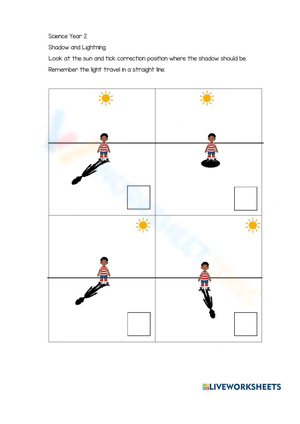
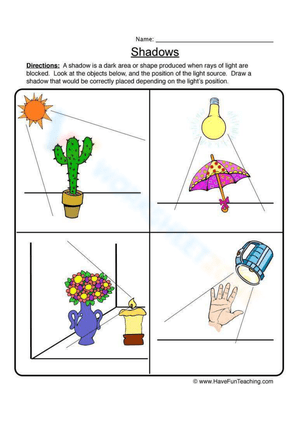
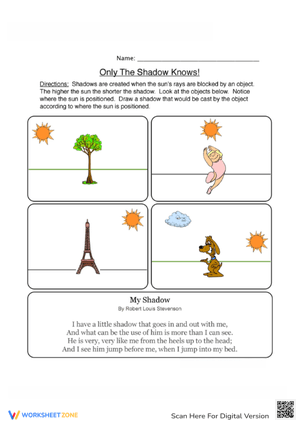
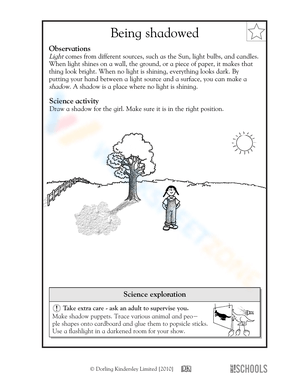
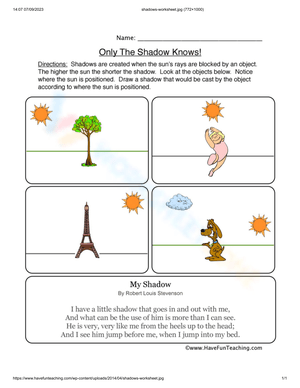
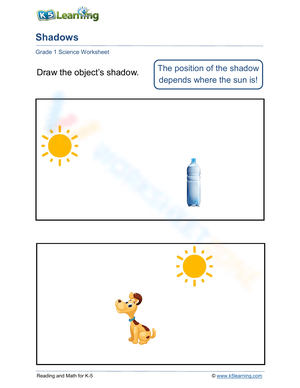
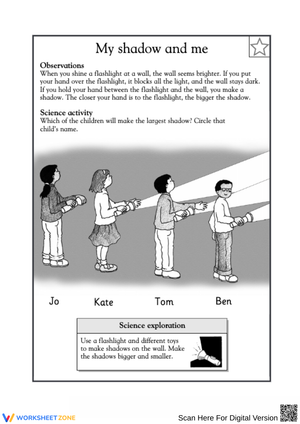
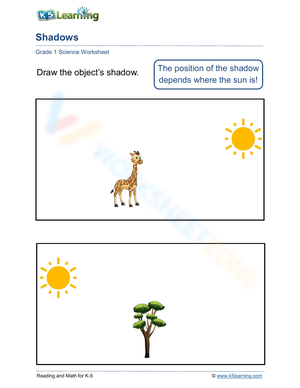
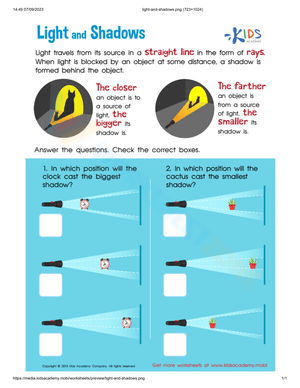
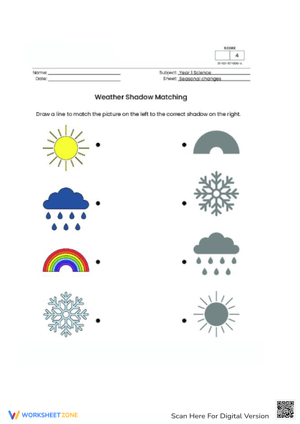
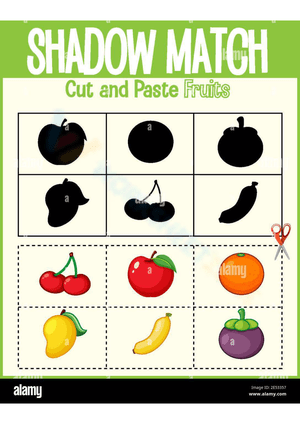
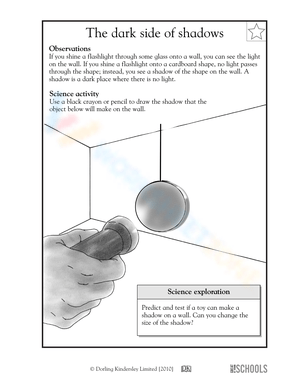
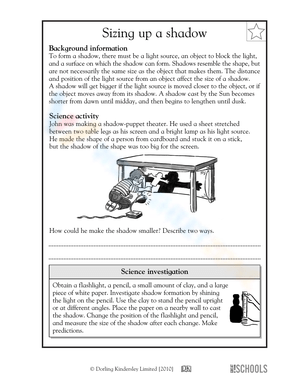
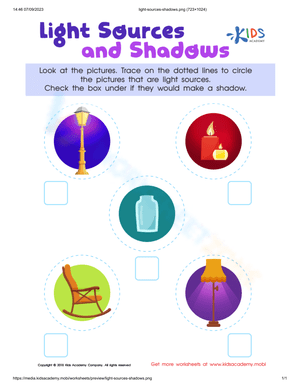
If you're planning a light-and-shadow unit, shadow work worksheets give students a printable place to record what they see when light meets an object. These pages ask learners to identify a light source, predict where a shadow will land, and describe how a shadow changes when the object or the light moves. For US elementary classrooms, that maps directly onto the first-grade waves strand, so the worksheets work as both practice and evidence of student thinking.
The strongest sets move students past coloring in a dark shape. They prompt kids to test materials, compare shadow sizes, and explain why a shadow appears at all. That shift from labeling to reasoning is what turns a five-minute activity into a real science task you can grade against a standard.
Aligning Shadow Worksheets to NGSS
Shadow investigations are one of the clearest ways to hit a first-grade physical science target, so it helps to name the standard on your lesson plan.
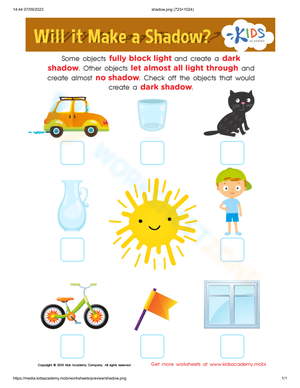
The Next Generation Science Standards list performance expectation 1-PS4-3, which asks first graders to plan and conduct an investigation to determine the effect of placing objects made of different materials in the path of a beam of light. Its disciplinary core idea, PS4B, states that materials block light to different degrees and that objects blocking all light cast a dark shadow on the surface beyond them.
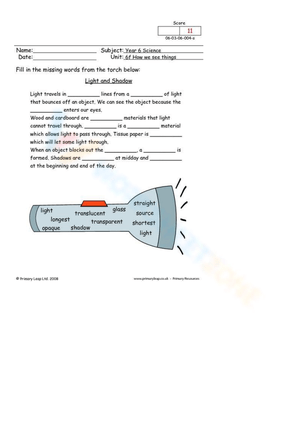
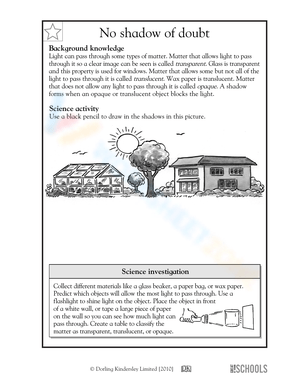
When a worksheet asks students to sort objects as opaque, translucent, or transparent, it's giving you a paper record of that exact core idea in action.
Pairing Worksheets With a Flashlight Station
Paper alone won't teach a shadow. The worksheets do their best work as a record sheet for a hands-on test, so build a simple flashlight station to go with them.
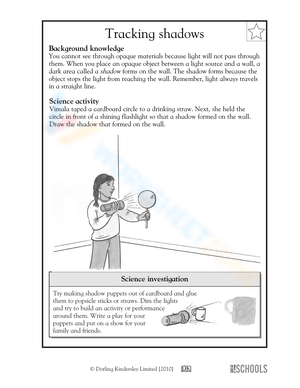
Give each small group a flashlight and a tray of objects: a wooden block, a plastic cup, a sheet of wax paper, and a clear plastic lid. Students shine the light, trace or sketch each shadow, and mark whether the object blocked all, some, or none of the light. The worksheet becomes the place they log results and defend a claim.
Science Buddies and NSTA both publish shadow-play lesson plans that pair this kind of flashlight test with observation prompts, and either one gives you a ready structure if you want a model before building your own station.
Classroom Implementation
Run the shadow unit as a rotation and the worksheets carry more weight. Set three stations: a flashlight-and-object test, an outdoor sun-tracking spot, and an independent worksheet table. Groups spend eight to ten minutes at each, and every station feeds the same recording page so students leave with one complete artifact.
For the outdoor rotation, have students trace a classmate's shadow in the morning and again after lunch, then compare the two lengths on the worksheet. That single comparison makes the sun's changing position concrete, and it gives you a talking point for how shadows shift across the school day.
Keep the language demand light for your youngest writers. Offer a word bank with light source, block, dark, and shadow so the science thinking isn't gated behind spelling. For students who need a stretch, add a sentence stem such as My shadow got longer because... and ask them to finish it with evidence from their test.
Frequently Asked Questions
1. What grade level are shadow worksheets appropriate for?
They fit K-3 science best. Kindergarten and grade 1 students use them for shadow recognition and identifying light sources, while grades 2 and 3 use them to measure and predict how shadow size and length change with distance and light angle.
2. What NGSS standard do shadow worksheets align to?
They align most directly to 1-PS4-3, which asks first graders to plan and conduct an investigation into how objects made of different materials affect a beam of light, along with core idea PS4B on how materials block light.
3. What materials do teachers need to pair with shadow worksheets?
A flashlight or lamp per group and a handful of test objects that block light differently, such as a wooden block, a plastic cup, wax paper, and a clear lid. Sunlight from a window works for outdoor tracing.
4. How can shadow worksheets be used for formative assessment?
Collect the materials-sorting or exit page and look for students who still confuse opaque and transparent objects or leave out the light source. Those errors show you exactly which part of the core idea needs reteaching.
5. How do shadow worksheets help teach opaque, translucent, and transparent materials?
When students test objects and record how much light each one blocks, they build the categories firsthand. Opaque items make a dark shadow, translucent ones make a faint shadow, and transparent ones make almost none, matching PS4B.












 Interactive Worksheet Maker
 Quiz Maker
 Word Search Maker
 Crossword Puzzle Maker
 Word Scramble Generator
 Sentence Scramble Generator
 Handwriting Worksheet Generator
 Name Tracing Generator
 Fill In The Blank Generator