


























Views
Downloads

Grade 5 Light and Shadows Worksheet | Essential Science
Paste this activity's link or code into your existing LMS (Google Classroom, Canvas, Teams, Schoology, Moodle, etc.).
Students can open and work on the activity right away, with no student login required.
You'll still be able to track student progress and results from your teacher account.
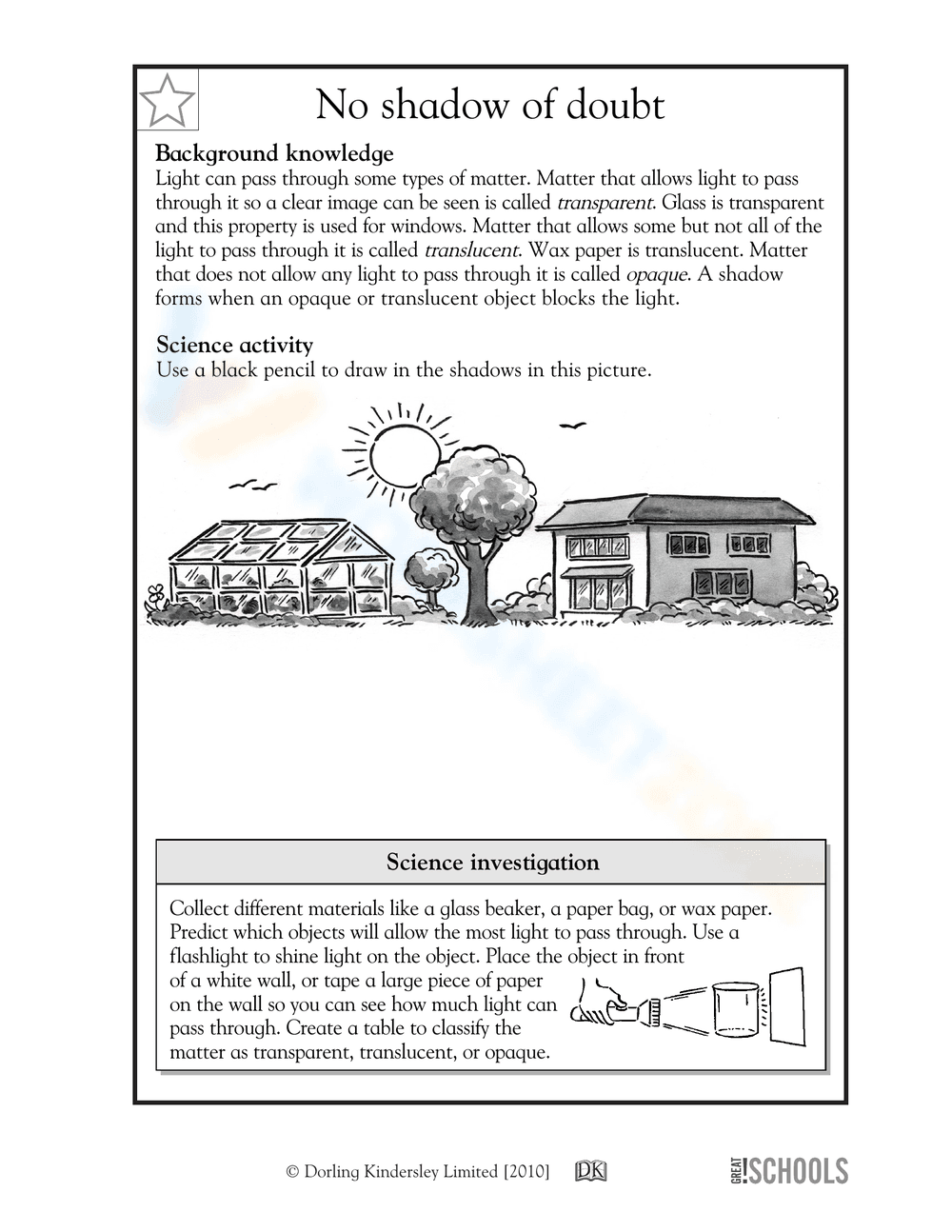
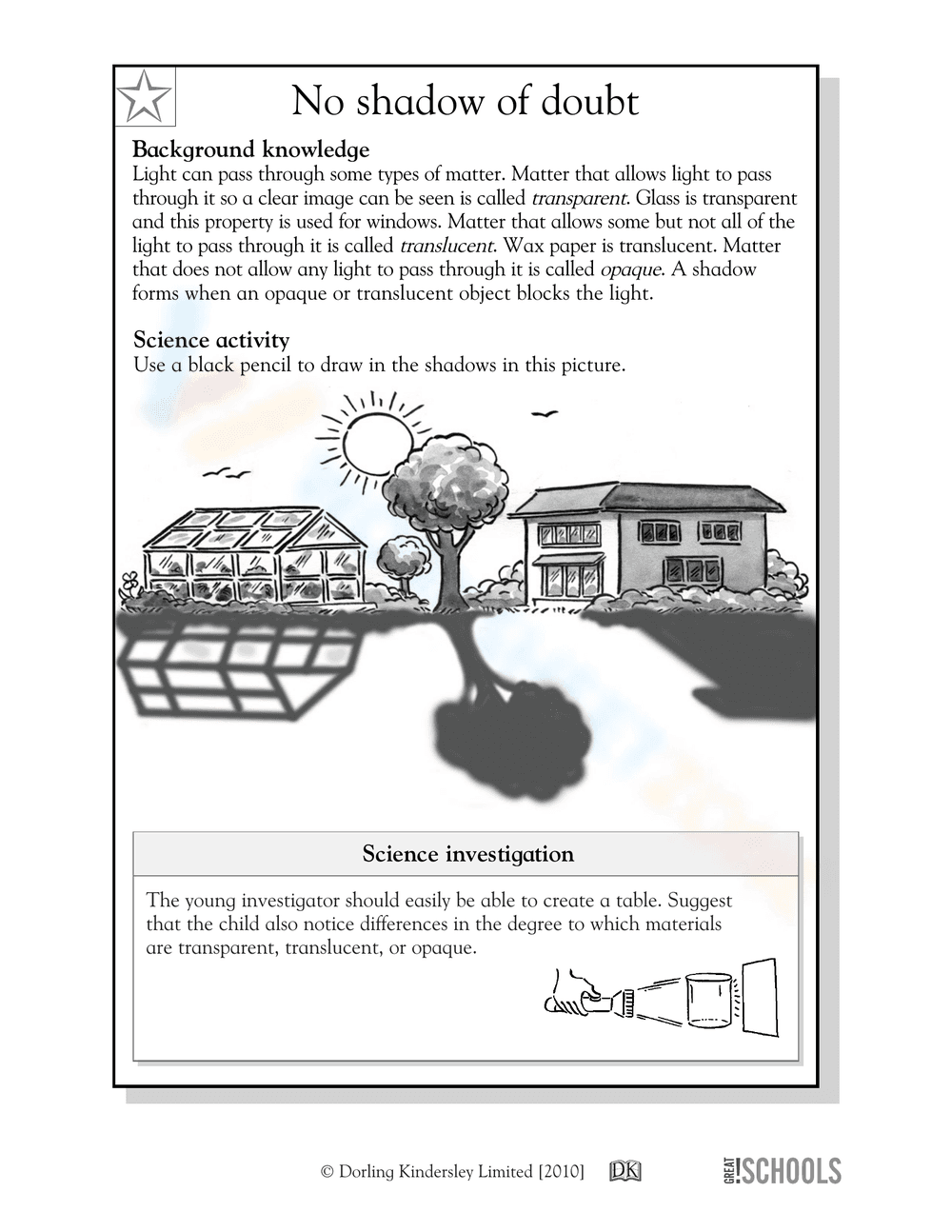
This Grade 5 science worksheet helps students understand how light interacts with different types of matter to create shadows. By defining transparent, translucent, and opaque materials, the resource provides the necessary background knowledge for students to predict and illustrate shadow formation. Students will apply their understanding by drawing shadows in a realistic scene and conducting a simple classification investigation.
At a Glance
At a Glance
- Grade: 5 · Subject: Science
- Standard:
5-PS1-1— Identify materials based on their properties, including how they interact with light.- Skill Focus: Light properties (Opaque, Translucent, Transparent)
- Format: 2 pages · 2 tasks · Answer key included · PDF
- Best For: Introduction to light behavior and shadows
- Time: 20–30 minutes
What's Inside
The worksheet features a concise background knowledge section that defines key vocabulary terms. Below this, a science activity presents a detailed illustration of a house and greenhouse, challenging students to use a black pencil to draw shadows based on the sun's position. The page also contains a science investigation prompt, which guides students through a hands-on experiment using common items and a flashlight to classify matter.
Zero-Prep Workflow
The zero-prep design allows for immediate classroom implementation. First, print the single-page student sheet (1 minute). Second, distribute the worksheet as a follow-up to a lesson on light or as a standalone sub plan (1 minute). Finally, use the provided answer key to review shadow placement and material classification with the whole class (5 minutes). Total teacher preparation time is under 2 minutes.
Standards Alignment
This resource is aligned with `5-PS1-1`, which requires students to develop a model to describe that matter is made of particles too small to be seen and to identify materials based on their properties. Understanding how light passes through or is blocked by matter is a fundamental property used to categorize substances. Both standard codes can be copied directly into lesson plans, IEP goals, or district curriculum mapping tools.
How to Use It
Use this worksheet during the explain or elaborate phase of a 5E instructional cycle. It serves as an excellent formative assessment tool; as students draw the shadows, observe whether they align the shadows opposite the light source to check for misconceptions about light travel. The investigation section can be completed in small groups or as a teacher-led demonstration, taking 25 minutes.
Who It's For
This resource is designed for Grade 5 students but is also appropriate for Grade 4 learners exploring light behavior. The heavy reliance on visual tasks makes it particularly effective for English Language Learners (ELLs) who are mastering science vocabulary. It provides a clear, structured format that supports students who benefit from explicit definitions before application.
According to EdReports 2024, high-quality science materials must bridge the gap between abstract physical concepts and observable phenomena. This Grade 5 worksheet on light properties achieves this by requiring students to apply the definitions of transparent, translucent, and opaque matter to a concrete visual scenario. By predicting and then illustrating shadow placement based on a fixed light source, learners engage in spatial reasoning and causal modeling, which are core components of the 5-PS1-1 standard. Research indicates that integrating a hands-on investigation—such as the flashlight classification task—significantly improves retention of vocabulary compared to rote memorization. This resource provides a structured pathway for students to demonstrate mastery of how light interacts with different types of matter. The inclusion of a clear answer key ensures that educators can provide immediate feedback, a critical factor in correcting misconceptions about light paths and shadow geometry during the formative stages of a physical science unit.


