


























Views
Downloads


Shadows Worksheet | Grade 1 Science Printable
Paste this activity's link or code into your existing LMS (Google Classroom, Canvas, Teams, Schoology, Moodle, etc.).
Students can open and work on the activity right away, with no student login required.
You'll still be able to track student progress and results from your teacher account.
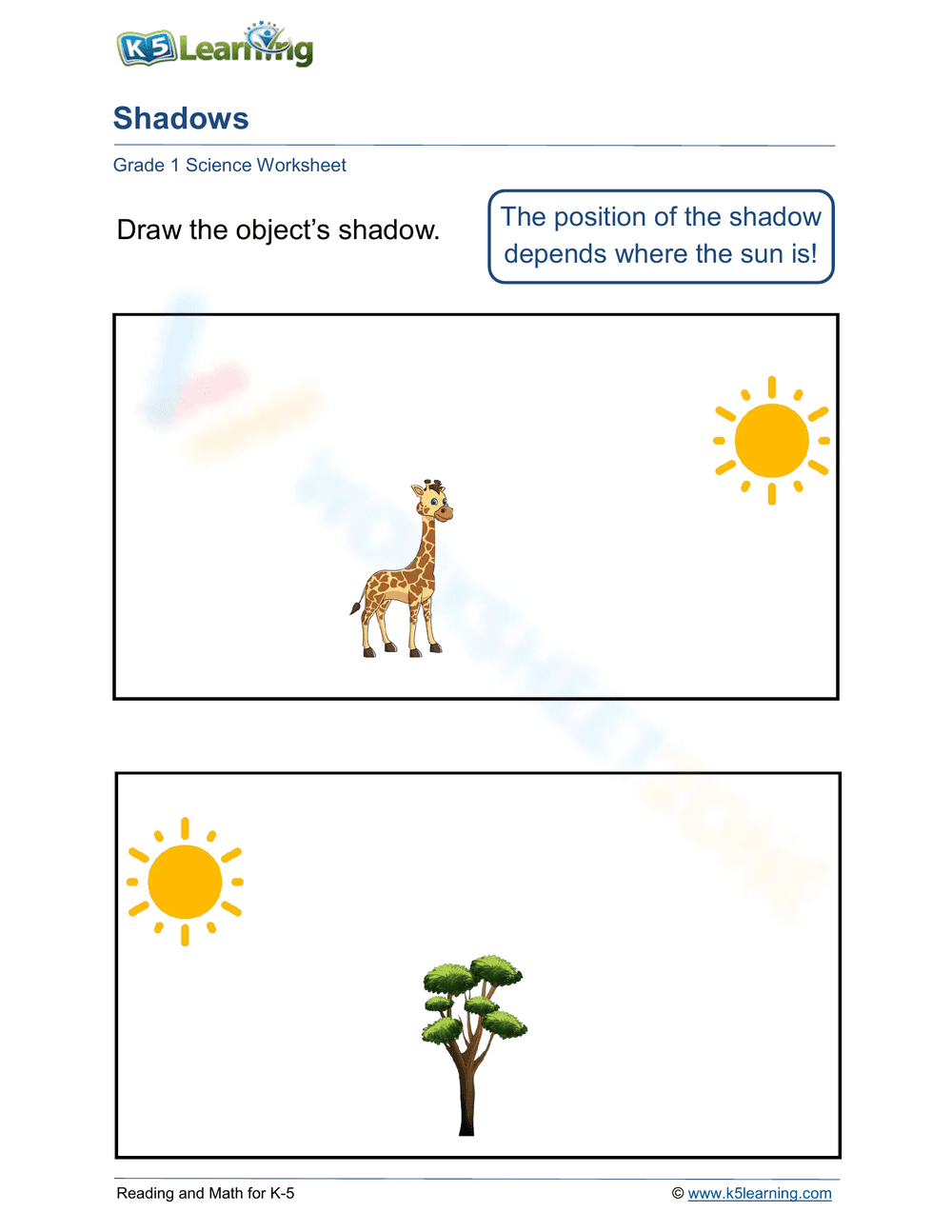
This Grade 1 science worksheet helps young learners visualize the relationship between light sources and shadows. By sketching shadows based on the sun's placement, students develop a concrete understanding of how light travels in straight lines. It provides an immediate, hands-on way to demonstrate physical science concepts through simple observation and drawing.
At a Glance
- Grade: 1 · Subject: Science
- Standard:
1-PS4-3— Determine the effect of placing objects in the path of light- Skill Focus: Shadow direction and light source positioning
- Format: 2 pages · 2 problems · Answer key included · PDF
- Best For: Introduction to light and shadow patterns
- Time: 5–10 minutes
The resource contains a single-page student activity and a corresponding answer key. It features two distinct scenarios: a giraffe with the sun in the upper right and a tree with the sun in the lower left. The layout includes clear visual cues and a helpful reminder box explaining that shadow position depends on the sun's location.
This worksheet is designed for immediate classroom implementation. Teachers can print the PDF in under 1 minute, distribute it to students for a 5-minute warm-up or exit ticket, and use the provided answer key for a 1-minute visual check. Total preparation time is less than 2 minutes, making it an ideal choice for busy science blocks or emergency sub plans.
Primary standard 1-PS4-3: "Plan and conduct an investigation to determine the effect of placing objects made with different materials in the path of a beam of light." This activity serves as a foundational observation task for understanding how opaque objects block light to create shadows. Both standard codes can be copied directly into lesson plans, IEP goals, or district curriculum mapping tools.
Use this as a formative assessment after a playground observation of real shadows. It works best during the "Explore" phase of a 5E lesson cycle. Teachers should observe if students draw the shadow directly opposite the sun; this provides a quick check for misconceptions about light travel. Expected completion time is 5 to 10 minutes.
This is tailored for Grade 1 students but is also appropriate for Kindergarteners exploring Earth and Space science. It pairs naturally with a flashlight demonstration or a read-aloud about the sun's path across the sky. The simple drawing tasks accommodate developing fine motor skills while reinforcing core scientific vocabulary.
According to the RAND AIRS 2024 report, early exposure to physical science phenomena through visual modeling significantly improves long-term retention of abstract concepts. This worksheet addresses the 1-PS4-3 standard by requiring students to predict the behavior of light when it encounters an opaque object. By identifying that the sun's position dictates the shadow's direction, students engage in basic scientific modeling. Research from Fisher & Frey (2014) emphasizes that instructional structures are most effective when paired with clear visual representations of physical laws. This resource provides that clarity, allowing first-grade students to demonstrate mastery of light-path principles without the cognitive load of heavy text. It is a high-utility tool for establishing the foundational logic required for more complex optics and astronomy units in later elementary grades. The inclusion of an answer key ensures that even non-specialist educators can provide accurate feedback on student predictions.


