




























Views
Downloads
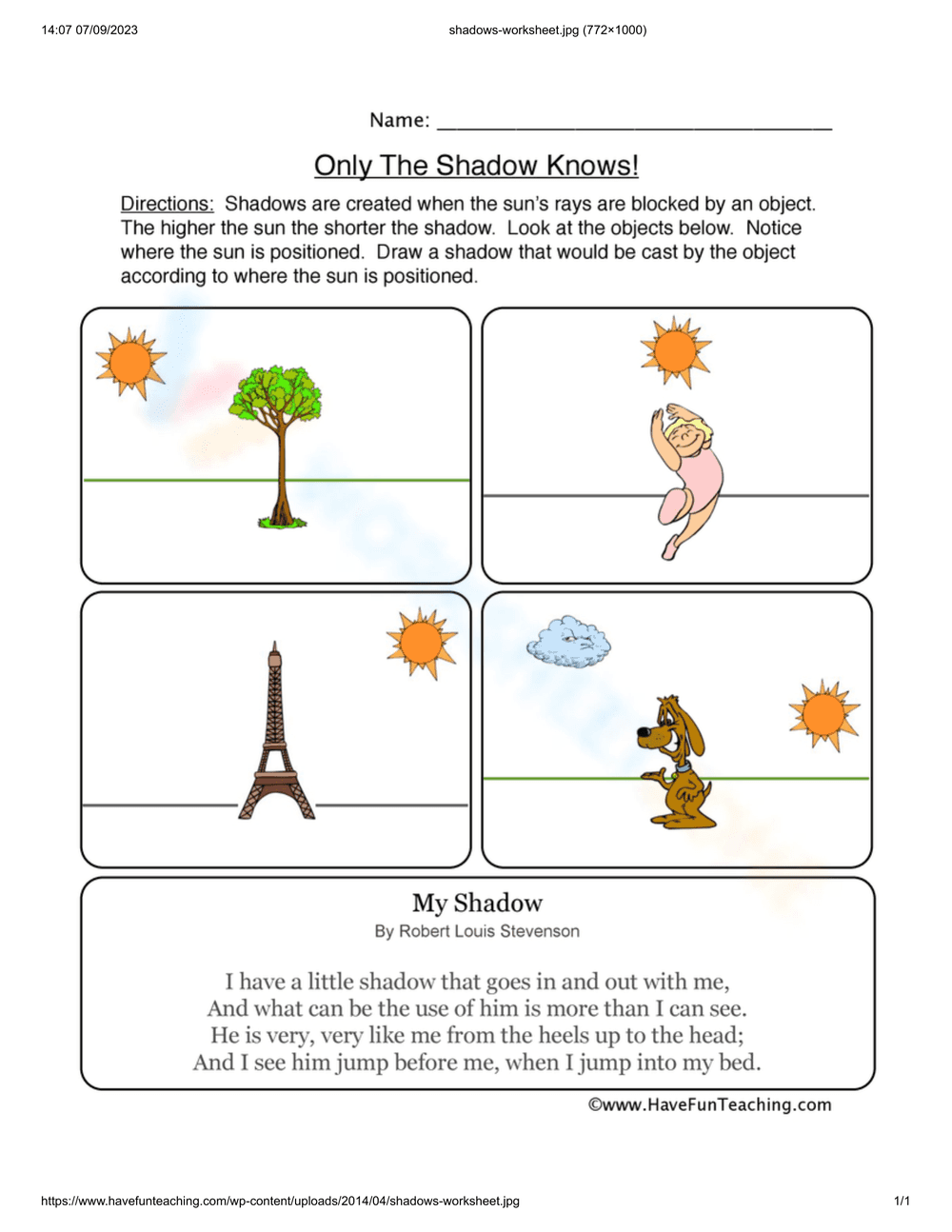

Grade 2-3 Shadows Worksheet — Printable Science Activity

Paste this activity's link or code into your existing LMS (Google Classroom, Canvas, Teams, Schoology, Moodle, etc.).
Students can open and work on the activity right away, with no student login required.
You'll still be able to track student progress and results from your teacher account.
This Grade 2-3 science worksheet helps students visualize the relationship between light sources and shadow formation. By observing the sun's position in four distinct scenarios, learners practice predicting and sketching accurate shadows. This activity bridges the gap between abstract physical science concepts and observable natural patterns in the world around them.
At a Glance
- Grade: 2-3 · Subject: Science
- Standard:
1-ESS1-1— Use observations of the sun to describe predictable patterns- Skill Focus: Shadow formation and sun position
- Format: 1 page · 4 problems · Answer key included · PDF
- Best For: Quick formative assessment or science centers
- Time: 15–20 minutes
What's Inside
The resource features a single-page layout containing four illustrated panels. Each panel provides a unique object—a tree, a dancer, the Eiffel Tower, and a dog—paired with a specific sun location. Students must determine the direction and length of the shadow to sketch. The bottom of the page includes the classic poem "My Shadow" by Robert Louis Stevenson to integrate literacy.
Zero-Prep Workflow
- Print: Generate copies for your class in under 1 minute.
- Distribute: Hand out the sheets as a standalone activity or part of a science journal.
- Review: Use the visual cues for a quick 5-minute whole-class check.
The clear visual cues and concise directions make it an ideal choice for emergency sub plans or as a transition activity between science units.
Standards Alignment
The primary alignment is `1-ESS1-1`, which requires students to use observations of the sun to describe patterns that can be predicted. By sketching shadows based on sun height and angle, students demonstrate an understanding of how light interacts with objects. Both standard codes can be copied directly into lesson plans, IEP goals, or district curriculum mapping tools.
How to Use It
Use this worksheet during a unit on Earth's place in the universe or light energy. It works best after a brief outdoor observation of real shadows. As a formative assessment, observe if students correctly place the shadow opposite the sun; this reveals their grasp of light travel. Expect completion in 15 to 20 minutes.
Who It's For
This activity is designed for second and third-grade students exploring physical science. It is particularly effective for visual learners who benefit from sketching. It pairs naturally with a classroom anchor chart showing the sun's path across the sky or a reading of the included Stevenson poem.
According to research by Fisher & Frey (2014) on the gradual release of responsibility, visual modeling of physical phenomena like shadow formation helps solidify conceptual understanding in early elementary science. This worksheet aligns with 1-ESS1-1 by requiring students to translate observations of sun position into predictable physical outcomes. By engaging with 4 distinct visual tasks, students move from simple recognition to active application of light-blocking principles. The inclusion of literary elements further supports cross-curricular integration, a key recommendation in the NAEP science framework for improving engagement. This resource provides a structured environment for students to practice spatial reasoning while reinforcing the scientific fact that shadows are created when an object obstructs light rays. It serves as a reliable tool for measuring student mastery of basic astronomical patterns and light properties in a classroom setting. The combination of artistic sketching and scientific observation ensures that students remain focused on the core objective of predicting natural patterns.


