


























Views
Downloads

School Word Scramble Worksheet | Grade 1-4 Essential
Paste this activity's link or code into your existing LMS (Google Classroom, Canvas, Teams, Schoology, Moodle, etc.).
Students can open and work on the activity right away, with no student login required.
You'll still be able to track student progress and results from your teacher account.
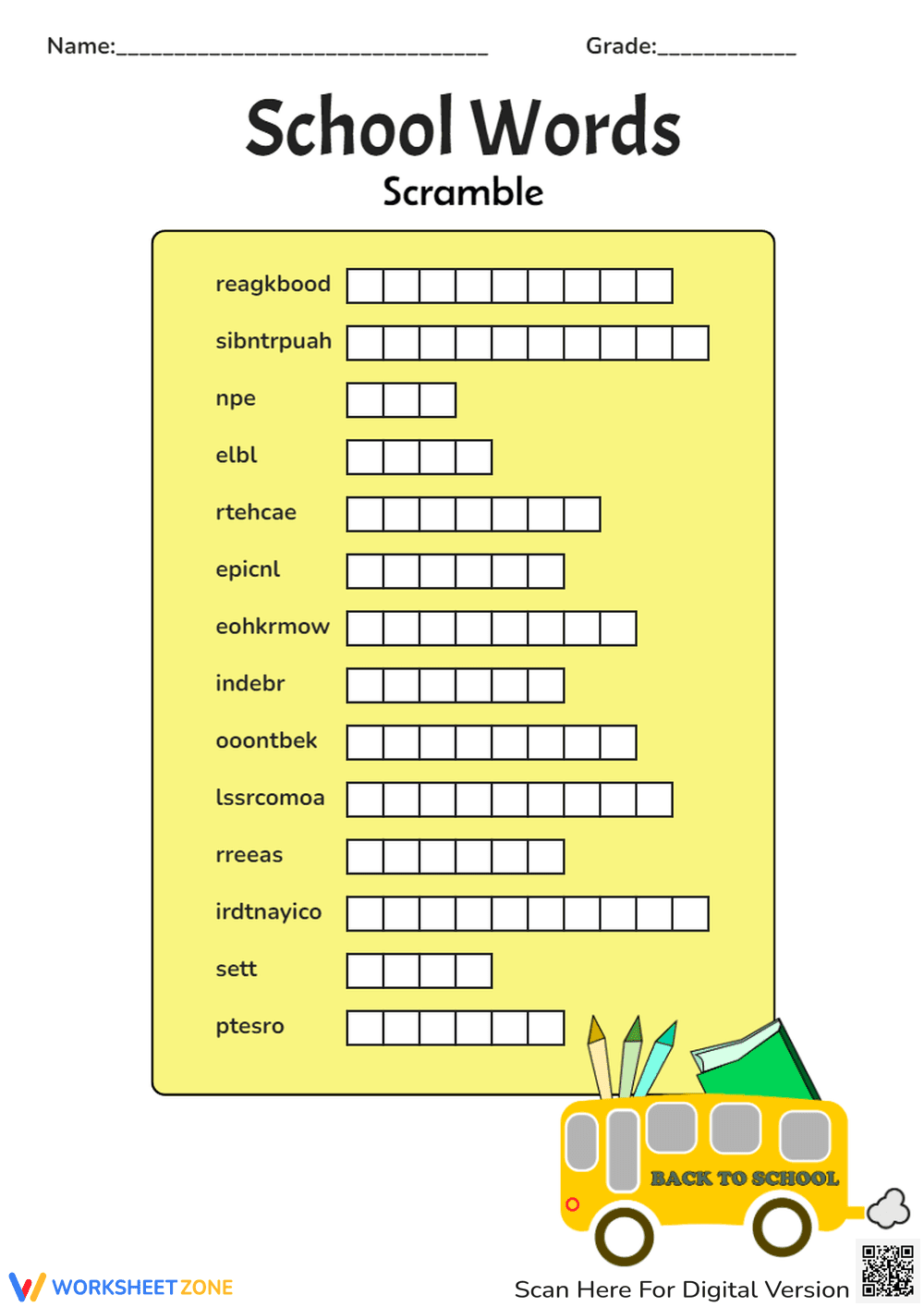
This school word scramble worksheet helps elementary students master academic vocabulary through an engaging puzzle format. By unscrambling 14 common classroom terms, learners strengthen their phonemic awareness and spelling patterns. This activity serves as an ideal icebreaker or morning work task during the first week of school to build confidence.
At a Glance
- Grade: 1-4 · Subject: ELA
- Standard:
CCSS.ELA-LITERACY.L.2.2— Demonstrate command of the conventions of standard English capitalization, punctuation, and spelling- Skill Focus: Spelling and Vocabulary
- Format: 1 page · 14 problems · Answer key included · PDF
- Best For: Back-to-school morning work or sub plans
- Time: 15–20 minutes
The worksheet features a clean, school-bus-themed layout containing 14 scrambled words related to the classroom. Students are provided with letter boxes for each word to guide their spelling and ensure the correct number of characters are used. The single-page PDF includes high-frequency words like teacher, pencil, and homework, making it accessible for various elementary levels. A comprehensive answer key is provided.
Zero-Prep Workflow
This resource is designed for immediate classroom implementation with a three-step workflow. First, print the single-page PDF (30 seconds). Second, distribute the sheets to students as they arrive for morning work or transition between subjects (1 minute). Third, review the answers as a whole group or use the provided key for self-correction (5 minutes). Total teacher preparation time is under two minutes.
Standards Alignment
The primary alignment for this activity is `CCSS.ELA-LITERACY.L.2.2`, which requires students to demonstrate command of the conventions of standard English spelling. By manipulating letters to form recognizable words, students practice orthographic mapping and letter-sound correspondences. It also supports vocabulary development by reinforcing the spelling of academic nouns. Both standard codes can be copied directly into lesson plans or IEP goals.
How to Use It
Use this worksheet as a bell ringer during the first week of school to keep students engaged while handling administrative tasks. It also functions effectively as a formative assessment to gauge students' spelling proficiency after the summer break. For a collaborative twist, have students work in pairs to solve the scrambles. Expected completion time ranges from 15 to 20 minutes depending on grade level.
Who It's For
This resource is tailored for students in Grades 1 through 4, with varying levels of support needed based on age. It is particularly beneficial for English Language Learners who are learning basic school-related vocabulary. Pair this worksheet with a back-to-school picture book or a classroom scavenger hunt to create a cohesive introductory unit. The visual cues provide built-in scaffolding for struggling spellers.
According to the RAND AIRS 2024 report, high-quality supplemental materials that focus on foundational literacy skills like spelling and word recognition are vital for closing achievement gaps in early elementary education. This worksheet addresses CCSS.ELA-LITERACY.L.2.2 by providing targeted practice in unscrambling 14 high-frequency school words. Research from Fisher & Frey (2014) emphasizes that word-play activities, such as scrambles and puzzles, increase student engagement and help solidify orthographic memory. By requiring students to mentally manipulate letter sequences, this activity moves beyond rote memorization and encourages active cognitive processing. This resource provides a structured yet low-stakes environment for students to apply their knowledge of English spelling patterns. Educators can utilize this tool to support diverse learners while meeting rigorous state and national standards for language conventions and vocabulary acquisition in the primary grades.


