


























Views
Downloads
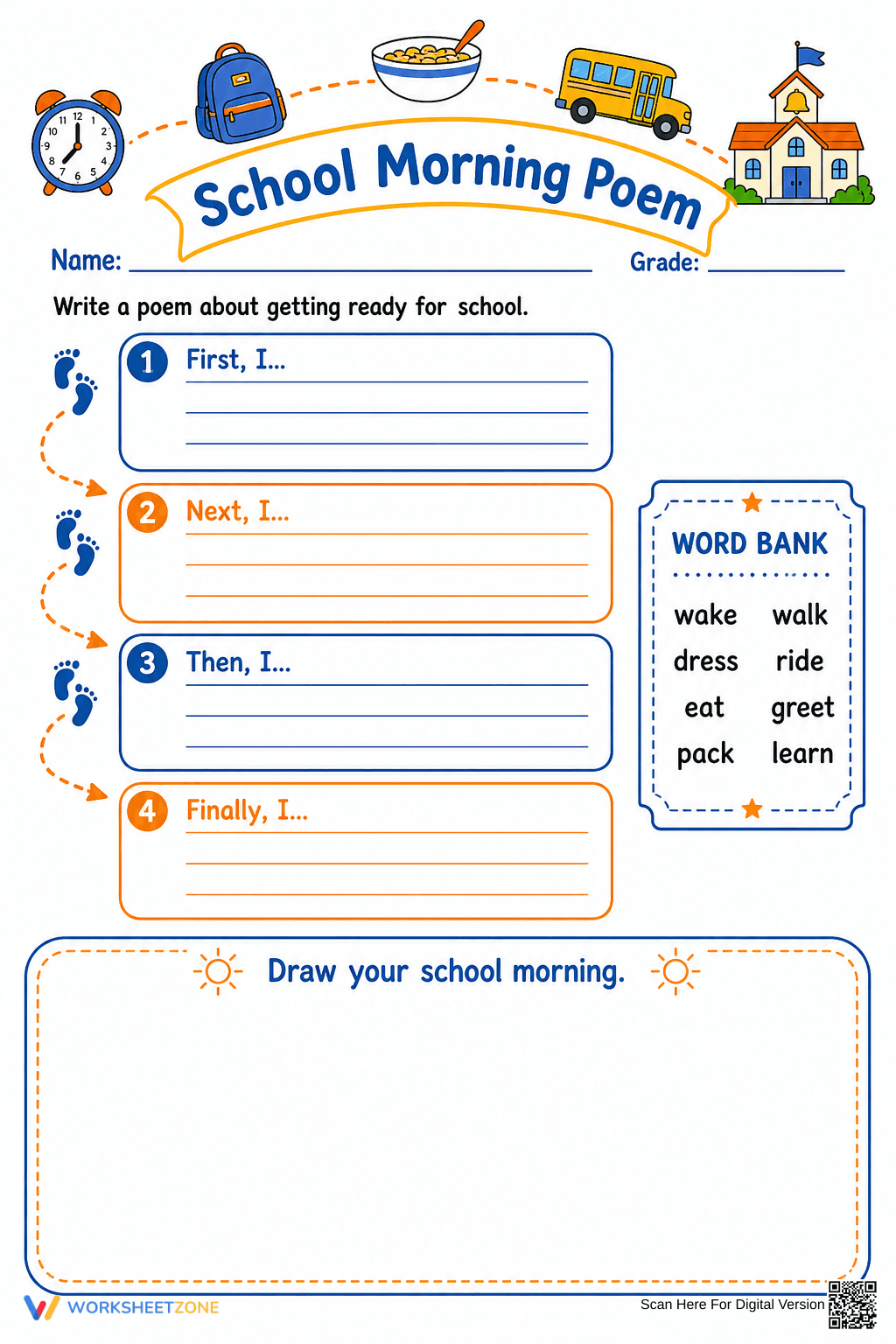

School Morning Poem Worksheet | Grade 2 Essential
Paste this activity's link or code into your existing LMS (Google Classroom, Canvas, Teams, Schoology, Moodle, etc.).
Students can open and work on the activity right away, with no student login required.
You'll still be able to track student progress and results from your teacher account.
This Grade 2 sequential writing worksheet helps students organize their morning routines into a structured poem. By using temporal transitions, learners practice chronological storytelling and vocabulary application. It provides a clear framework for young writers to express their daily experiences through both text and illustration, ensuring a successful start to the school day.
At a Glance
- Grade: 2 · Subject: ELA
- Standard:
CCSS.ELA-LITERACY.W.2.3— Recount a sequence of events with temporal words and closure- Skill Focus: Sequential Writing & Poetry
- Format: 1 page · 5 tasks · Word bank included · PDF
- Best For: Morning work or narrative writing intro
- Time: 15–25 minutes
Inside this single-page PDF, you will find four distinct writing panels labeled with sequence markers: First, Next, Then, and Finally. Each panel includes three ruled lines for student responses. A dedicated word bank featuring 8 high-frequency verbs like "wake," "pack," and "greet" supports vocabulary development. The bottom half features a large, framed drawing box for visual expression.
The zero-prep design allows for immediate classroom implementation. First, print the single-page PDF (30 seconds). Next, distribute the sheets to students and read the word bank together (1 minute). Finally, review the completed poems or have students share their drawings with a partner (5 minutes). Total teacher preparation time is under 2 minutes, making it an ideal sub plan.
This resource aligns with `CCSS.ELA-LITERACY.W.2.3`, which requires students to write narratives recounting a well-elaborated sequence of events using temporal words to signal order. It also supports `CCSS.ELA-LITERACY.L.2.1` through the application of action verbs in context. Both standard codes can be copied directly into lesson plans, IEP goals, or district curriculum mapping tools.
Use this as a "First Week of School" icebreaker to help students share their home-to-school transitions. It also serves as an effective formative assessment for checking a student's grasp of chronological transition words. During the activity, observe if students are using the provided word bank to enhance their descriptions. Completion typically takes 20 minutes depending on the depth of the drawing.
This worksheet is designed for second-grade students but is easily adaptable for first-grade guided writing or third-grade review. It is particularly helpful for English Language Learners (ELLs) who benefit from the visual cues and word bank support. Pair this with a mentor text about daily routines or a morning anchor chart to reinforce the sequence of events.
According to Fisher & Frey (2014), providing scaffolds like sentence frames and word banks is essential for the gradual release of responsibility in writing instruction. This worksheet utilizes those specific scaffolds to bridge the gap between oral storytelling and formal narrative structure. By focusing on the familiar context of a morning routine, the resource reduces cognitive load, allowing students to focus on the mechanics of sequencing and verb usage. The inclusion of a drawing component further reinforces comprehension through dual coding, a proven strategy for early literacy development. This alignment with evidence-based practices ensures that the CCSS.ELA-LITERACY.W.2.3 standard is met through meaningful, structured practice. Educators can confidently integrate this tool into their writing blocks to support diverse learners in achieving mastery of sequential narrative standards while fostering creative expression.


