


























Views
Downloads

Essential SAT Vocab Sentence Completion | Grade 9-12
Paste this activity's link or code into your existing LMS (Google Classroom, Canvas, Teams, Schoology, Moodle, etc.).
Students can open and work on the activity right away, with no student login required.
You'll still be able to track student progress and results from your teacher account.
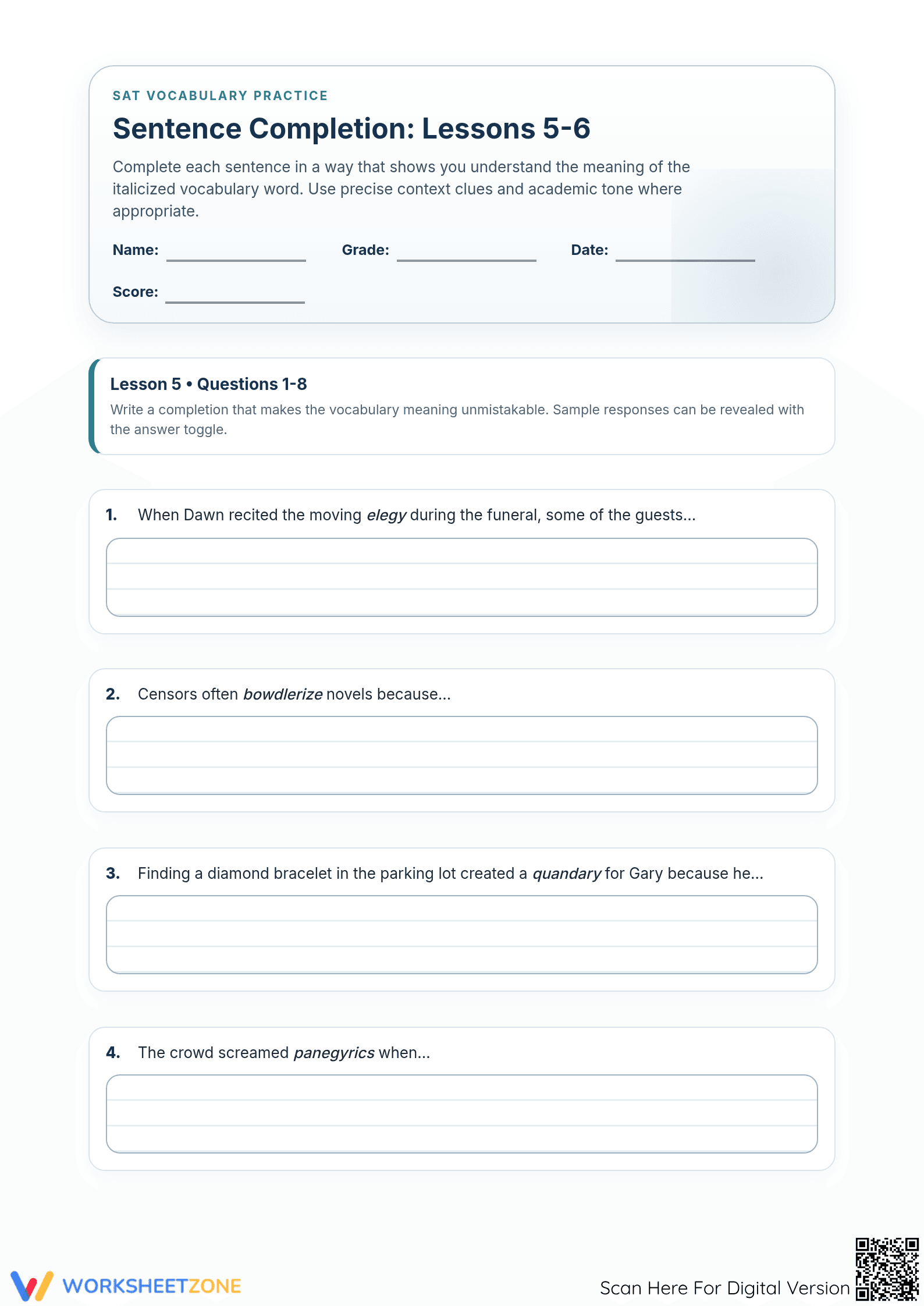
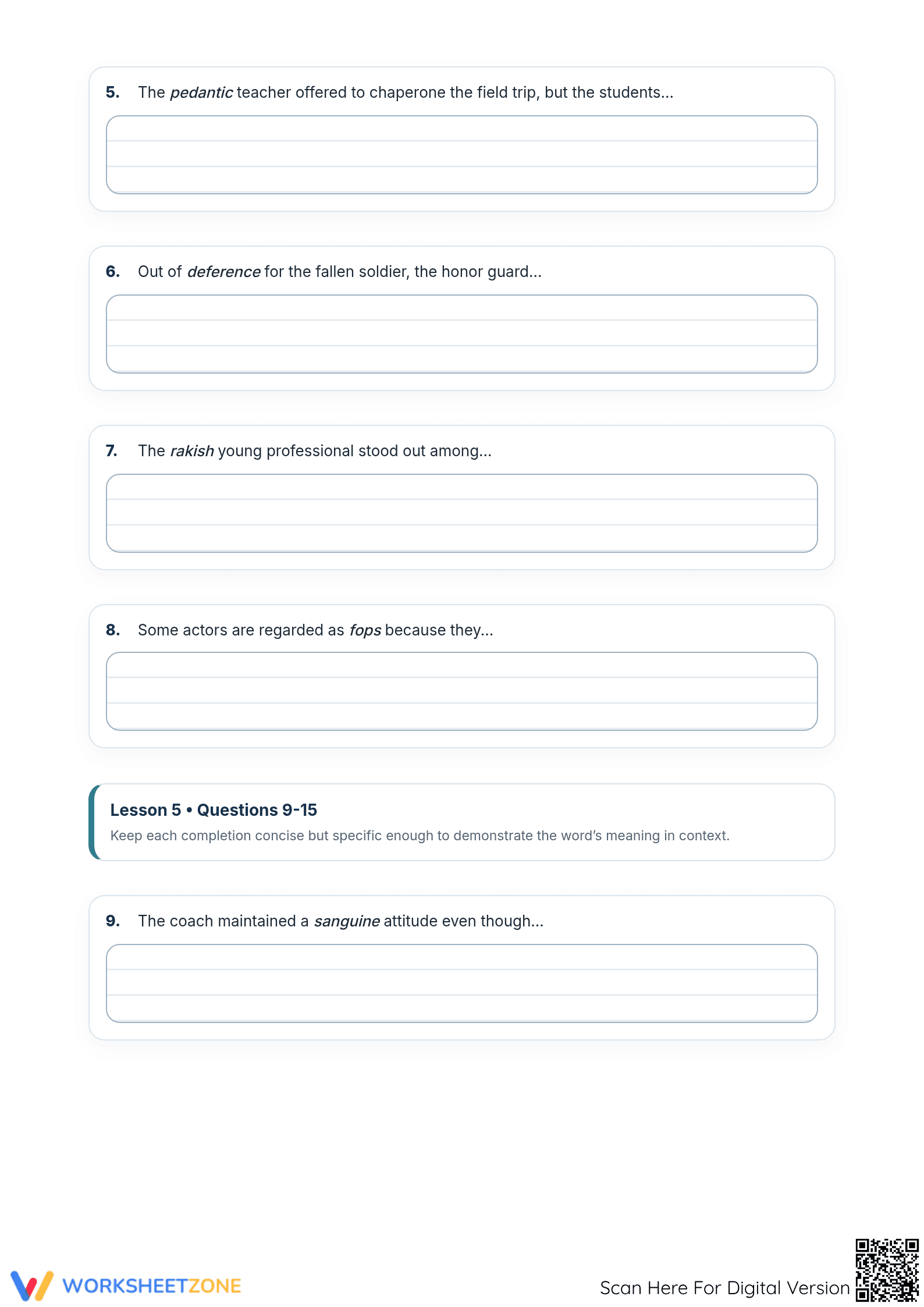
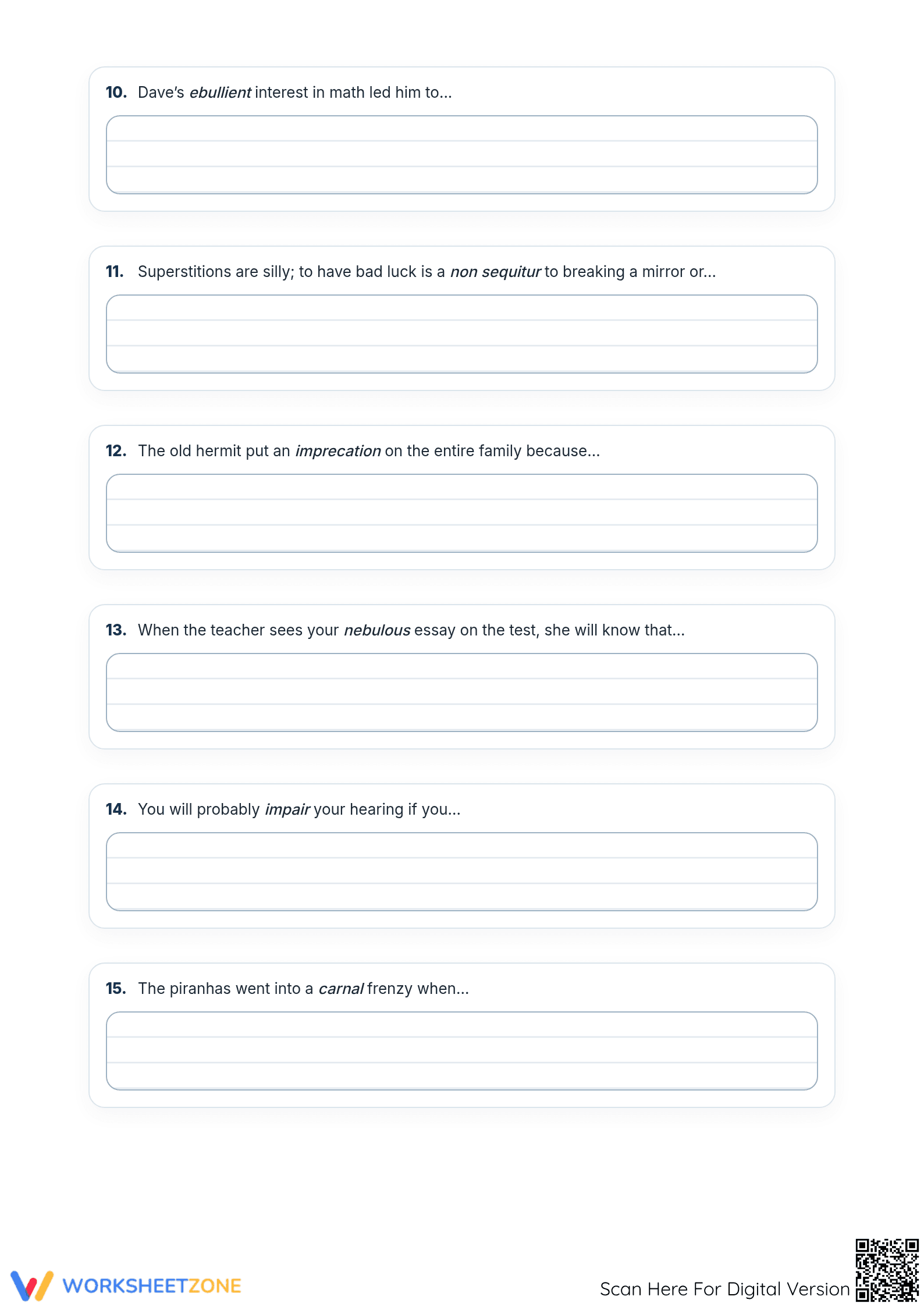
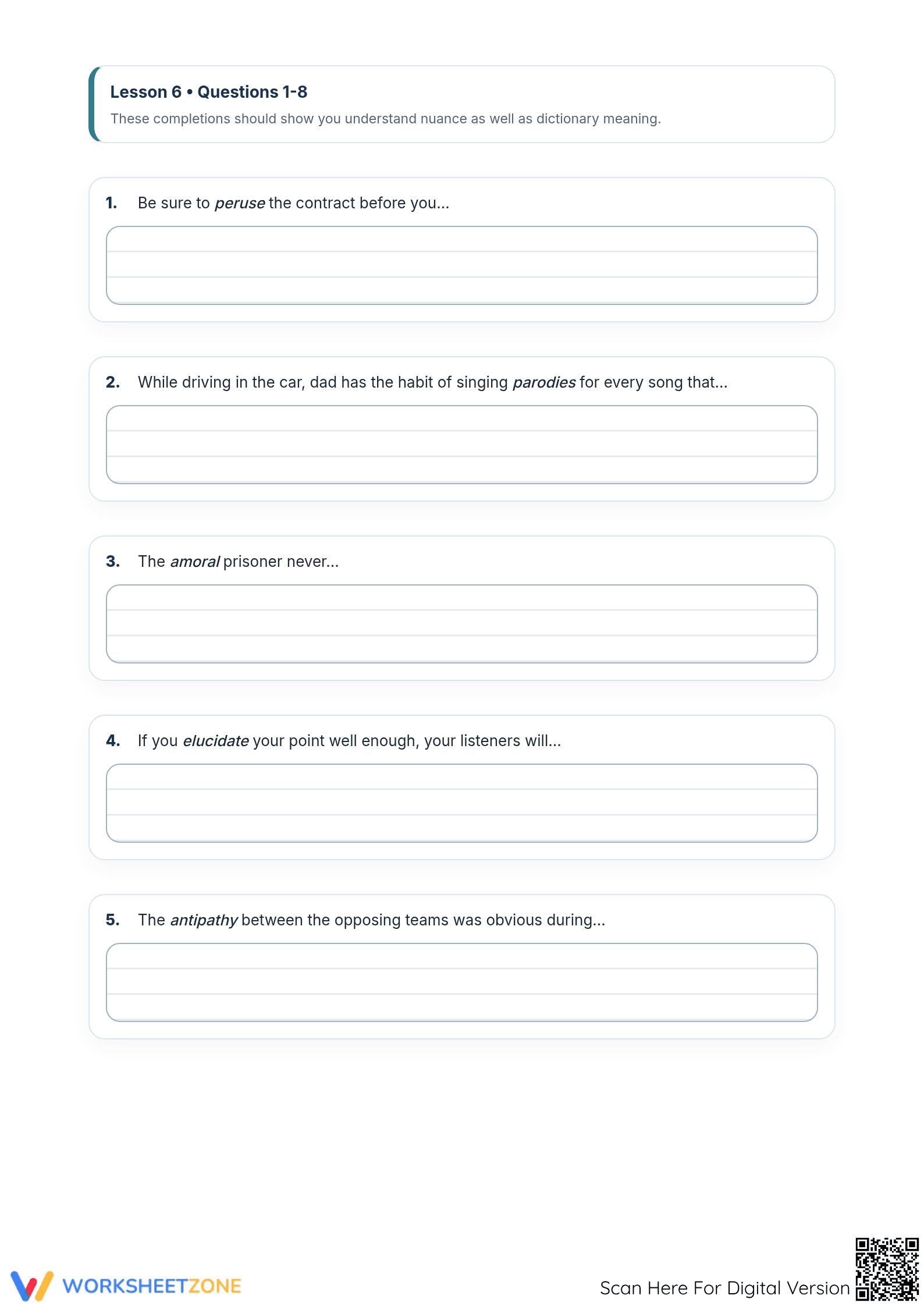
This advanced SAT vocabulary worksheet empowers Grade 9-12 students to master 30 high-frequency words through intensive sentence completion exercises. By requiring students to generate their own endings based on specific semantic cues, the activity shifts from simple recognition to deep conceptual understanding. Students must analyze context clues to demonstrate precise usage of words like elegy, quandary, and sedulous.
At a Glance
- Grade: 9–12 · Subject: English Language Arts
- Standard:
CCSS.ELA-LITERACY.L.11-12.4.A— Use context clues to determine the meaning of unknown words- Skill Focus: Advanced SAT Vocabulary Acquisition
- Format: 5 pages · 30 problems · Answer key included · PDF
- Best For: SAT prep, Bell-ringers, and Vocabulary Enrichment
- Time: 25–40 minutes
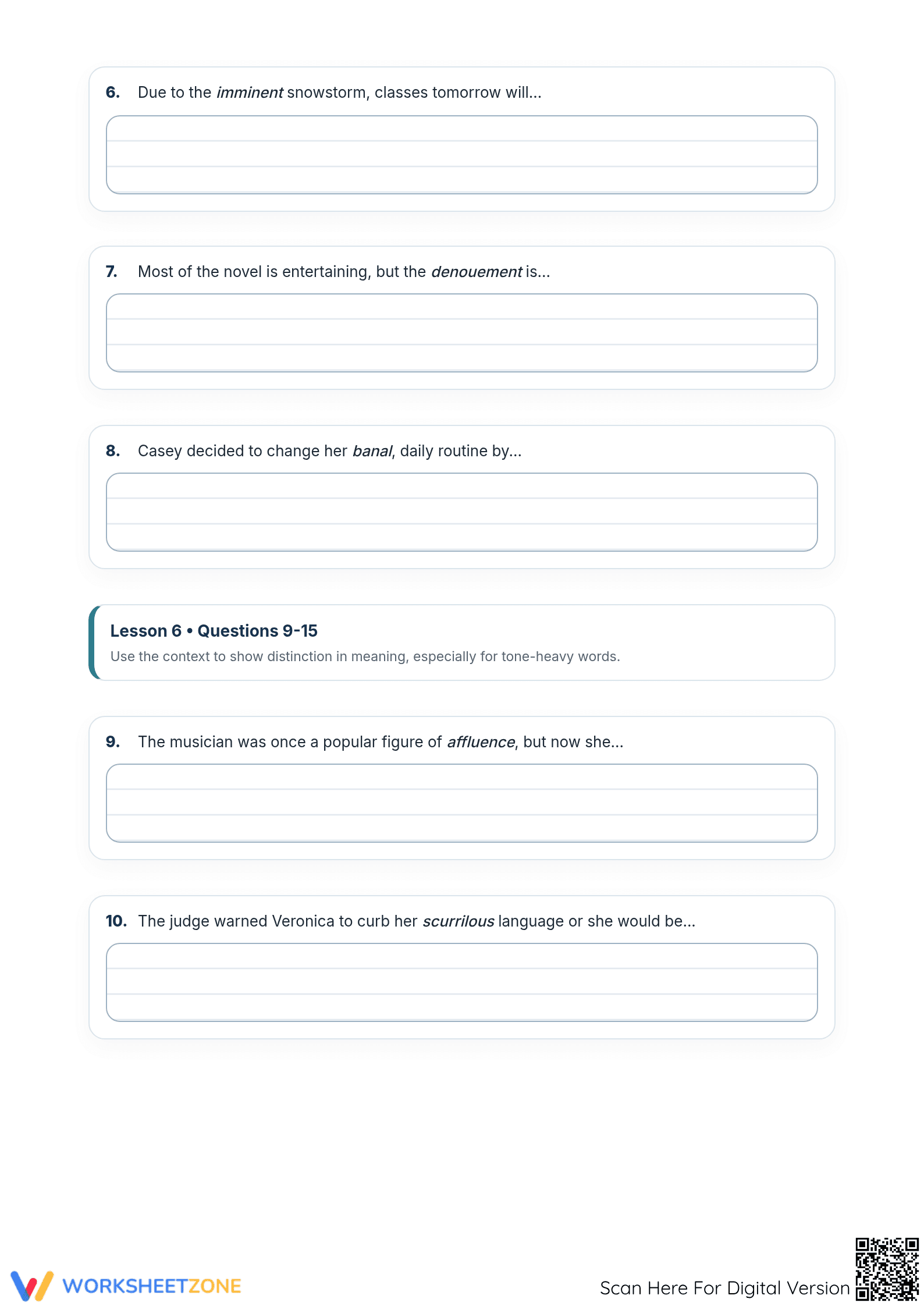
Inside this comprehensive five-page PDF, teachers will find 30 structured sentence completion tasks divided into two distinct lessons. Each task provides an italicized vocabulary word within a starter sentence, challenging the student to finish the thought in a way that proves they grasp the word's nuanced meaning. A full answer key is provided to streamline the grading process and facilitate immediate feedback.
The worksheet follows a strategic skill progression that mirrors the gradual release of responsibility. Each lesson is structured to build confidence through increasing complexity:
- Guided practice: The first sentences use strong semantic markers to help students identify the necessary logic for completion.
- Supported practice: Middle items introduce complex sentence structures requiring consistency across multiple clauses.
- Independent practice: Final tasks feature high-level abstraction, forcing students to apply vocabulary in sophisticated contexts.
This resource is explicitly aligned to `CCSS.ELA-LITERACY.L.11-12.4.A`, which requires students to use context (e.g., the overall meaning of a sentence or paragraph; a word's position or function in a sentence) as a clue to the meaning of a word or phrase. Both standard codes can be copied directly into lesson plans, IEP goals, or district curriculum mapping tools.
Use this worksheet as a focused exit ticket or a rigorous bell-ringer. Assign one lesson after a direct instruction session on the week's vocabulary. Teachers should circulate, observing whether students use descriptive phrases to prove their understanding—a key formative indicator. Most students complete the tasks within 30 minutes.
Designed for high school students in honors or AP tracks, this practice is also an effective scaffold for any learner preparing for college entrance exams. It pairs naturally with an SAT-level reading passage or a Greek/Latin roots anchor chart. The open-ended completion format allows for natural differentiation as students write at their individual complexity levels.
According to Fisher & Frey (2014), students who engage in sentence completion activities requiring them to apply a word's meaning in original contexts show higher retention rates than those who merely define terms. This SAT vocabulary resource directly addresses `CCSS.ELA-LITERACY.L.11-12.4.A` by forcing a deep dive into context clues. By mastering words like antipathy and denouement within structured syntactic frames, students build the word wealth necessary for the Reading and Writing sections of the SAT. The 30 tasks provided here offer a robust data set for tracking progress toward graduation-readiness standards. This evidence-based approach ensures that learners are not just identifying words but internalizing the logic of academic English, a critical bridge to college-level literacy success.


