


























Views
Downloads
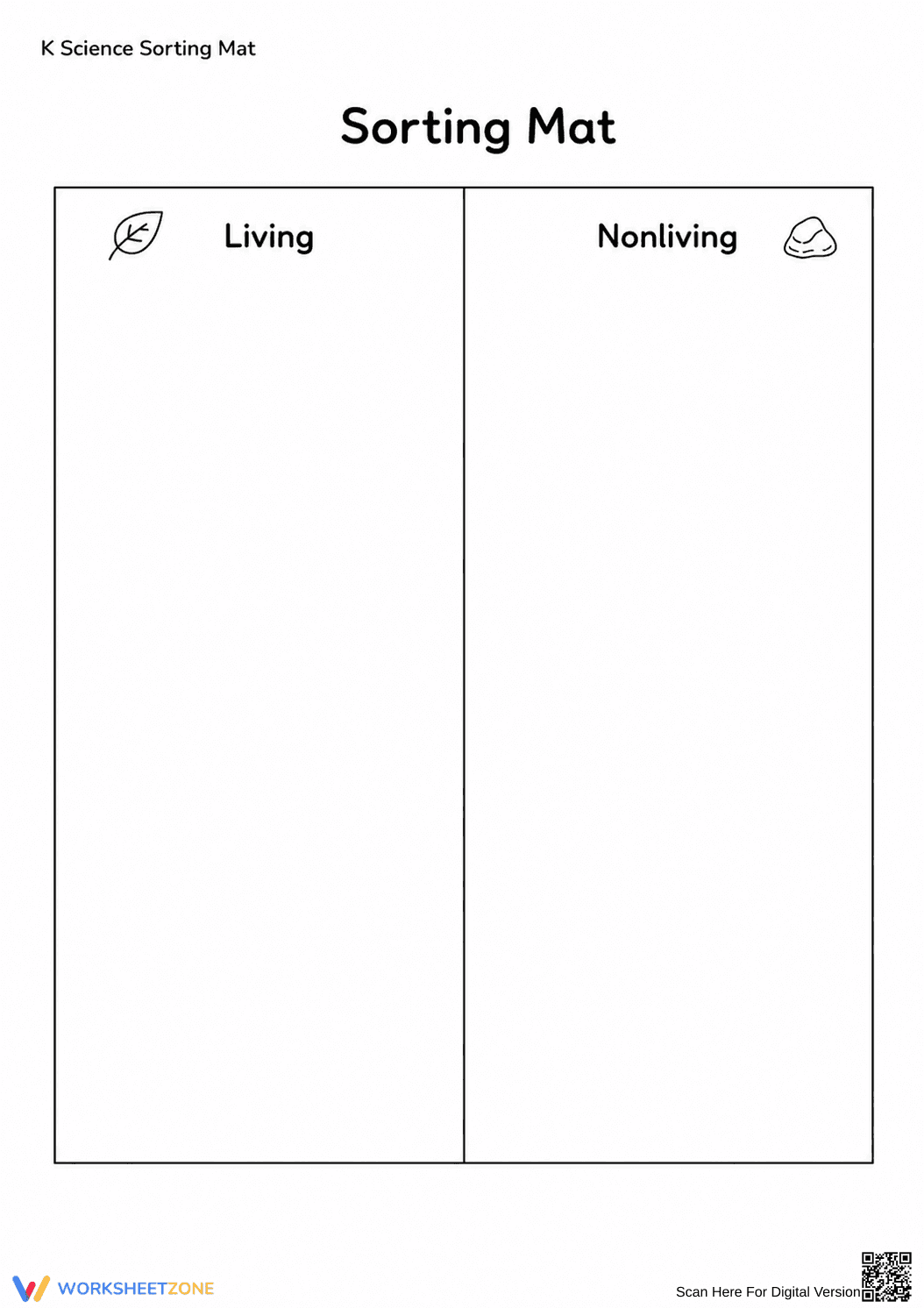

Grade K Living vs Nonliving — Printable No-Prep Worksheet
Paste this activity's link or code into your existing LMS (Google Classroom, Canvas, Teams, Schoology, Moodle, etc.).
Students can open and work on the activity right away, with no student login required.
You'll still be able to track student progress and results from your teacher account.
This Kindergarten science sorting mat provides a clear, structured framework for students to categorize objects based on biological characteristics. By distinguishing between living and nonliving entities, young learners develop foundational observation skills necessary for life science mastery. This resource ensures students can visually organize their findings during hands-on exploration.
At a Glance
- Grade: Kindergarten · Subject: Science
- Standard:
K-LS1-1— Describe patterns of what plants and animals need to survive- Skill Focus: Living vs. Nonliving Classification
- Format: 1 page · 1 activity · PDF
- Best For: Science centers and small group instruction
- Time: 10–15 minutes
Inside this resource, you will find a clean, high-contrast sorting mat divided into two distinct columns: Living and Nonliving. The 1-page layout is designed for maximum clarity, featuring bold headings and simple icons that are easy for early readers to decode. This template works perfectly with physical manipulatives, magazine cutouts, or teacher-provided picture cards, offering a versatile canvas for various biological classification tasks.
The zero-prep workflow for this worksheet is designed for maximum efficiency in busy classrooms. First, print the single-page mat (30 seconds). Second, distribute the mats along with your chosen sorting items or picture cards (1 minute). Third, facilitate a quick review as students place their items, allowing for immediate feedback (5 minutes). Total teacher preparation time is under 2 minutes, making this an ideal choice for emergency sub plans or spontaneous science lessons.
This worksheet aligns with the Next Generation Science Standard K-LS1-1. This standard requires students to use observations to describe patterns of what plants and animals need to survive. By identifying what is living, students begin to recognize the shared needs of organisms. Both standard codes can be copied directly into lesson plans, IEP goals, or district curriculum mapping tools.
Use this mat during the "Explore" phase of a 5E lesson model. After a nature walk, have students draw or place items they found into the correct columns. It also serves as an excellent formative assessment tool; observe if students can explain why a rock is nonliving while a leaf is living. Completion typically takes 10 to 15 minutes depending on the number of items sorted.
This resource is tailored for Kindergarten students but is also suitable for Pre-K learners or English Language Learners (ELLs) who benefit from visual organizers. It pairs naturally with a "Living Things" anchor chart or a read-aloud about the needs of plants and animals. The high-contrast design supports students with visual processing needs by reducing clutter.
Scientific classification in early childhood is a critical precursor to complex biological reasoning. According to the RAND AIRS 2024 report, providing students with structured graphic organizers like sorting mats significantly improves their ability to retain categorical information and apply it to new contexts. This K-LS1-1 aligned resource focuses on the plain-English skill of observing and describing patterns in the natural world. By engaging in the physical act of sorting, students move from abstract concepts to concrete understanding. This 1-page tool provides the necessary scaffolding for students to demonstrate mastery of life science basics while building the vocabulary needed for future inquiry-based learning. It is a reliable, research-backed addition to any early elementary science curriculum that builds foundational knowledge for future scientific exploration.


