


























Views
Downloads

Printable Plant Parts Worksheet | Grade K Science
Paste this activity's link or code into your existing LMS (Google Classroom, Canvas, Teams, Schoology, Moodle, etc.).
Students can open and work on the activity right away, with no student login required.
You'll still be able to track student progress and results from your teacher account.
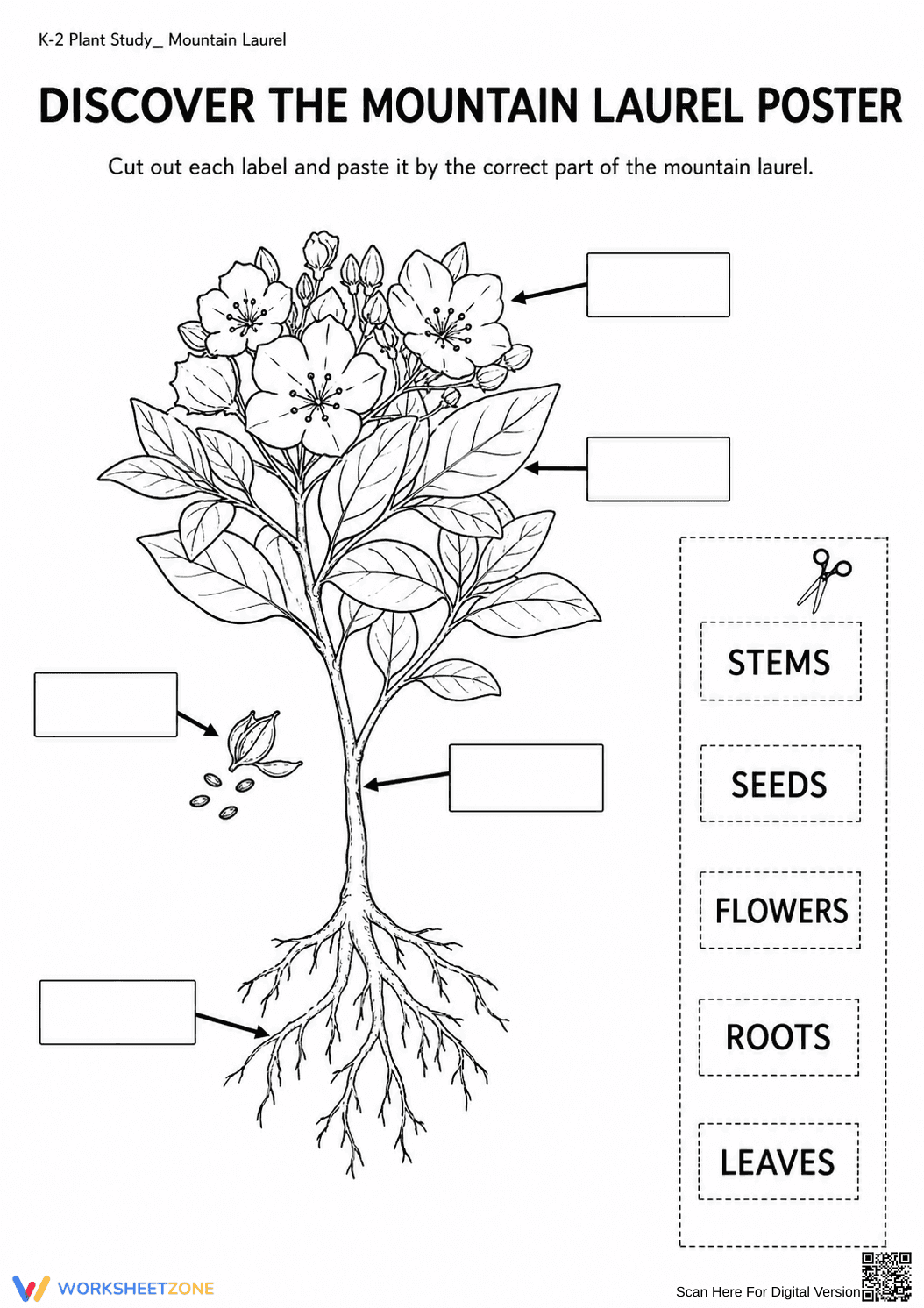
This foundational science worksheet helps early learners identify and label the basic external structures of a plant. By cutting and pasting vocabulary words onto a Mountain Laurel diagram, students actively connect scientific terms to visual representations, building essential fine motor skills alongside core botanical knowledge.
At a Glance
- Grade: K · Subject: Science
- Standard:
K-LS1-1— Identify and label basic plant structures- Skill Focus: Plant Anatomy
- Format: 1 page · 5 problems · Answer key included · PDF
- Best For: Independent science centers
- Time: 10–15 minutes
This single-page resource features a clear, black-and-white illustration of a Mountain Laurel plant alongside a dashed cut-out section. Students will find five specific vocabulary labels—stems, seeds, flowers, roots, and leaves—that they must physically cut out and glue into the corresponding blank boxes pointing to the plant's structures. A complete answer key is provided for quick grading.
This activity is designed for immediate classroom implementation with a streamlined workflow:
- Print (1 minute): Generate enough copies for the class directly from the PDF.
- Distribute (1 minute): Hand out the sheets along with scissors and glue sticks.
- Review (3 minutes): Quickly check completed diagrams against the provided key.
With a total teacher prep time of under two minutes, this self-explanatory task is highly suitable for emergency sub plans or spontaneous science center rotations.
Aligned to K-LS1-1: Use observations to describe patterns of what plants and animals (including humans) need to survive. By identifying roots, stems, and leaves, students build the prerequisite vocabulary needed to explain how these specific parts gather water and sunlight. Both standard codes can be copied directly into lesson plans, IEP goals, or district curriculum mapping tools.
Deploy this worksheet during the independent practice phase of a life science unit, immediately following direct instruction on plant anatomy. It also functions perfectly as a morning work activity to activate prior knowledge before a nature walk. As students work, teachers can use this as a formative assessment opportunity by observing whether children correctly distinguish between the seeds and the flowers before they apply the glue. Expect the cutting, matching, and pasting process to take most kindergarteners between 10 and 15 minutes.
This resource is primarily designed for kindergarten and first-grade students developing early science literacy and fine motor coordination. For students requiring additional support, teachers can pre-cut the vocabulary labels or color-code the boxes to match the words. This cut-and-paste diagram pairs naturally with a hands-on seed planting lesson or a read-aloud book about the plant life cycle.
Integrating tactile activities like cutting and pasting with academic vocabulary acquisition significantly reinforces early childhood learning. When students identify and label basic plant structures, they are engaging in dual-coding—processing visual spatial information alongside linguistic data. According to Fisher & Frey (2014), providing structured, hands-on tasks during the independent learning phase increases student retention of domain-specific vocabulary. This specific exercise supports K-LS1-1 by ensuring learners can accurately name the physical structures plants use to interact with their environment. By physically moving the labels for roots, stems, and leaves into their correct anatomical positions, young learners solidify their mental models of living organisms. This multimodal approach not only builds foundational science comprehension but also refines the fine motor skills necessary for early writing development, making it a highly efficient instructional tool for primary classrooms.


