


























Views
Downloads

Printable Sunflower Life Cycle Worksheet | Grade K Science
Paste this activity's link or code into your existing LMS (Google Classroom, Canvas, Teams, Schoology, Moodle, etc.).
Students can open and work on the activity right away, with no student login required.
You'll still be able to track student progress and results from your teacher account.
This Kindergarten science worksheet helps students understand the stages of plant growth by sequencing the life cycle of a sunflower. By cutting and pasting images into a continuous cycle, young learners build foundational biology knowledge while simultaneously developing essential fine motor skills.
At a Glance
- Grade: Kindergarten · Subject: Science
- Standard:
K-LS1-1— Observe and describe patterns of plant growth- Skill Focus: Sequencing plant life cycles
- Format: 2 pages · 4 problems · PDF
- Best For: Independent practice and science centers
- Time: 15–20 minutes
What's Inside
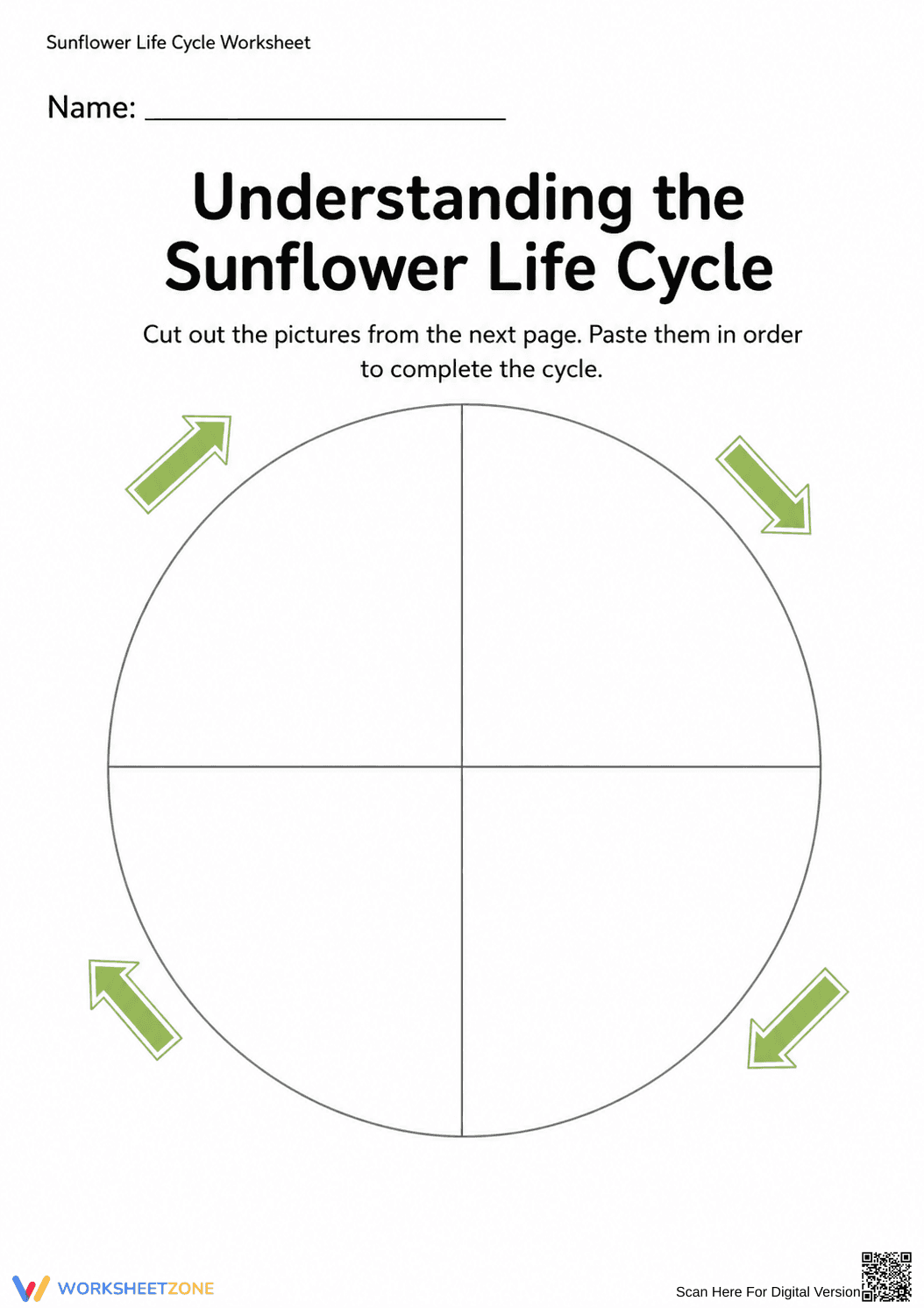
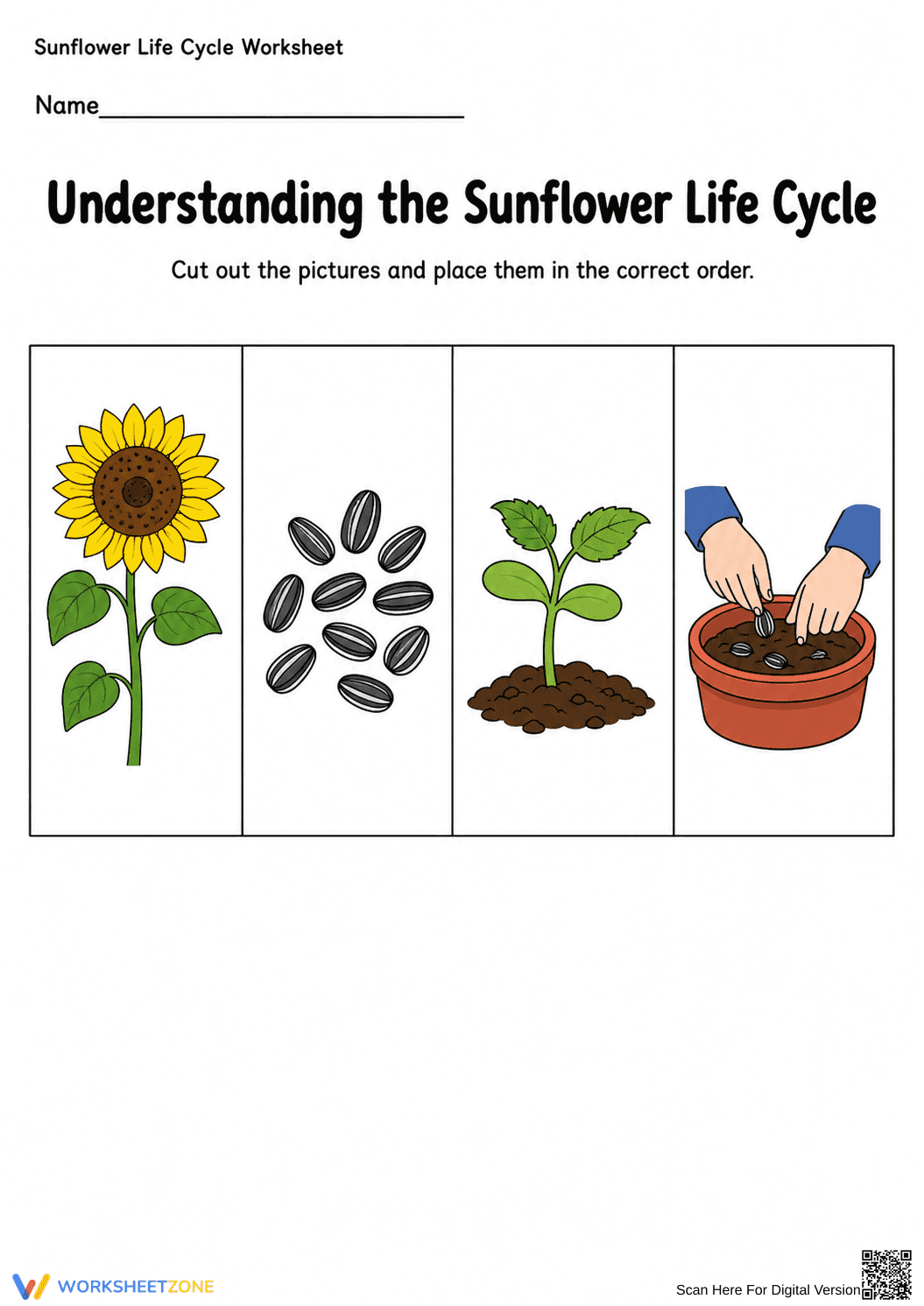
This two-page resource features a clear, four-quadrant cycle diagram on the first page and a set of four distinct sunflower growth stages on the second page. Students will find illustrations of seeds being planted, a sprouting seedling, a mature sunflower, and harvested seeds. The large, easy-to-cut image blocks are specifically designed for early elementary hands, making the physical task of cutting and pasting manageable and engaging.
Zero-Prep Workflow
- Print (1 minute): Simply print the two-page PDF. No special materials are required beyond standard classroom supplies.
- Distribute (1 minute): Hand out the worksheets along with scissors and glue sticks. The visual instructions are intuitive for early readers.
- Review (3 minutes): Quickly check students' completed cycles to ensure the four stages are placed in the correct chronological order. Total teacher prep time is under two minutes, making this an excellent addition to emergency sub plans or spontaneous science blocks.
Standards Alignment
Aligned to primary standard K-LS1-1, this activity supports students as they use observations to describe patterns of what plants need to survive and how they grow. By organizing the stages of a sunflower's life, students recognize the predictable patterns of living organisms. Both standard codes can be copied directly into lesson plans, IEP goals, or district curriculum mapping tools.
How to Use It
- Science Centers: Place copies of this worksheet at a designated science station following a read-aloud about plants. Students can work independently to complete the cycle.
- Formative Assessment: Use this activity after direct instruction on living things. Observe students as they sequence the cards; if a student places the mature flower before the seedling, it provides an immediate opportunity to gently correct their understanding of chronological growth. Expected completion time is 15 to 20 minutes.
Who It's For
This resource is designed for Kindergarten and first-grade students developing basic science literacy and fine motor control. It is easily differentiated by pre-cutting the images for students who struggle with scissor skills. Pair this worksheet with a physical seed-planting activity or a classroom anchor chart detailing the parts of a plant for a comprehensive learning experience.
Integrating hands-on sequencing tasks into early childhood science education reinforces both foundational biological concepts and essential cognitive organization skills. Addressing the K-LS1-1 standard, this activity requires students to observe and describe patterns of plant growth and survival through a structured visual format. According to Fisher & Frey (2014), providing students with interactive, manipulative tasks significantly increases their retention of academic vocabulary and sequential processes compared to passive observation alone. By physically moving the four distinct stages of the sunflower life cycle into their correct chronological positions, young learners transition abstract scientific concepts into concrete, observable understanding. This tactile approach not only supports critical fine motor development but also builds a much stronger conceptual foundation for future STEM exploration in the upper elementary grades.


