


























Views
Downloads

Essential Seed Pocket Activity | Kindergarten Science
Paste this activity's link or code into your existing LMS (Google Classroom, Canvas, Teams, Schoology, Moodle, etc.).
Students can open and work on the activity right away, with no student login required.
You'll still be able to track student progress and results from your teacher account.
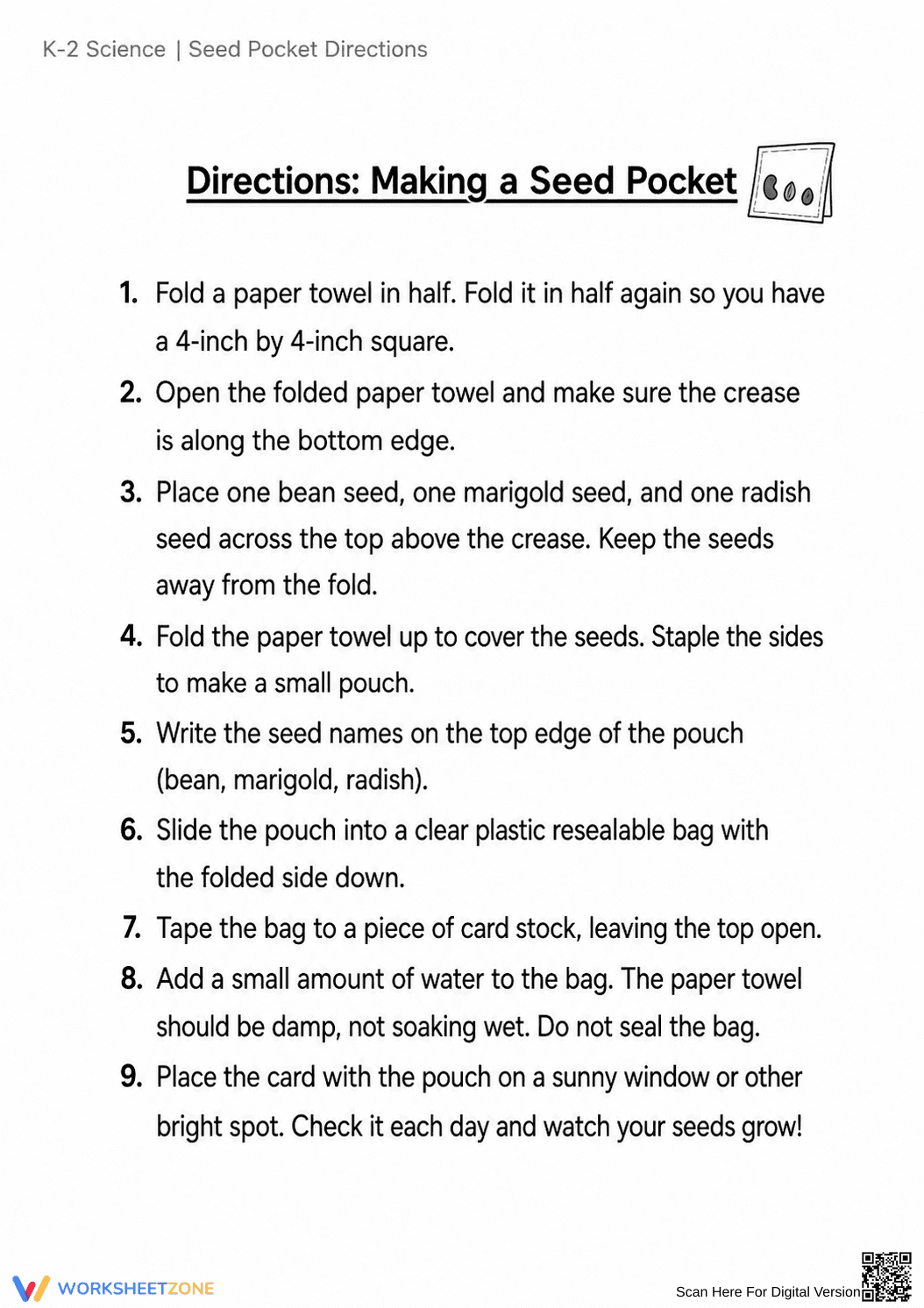
This Kindergarten science worksheet provides a clear, 9-step guide for students to create their own seed pockets for germination observation. By following these procedural directions, young learners explore the fundamental needs of plants while developing fine motor skills. It transforms a complex biological process into a manageable, hands-on classroom experiment.
At a Glance
- Grade: Kindergarten · Subject: Science
- Standard:
K-LS1-1— Use observations to describe patterns of what plants need to survive- Skill Focus: Seed germination and procedural following
- Format: 1 page · 9 steps · Activity Guide · PDF
- Best For: Hands-on life science lab activity
- Time: 15–20 minutes
This single-page PDF features a structured list of 9 numbered instructions designed for early elementary readers. It includes specific measurements, such as the 4-inch square fold, a list of required seeds including bean, marigold, and radish, and clear environmental setup cues. The layout is clean and distraction-free, ensuring students can focus on the sequence of the experiment without visual overwhelm.
Zero-Prep Workflow:
- Print: Select the single-page PDF and print copies for each student or small group in approximately 30 seconds.
- Distribute: Hand out the instruction sheets alongside pre-gathered materials like paper towels, seeds, and plastic bags in about 1 minute.
- Review: Read the 9 steps aloud to model procedural literacy before students begin their hands-on construction.
Total teacher prep time is under 2 minutes, making this an ideal resource for busy science blocks or unexpected sub plans.
This resource aligns with K-LS1-1, requiring students to observe and describe what plants need to survive. By placing the seed pocket in a sunny window and adding water, students directly manipulate the variables necessary for life. This standard code can be copied directly into lesson plans, IEP goals, or district curriculum mapping tools.
Use this worksheet during the "Explore" phase of a 5E instructional model for plant life cycles. It serves as an excellent formative assessment for following multi-step directions. Expect students to spend 15 to 20 minutes on the initial setup, followed by daily 2-minute observation periods over the next week to track growth progress.
Designed for Kindergarten students, this activity is also highly effective for Grade 1 and 2 learners or ESL students needing visual procedural support. It pairs naturally with a plant growth observation journal or an anchor chart detailing the parts of a seed and the requirements for germination.
According to the RAND AIRS 2024 report on elementary science instruction, hands-on procedural activities significantly increase retention of biological concepts compared to passive reading. This worksheet facilitates the K-LS1-1 standard by allowing students to observe the transition from seed to sprout in a controlled environment. By engaging in the 9-step "Making a Seed Pocket" activity, students practice scientific inquiry and data collection through daily observation. Research by Fisher & Frey (2014) emphasizes that structured procedural guides in early childhood help bridge the gap between literacy and scientific practice. This resource provides the necessary scaffolding for young learners to achieve mastery in life science while building the foundational skills required for later NGSS performance expectations. The clear formatting ensures that students remain focused on the biological outcomes of the experiment.


