




























Views
Downloads

Grade 3 Ecosystems — Printable No-Prep Worksheet

Paste this activity's link or code into your existing LMS (Google Classroom, Canvas, Teams, Schoology, Moodle, etc.).
Students can open and work on the activity right away, with no student login required.
You'll still be able to track student progress and results from your teacher account.
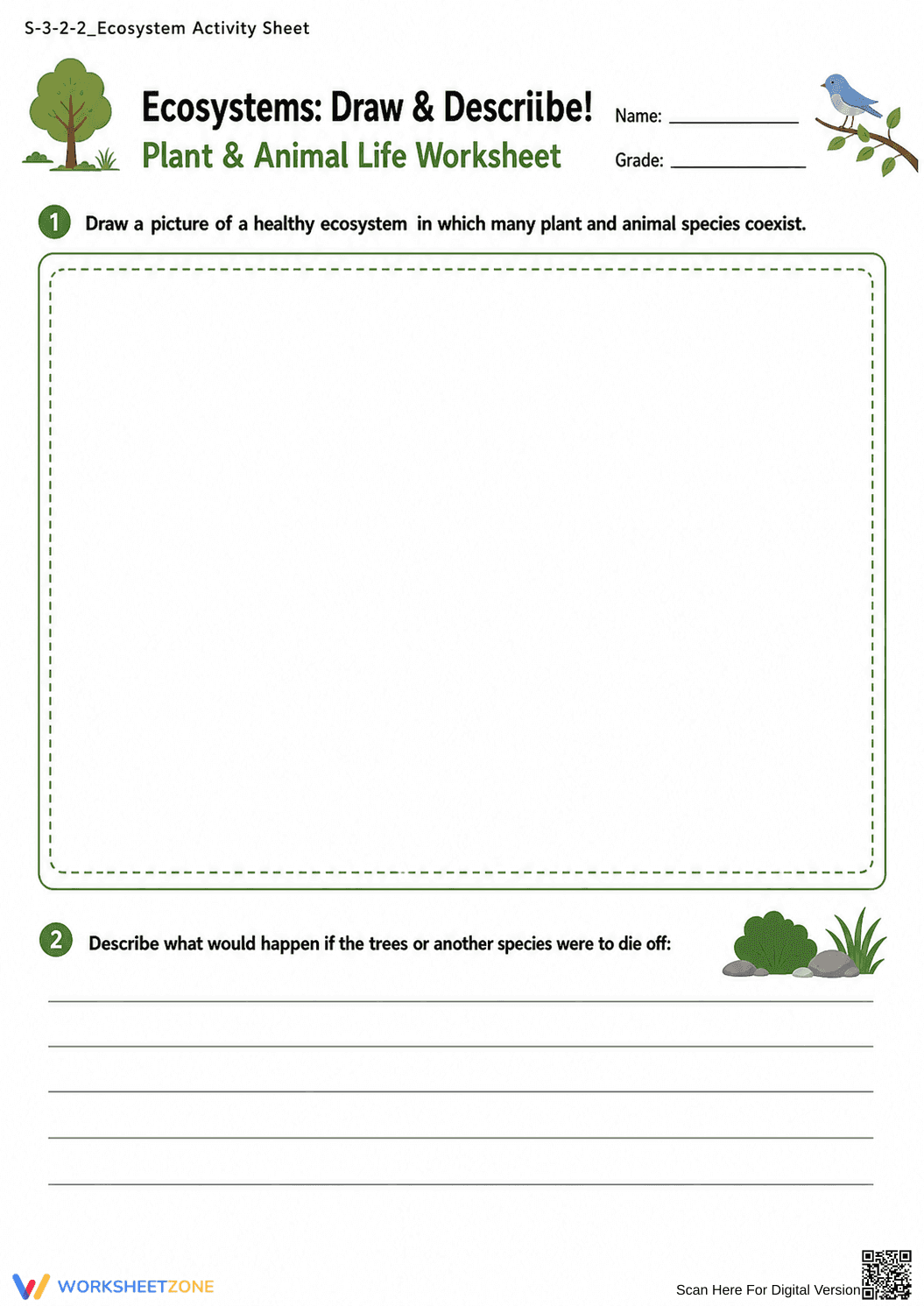
This Grade 3 science worksheet prompts students to visualize the delicate balance of ecosystems. By drawing a healthy habitat and writing about the consequences of species loss, learners actively explore biodiversity. It effectively bridges creative expression with critical scientific thinking.
At a Glance
- Grade: 3 · Subject: Science
- Standard:
3-LS4-4— Analyze how environmental changes affect plant and animal survival- Skill Focus: Ecosystem interdependence
- Format: 1 page · 2 problems · Answer key included · PDF
- Best For: Independent practice or formative assessment
- Time: 15–20 minutes
This single-page resource features two task types to assess comprehension of ecological relationships. The top half provides a framed space for illustrating a thriving ecosystem. The bottom half features a lined section where students write a paragraph explaining the cascading effects if a specific population dies off. A sample response key is included.
Designed for immediate classroom implementation, this activity requires minimal setup:
- Print (1 minute): Print the single-page PDF.
- Distribute (1 minute): Hand out sheets and colored pencils.
- Review (3 minutes): Use the sample responses to evaluate understanding.
With under two minutes of prep time, this is an excellent addition to sub plans.
This activity aligns with 3-LS4-4: Make a claim about a problem caused when the environment changes and the types of plants and animals that live there change. By predicting the outcome of a species dying off, it addresses how environmental shifts impact survival. Both standard codes can be copied directly into lesson plans, IEP goals, or district curriculum mapping tools.
Deploy this worksheet during an ecology unit to check for understanding before introducing complex food webs. It serves as an excellent formative assessment; teachers can observe whether students include both living and non-living elements. Alternatively, use it as an independent science center. Expected completion time is 15 to 20 minutes.
Ideal for third-grade students, this resource can also serve fourth graders reviewing foundational ecology. For students who struggle with writing, teachers can provide sentence starters like "If the trees died, then..." It pairs perfectly with an introductory lesson on food chains.
Integrating creative visualization with analytical writing significantly enhances elementary science instruction. This worksheet aligns with 3-LS4-4, requiring students to analyze how environmental changes affect plant and animal survival. According to a recent EdReports 2024 review of effective science curricula, providing students with multimodal opportunities to express their understanding—such as combining drawing with written explanations—increases retention of complex ecological concepts by allowing learners to process information both spatially and linguistically. When students actively illustrate a healthy ecosystem and then logically deduce the consequences of removing a single species, they develop a more profound, internalized grasp of biodiversity and interdependence. This dual-task approach ensures that learners are not merely memorizing vocabulary, but are actively engaging in the scientific practices of modeling and constructing explanations based on evidence, which is critical for long-term mastery.


