


























Views
Downloads

Printable Rhyming Words Matching Worksheet | Grade K ELA
Paste this activity's link or code into your existing LMS (Google Classroom, Canvas, Teams, Schoology, Moodle, etc.).
Students can open and work on the activity right away, with no student login required.
You'll still be able to track student progress and results from your teacher account.
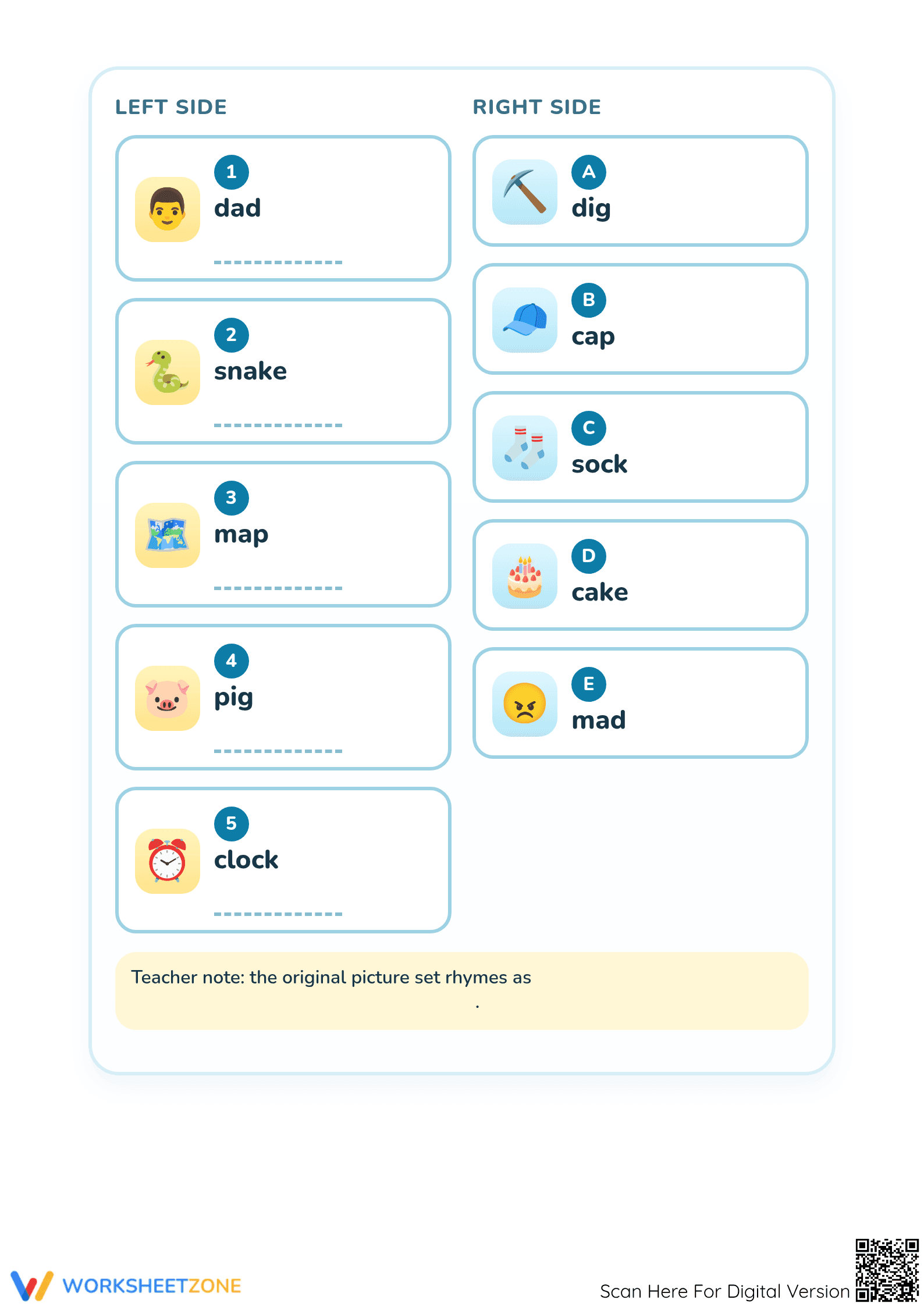
This kindergarten rhyming words matching worksheet helps young learners identify identical ending sounds through visual associations. By matching common words like "pig" and "dig," students build the foundational phonological awareness necessary for future reading fluency. This printable resource provides immediate practice in recognizing rhyme patterns, ensuring a successful start to the early literacy journey.
At a Glance
- Grade: Kindergarten · Subject: English Language Arts
- Standard:
CCSS.ELA-LITERACY.RF.K.2.A— Students recognize and produce rhyming words to build foundational phonemic awareness- Skill Focus: Rhyme Recognition & Ending Sounds
- Format: 2 pages · 5 problems · Answer key included · PDF
- Best For: Zero-prep independent practice or morning work
- Time: 5–10 minutes
This two-page PDF includes a focused exercise featuring five matching pairs of high-frequency words and clear icons. The first page contains the lesson header and a notes section for teacher observations. The second page presents the active task, where students connect items from the left side to rhyming counterparts on the right. A complete answer key is included.
Zero-Prep Workflow
The zero-prep design allows teachers to implement this activity in less than two minutes. First, print the two-page document. Second, distribute to students and read the "Say it out loud" instructions. Third, review the completed work using the included key. This streamlined workflow makes it an ideal choice for substitute folders or unexpected schedule gaps during the school day.
This resource is primary aligned to `CCSS.ELA-LITERACY.RF.K.2.A`, which requires students to recognize and produce rhyming words. It also supports general phonological development by requiring students to isolate ending sounds. Both standard codes can be copied directly into lesson plans, IEP goals, or district curriculum mapping tools to ensure instructional compliance and track student progress toward grade-level mastery.
Use this worksheet as a quick check for understanding during a small-group phonics lesson. Hand this out for independent practice to observe which students can accurately pair sounds without prompting. It also serves as an excellent formative assessment tool; observe if students need to verbalize the words repeatedly to find the match. Completion typically takes between five and ten minutes.
This activity is designed for kindergarten students, though it is effective for preschool enrichment or Grade 1 intervention. The use of clear icons and labels provides necessary scaffolding for English Language Learners and students with IEPs who benefit from visual cues. It pairs naturally with rhyming picture books or direct instruction lessons focusing on short vowel word families.
Early literacy research emphasized in the RAND AIRS 2024 report highlights that phonological awareness, specifically the ability to recognize rhyming words like those in the `CCSS.ELA-LITERACY.RF.K.2.A` standard, is one of the strongest predictors of later reading success. This worksheet targets rhyme recognition by requiring students to connect sounds across different word families, a process that Fisher & Frey (2014) identify as critical for the gradual release of responsibility in foundational ELA skills. By engaging in these five structured matching tasks, students reinforce the auditory-visual connection between letters and sounds. The inclusion of an answer key supports immediate feedback, a strategy validated by ScienceDirect TpT Analysis as essential for preventing the solidification of phonemic misconceptions in early learners. This printable resource offers a high-impact, evidence-based method for strengthening reading fluency through consistent, focused practice on ending sound identification within a classroom-ready format.


