


























Views
Downloads


Grade K-1 Rhyming Words — Printable No-Prep Worksheet
Paste this activity's link or code into your existing LMS (Google Classroom, Canvas, Teams, Schoology, Moodle, etc.).
Students can open and work on the activity right away, with no student login required.
You'll still be able to track student progress and results from your teacher account.
Strengthen early phonemic awareness with this comprehensive rhyming words worksheet designed for Kindergarten and Grade 1 learners. Students practice identifying, matching, and generating rhymes to build the foundational literacy skills necessary for reading fluency and decoding. By the end of these activities, learners will confidently recognize auditory patterns in CVC and common word families.
At a Glance
- Grade: K–1 · Subject: ELA
- Standard:
CCSS.ELA-LITERACY.RF.K.2.A— Recognize and produce rhyming words- Skill Focus: Phonemic Awareness · Rhyming
- Format: 2 pages · 13 problems · Answer key included · PDF
- Best For: Literacy centers and quick morning work
- Time: 15–20 minutes
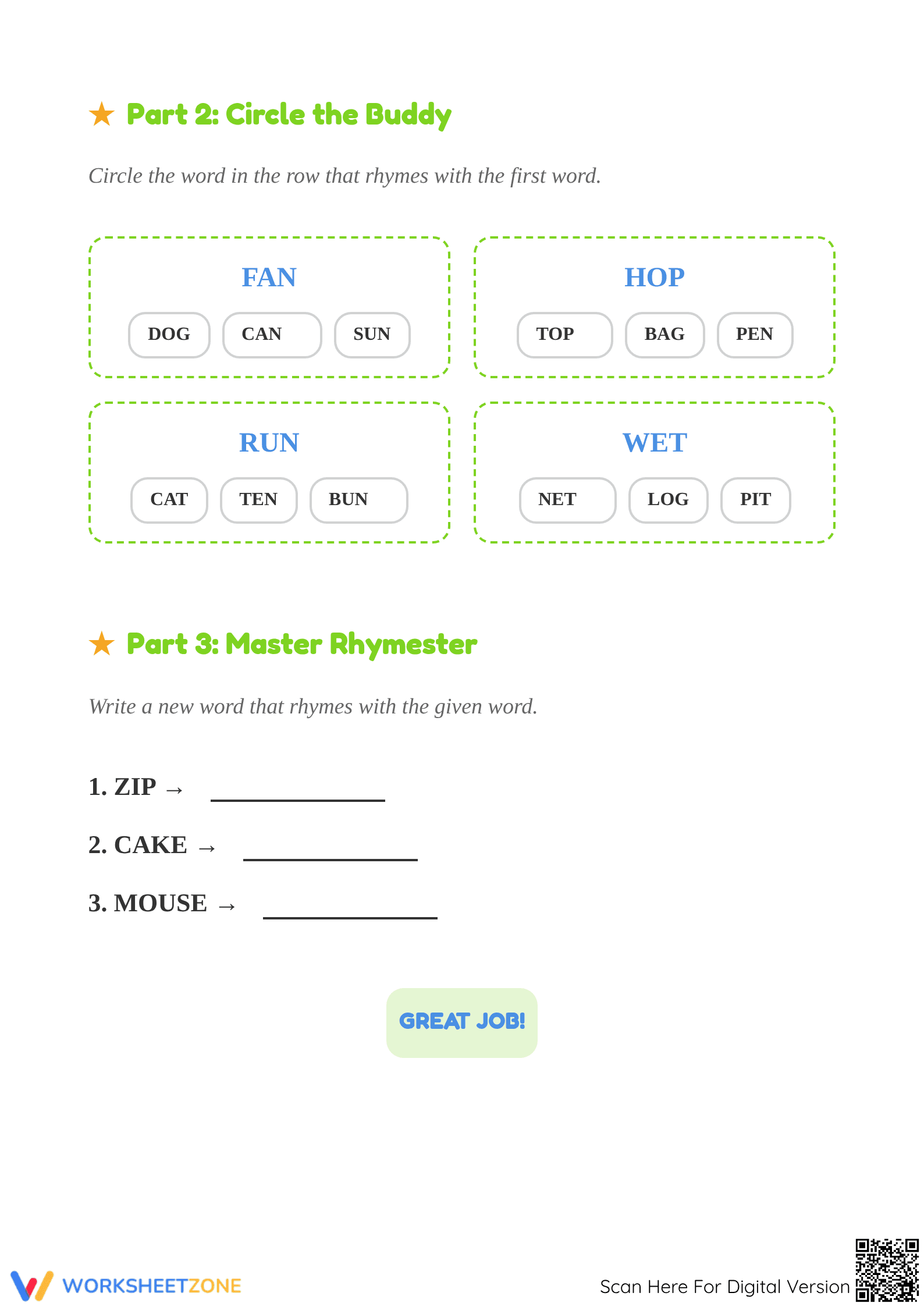
This two-page printable resource features a structured progression of 13 unique tasks. Page one includes a "Rhyme Connection" matching activity with six pairs of high-frequency words such as CAT and HAT or BED and RED. Page two expands on this with a "Circle the Buddy" multiple-choice section and a "Master Rhymester" creative writing component where students must generate their own rhyming words for given prompts like CAKE or MOUSE. A full answer key is included for rapid grading.
Zero-Prep Workflow
This resource is designed to minimize teacher administrative load while maximizing instructional impact. Follow these three simple steps for a successful implementation:
- Print (30 seconds): Download the PDF and print copies for your class or small group.
- Distribute (1 minute): Hand out the sheets along with pencils or crayons for the circling activity.
- Review (30 seconds): Use the provided answer key to check for student understanding or display it for self-correction.
Aligned strictly to CCSS.ELA-LITERACY.RF.K.2.A, this worksheet requires students to demonstrate their ability to "recognize and produce rhyming words." By moving from recognition (matching) to production (writing), it ensures students reach the cognitive depth required by state frameworks. These standard codes can be copied directly into lesson plans, IEP goals, or district curriculum mapping tools.
This worksheet serves as an excellent formative assessment tool. During independent practice, observe if students use onset-rime segmentation to identify matches. We recommend using this as a follow-up to a direct instruction lesson on word families or as a "Ticket out the Door" to gauge mastery. Expect most Kindergarten students to complete the 13 tasks within 15 to 20 minutes.
This resource is optimized for emerging readers in Preschool, Kindergarten, and Grade 1. It provides significant support for English Language Learners (ELLs) by focusing on simple CVC structures. Pair this worksheet with a rhyming picture book or an interactive anchor chart to reinforce the connection between spoken and written rhyming patterns during your literacy block.
The importance of phonemic awareness in early childhood development is well-documented in the RAND AIRS 2024 report, which highlights rhyming as a critical precursor to decoding success. This worksheet targets CCSS.ELA-LITERACY.RF.K.2.A by requiring students to recognize and produce rhyming words through a multi-modal approach of matching, identifying, and independent generation. With 13 distinct tasks across two pages, the resource provides the necessary repetition to move students from auditory recognition to phonetic application. Educational analysis from ScienceDirect suggests that structured practice with rhyming patterns significantly reduces later reading difficulties by sharpening a student's ability to manipulate phonemes. This document is a self-contained instructional asset that provides teachers with immediate data on student mastery levels while requiring zero preparatory time. It remains a printable and interactive solution for modern primary classrooms seeking standards-aligned phonics practice.


