


























Views
Downloads

Recess Expectations Worksheet | Grade 1 Essential
Paste this activity's link or code into your existing LMS (Google Classroom, Canvas, Teams, Schoology, Moodle, etc.).
Students can open and work on the activity right away, with no student login required.
You'll still be able to track student progress and results from your teacher account.
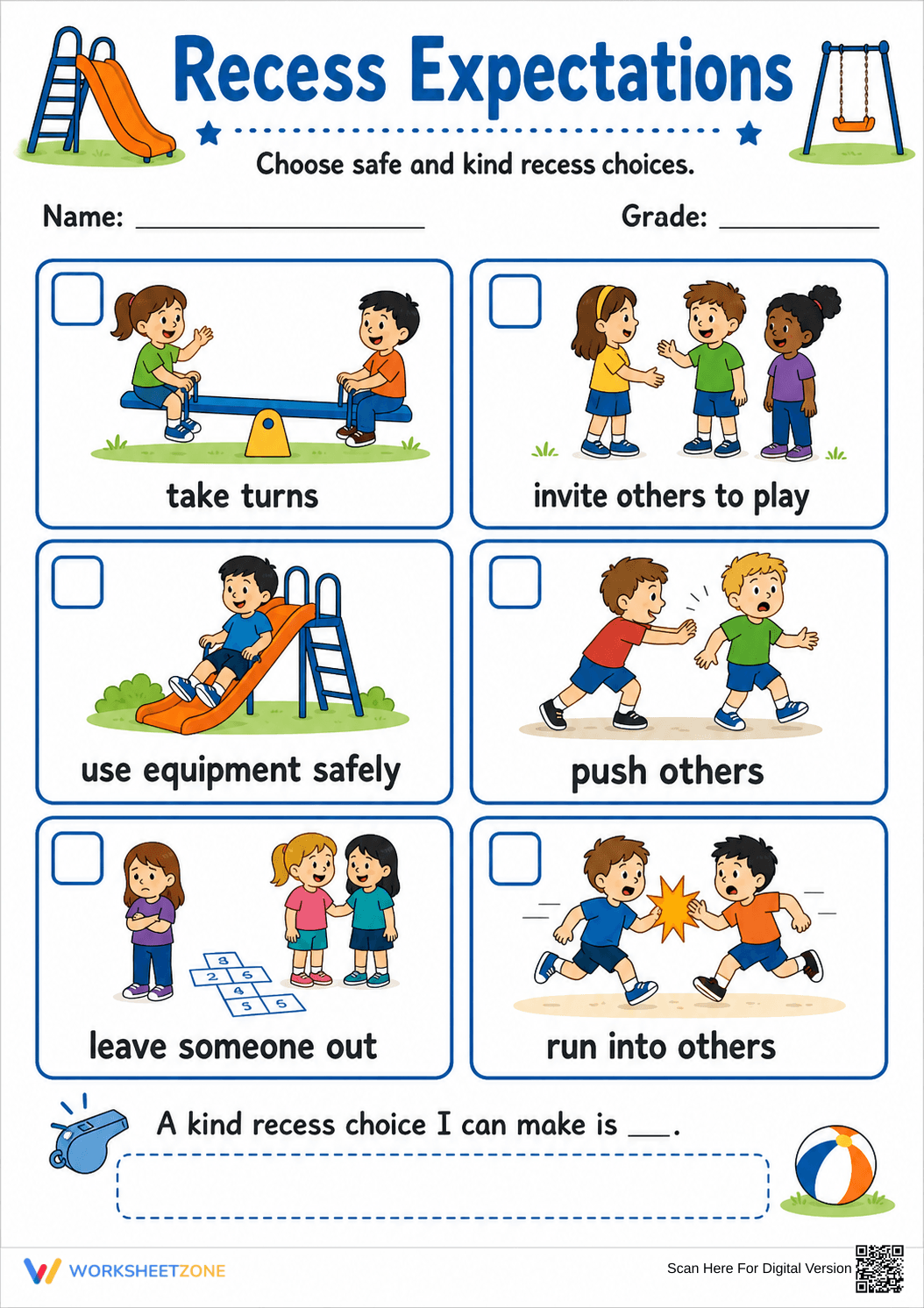
This Recess Expectations worksheet helps early elementary students identify safe and kind playground behaviors through visual discrimination. By evaluating common social scenarios, learners build the foundational self-regulation skills necessary for a positive school climate. It provides a clear framework for discussing playground etiquette before students head outside for play.
At a Glance
- Grade: 1 · Subject: Social Emotional Learning
- Standard:
CCSS.ELA-LITERACY.SL.1.1— Follow agreed-upon rules for social interactions and playground safety- Skill Focus: Playground safety and social expectations
- Format: 1 page · 7 tasks · Answer key included · PDF
- Best For: Morning meeting or pre-recess behavior review
- Time: 10–15 minutes
The single-page PDF features six illustrated scenario cards with checkboxes for student evaluation. It includes positive behaviors like taking turns and inviting others, alongside unsafe actions like pushing or running into peers. A dedicated reflection box at the bottom allows students to internalize a specific kind choice they plan to make during their next break.
Zero-Prep Workflow
- Print: Select the single-page PDF and print enough copies for your cohort in approximately 30 seconds.
- Distribute: Hand out the sheets during a morning meeting or right before the first recess block of the day.
- Review: Use the visual icons to facilitate a 5-minute group discussion on why specific choices are safe or unsafe.
Total teacher preparation time is under 2 minutes, making this an ideal resource for sub plans or emergency behavior resets.
Standards Alignment
This resource aligns with `CCSS.ELA-LITERACY.SL.1.1`, which requires students to follow agreed-upon rules for discussions and social interactions. By identifying and reflecting on behavioral expectations, students demonstrate an understanding of the social norms required for collaborative environments. Both standard codes can be copied directly into lesson plans, IEP goals, or district curriculum mapping tools.
How to Use It
Use this worksheet as a proactive tool after a long break or when playground conflicts increase. It serves as an excellent formative assessment; observe which students struggle to identify unsafe choices to determine who may need additional social skills coaching. Completion typically takes 10 to 15 minutes depending on the depth of the closing reflection and group discussion.
Who It's For
This resource is designed for Kindergarten through 2nd-grade students, including English Language Learners who benefit from the heavy visual support. It pairs naturally with a classroom anchor chart about safe hands or a direct instruction lesson on conflict resolution. It is also suitable for school counselors working with small social-skills groups or Tier 2 behavioral interventions.
Effective behavioral instruction relies on the gradual release of responsibility, where expectations are clearly modeled before independent application. According to Fisher & Frey (2014), providing students with visual scaffolds and opportunities for written reflection reinforces the "You Do" phase of learning, ensuring that social norms transition from teacher-led directives to internalized student habits. This worksheet addresses CCSS.ELA-LITERACY.SL.1.1 by asking students to evaluate social interactions through a safety lens. Research indicates that explicit instruction in playground expectations significantly reduces disciplinary referrals and increases inclusive play. By utilizing these 7 structured tasks, educators provide a concrete reference point for students to return to throughout the school year. This approach ensures that the plain-English skill of following social rules is practiced in a low-stakes, high-engagement format that supports long-term behavioral mastery and classroom community health.


