


























Views
Downloads


Ready US Presidents Word Search | Grades 5–6 Social Studies
Paste this activity's link or code into your existing LMS (Google Classroom, Canvas, Teams, Schoology, Moodle, etc.).
Students can open and work on the activity right away, with no student login required.
You'll still be able to track student progress and results from your teacher account.
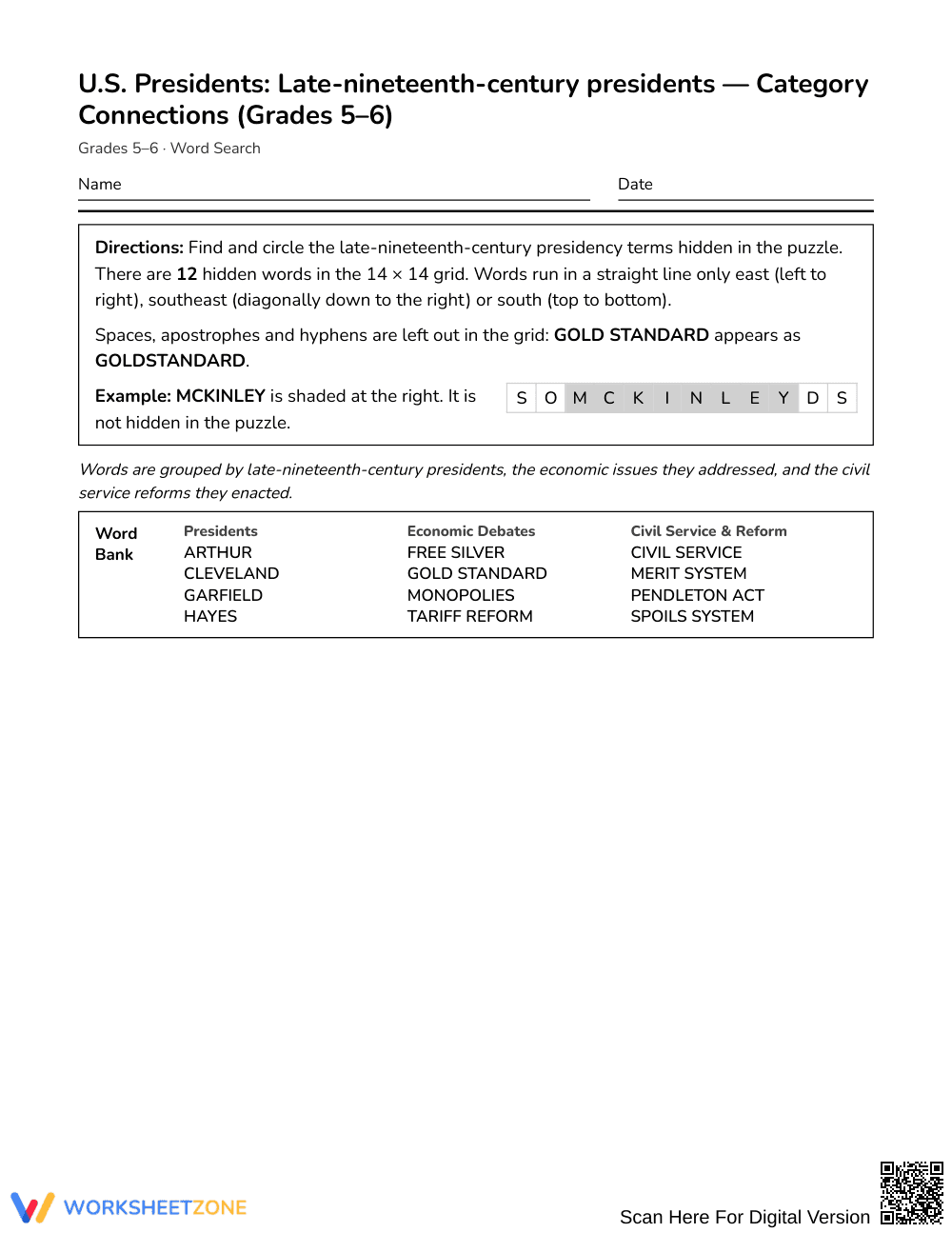
This Grades 5–6 Social Studies word search reinforces knowledge of late-nineteenth-century presidents and pivotal Gilded Age policies. Students identify 12 essential historical terms organized by thematic categories, strengthening content-area vocabulary, spelling accuracy, and historical literacy. The engaging puzzle format builds background knowledge before deeper historical inquiry, helping intermediate learners connect key presidential leaders with their defining economic and political reforms.
At a Glance
- Grade: Grades 5–6 · Subject: Social Studies
- Standard: Not standards-assessed — vocabulary enrichment for historical literacy
- Skill Focus: Late-nineteenth-century presidents, economic debates, and civil service reforms
- Format: 2 pages · 12 hidden words · Full 3-page answer key included · PDF
- Best For: Independent vocabulary review, sub plans, and lesson warm-ups
- Time: 15–25 minutes
What's Inside
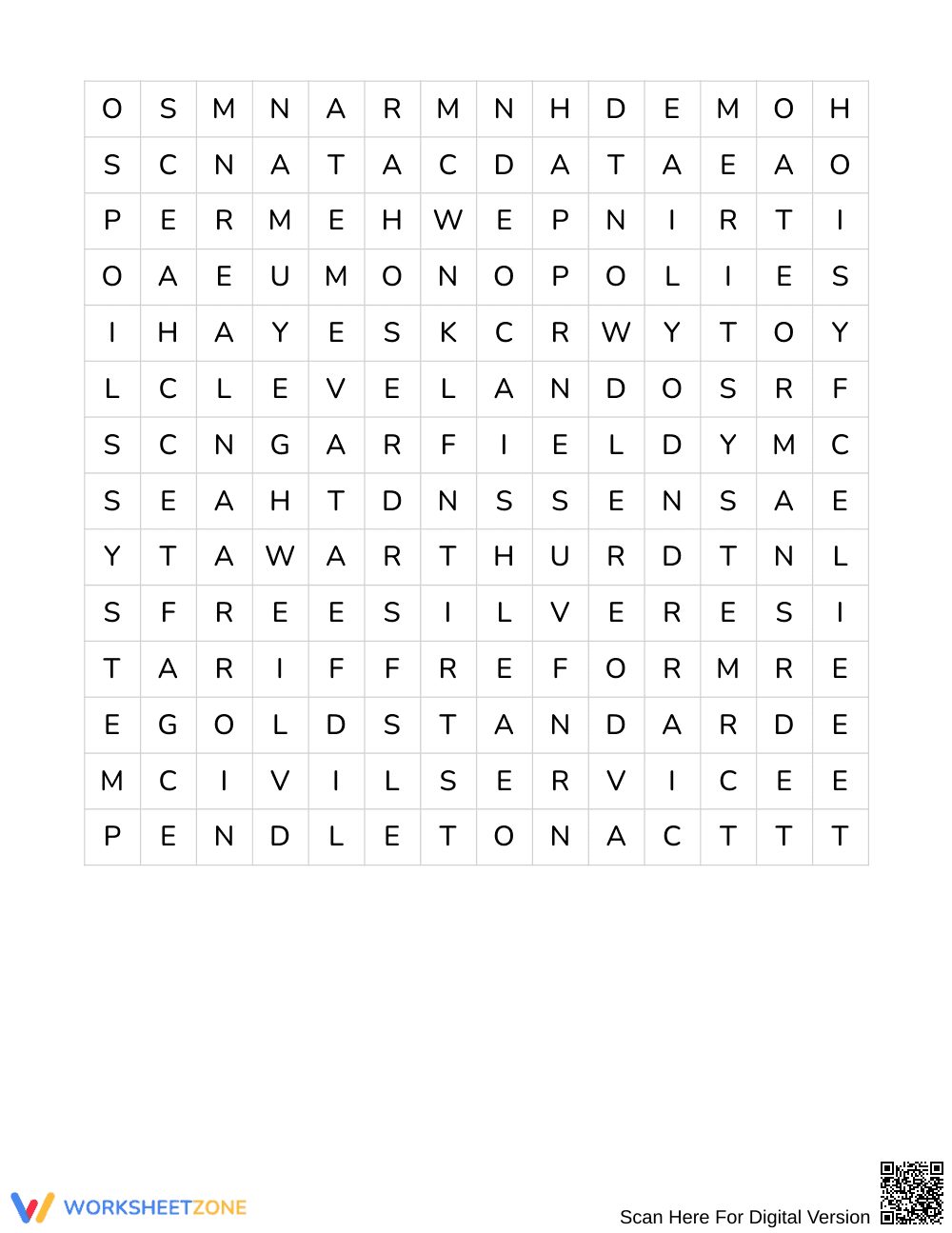
This 2-page print-and-go activity features 12 content-rich vocabulary terms centered on late-nineteenth-century American politics. Instead of an alphabetized list, the word bank arranges terms into three conceptual categories: executive leaders, economic debates, and civil service reforms. A comprehensive 3-page answer key highlights every hidden term within the letter matrix, allowing quick grading or student-led self-checking.
Puzzle Structure and Mechanics
The puzzle is built around an accessible 14 × 14 letter grid configured specifically for upper-elementary and early middle school students. Hidden vocabulary terms run in three predictable directions: East (left-to-right), South (top-to-bottom), and Southeast (diagonal downward). By omitting reverse and upward orientations, the layout maintains a manageable challenge level that prevents visual frustration while encouraging sustained engagement with historical terminology.
Standards Alignment
This social studies activity serves as supplemental vocabulary enrichment and is not aligned to an assessed state standard. It provides foundational terminology support for fifth- and sixth-grade U.S. history units covering post-Reconstruction America, the Gilded Age, and the development of modern federal governance.
How to Use It
Use this word search as an introductory warm-up before launching a unit on Gilded Age politics, activating schema around early reform movements. Alternatively, assign it after direct instruction to consolidate key names and policies during independent work. For formative assessment, observe which category of terms students locate first to gauge familiarity, and expect completion within 15 to 25 minutes.
Who It's For
This activity is designed for Grades 5–6 learners developing social studies academic vocabulary. It offers low-stakes, accessible practice for diverse classrooms, including English learners building historical terminology. Pair this word search with a post-Reconstruction presidential timeline or a biographical anchor chart highlighting Hayes, Garfield, Arthur, and Cleveland.
According to Fisher & Frey (2014), intentional content-area vocabulary instruction plays a pivotal role in disciplinary literacy by establishing the background schema students require for advanced reading comprehension. This Grades 5–6 Social Studies activity strengthens familiarity with late-nineteenth-century presidents and late-1800s civic vocabulary through structured word identification. By encountering foundational concepts—such as civil service reform, the merit system, the gold standard, and executive leadership under Hayes, Garfield, Arthur, and Cleveland—students solidify mental connections between historical figures and their policy initiatives. Although designed for supplemental enrichment rather than formal standard-based testing, targeted vocabulary exposure provides the conceptual scaffolding necessary for interpreting complex informational texts and primary sources. Engaging with domain-specific terms in an organized thematic format reduces cognitive load during introductory historical inquiries, ensuring intermediate learners develop the academic fluency needed to participate in meaningful historical analysis and classroom discussions.


