





























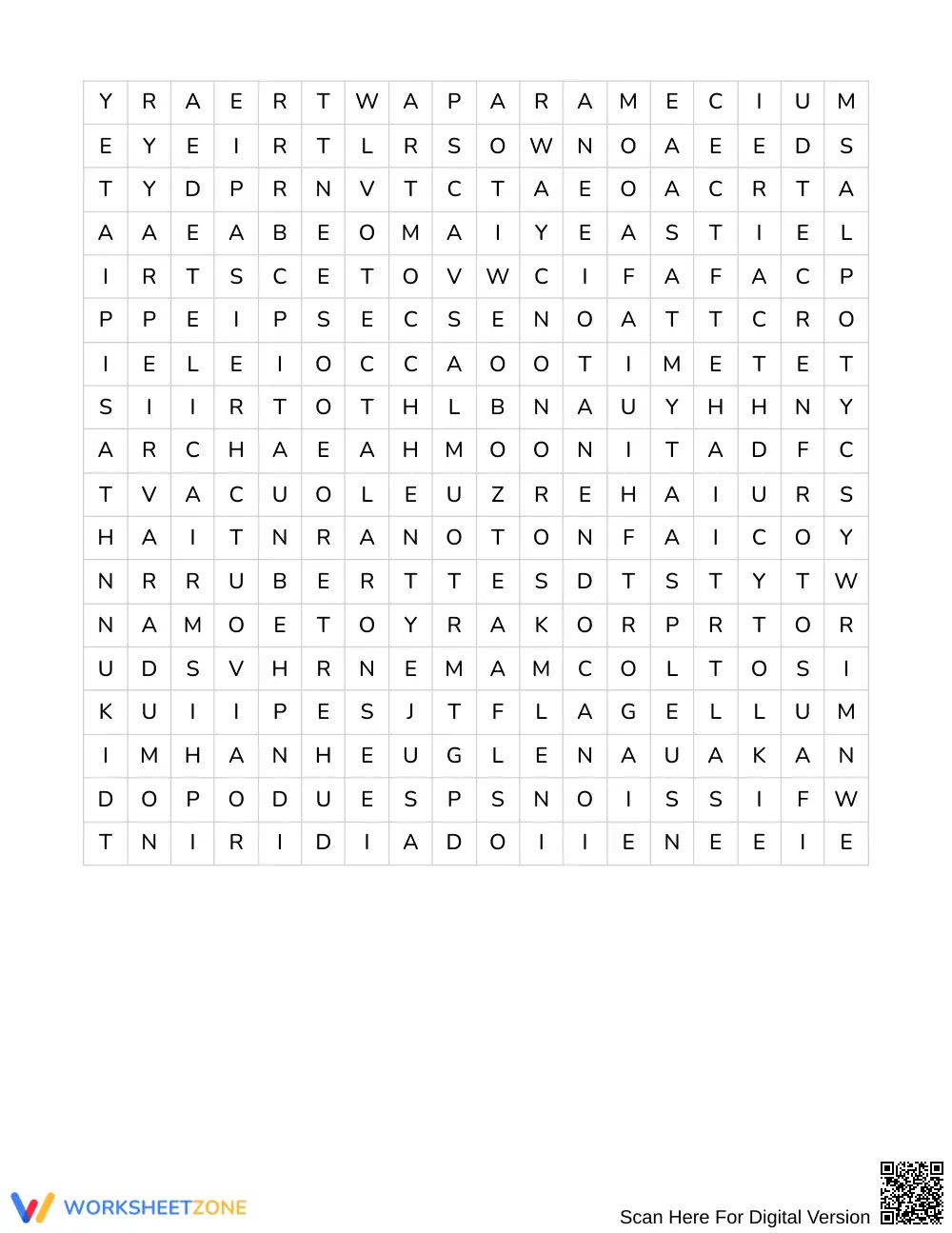


Ready Unicellular Organisms Word Search | Grades 6–7 Science

Paste this activity's link or code into your existing LMS (Google Classroom, Canvas, Teams, Schoology, Moodle, etc.).
Students can open and work on the activity right away, with no student login required.
You'll still be able to track student progress and results from your teacher account.
This Grades 6–7 science word search reinforces foundational knowledge of unicellular organisms by combining biological clue retrieval with focused vocabulary identification. Students analyze 16 descriptive clues detailing single-celled microbes, specialized organelles, and locomotion methods, identifying key life science terms before locating them within an intricate puzzle grid to solidify core cell terminology.
At a Glance
- Grade: Grades 6–7 · Subject: Middle School Science
- Standard: Not standards-assessed — vocabulary enrichment
- Skill Focus: Unicellular organisms, protist locomotion, cellular structures, and microbial classification
- Format: 3 pages · 16 words · Full teacher answer key included · PDF
- Best For: Cell biology vocabulary reinforcement and sub plans
- Time: 25–35 minutes of active clue reading and word search completion
What's Inside
This 3-page printable science resource features an 18-by-18 letter grid containing 16 hidden biology terms paired with detailed scientific clues rather than a standard word list. Students must read each clue to deduce the target term before locating it. A complete 3-page teacher answer key provides full solution grids displaying word placements for efficient grading.
Puzzle Mechanics and Structure
This word search operates as a no-bank challenge designed to deepen cognitive engagement with cell terminology. Instead of scanning for familiar letter strings from a list, learners deduce 16 vocabulary terms from descriptive definitions. Target words are hidden across an 18-by-18 letter grid running in all 8 compass directions: north, northeast, east, southeast, south, southwest, west, and northwest.
Standards Alignment
This activity provides targeted vocabulary enrichment and is not aligned to a formal standard. It supplements middle school life science units on cell structure and function by deepening conceptual familiarity with single-celled life forms, protist anatomy, and microbial reproduction without the constraints of standardized testing rubrics.
How to Use It
Deploy this word search during or immediately after direct instruction on single-celled organisms to solidify scientific vocabulary. As a formative assessment check, observe whether students can identify the correct terms directly from clues like locomotion structures or cellular organelles before searching the grid. The activity also serves as an effective, self-contained lesson for substitute plans, taking 25 to 35 minutes to complete.
Who It's For
This puzzle is crafted for Grades 6–7 life science students exploring cell theory and microscopic life. For differentiated support, emerging readers can work in pairs or use an introductory textbook glossary, while advanced learners complete the no-bank challenge independently. It pairs naturally with pond-water microscopy labs or cell structure anchor charts.
Vocabulary acquisition in secondary science requires deliberate opportunities to connect domain-specific definitions with precise biological nomenclature. According to Fisher & Frey (2014), intentional word exposure through contextual clues and interactive retrieval tasks significantly strengthens conceptual retention in middle school content classrooms. This Grades 6–7 unicellular organisms word search operationalizes that principle by replacing passive word matching with active clue interpretation. Rather than scanning for arbitrary letter combinations, students analyze functional descriptions of 16 critical terms, including specialized organelles, protist locomotion structures, and microbial classifications, before locating them within an 18-by-18 grid. This dual-step process demands authentic semantic retrieval, bridging the gap between passive recognition and active scientific literacy. The puzzle provides targeted vocabulary enrichment for cell biology units, reinforcing how single-celled life forms survive, feed, and reproduce, while giving educators a structured tool to evaluate vocabulary mastery in general life science curricula.


