




























Views
Downloads

Ready Trait Expression Word Search | Grades 10–12 Science

Paste this activity's link or code into your existing LMS (Google Classroom, Canvas, Teams, Schoology, Moodle, etc.).
Students can open and work on the activity right away, with no student login required.
You'll still be able to track student progress and results from your teacher account.
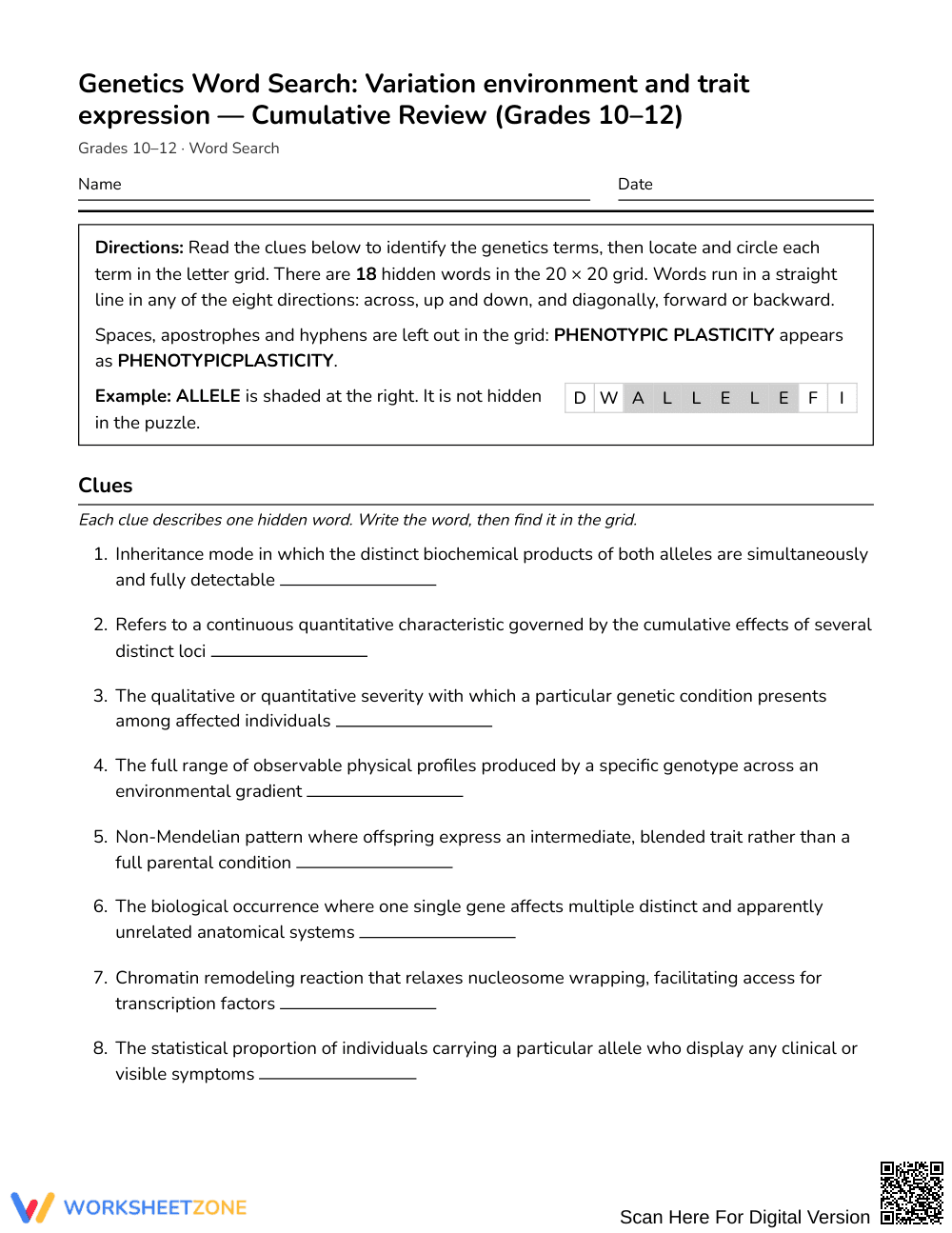
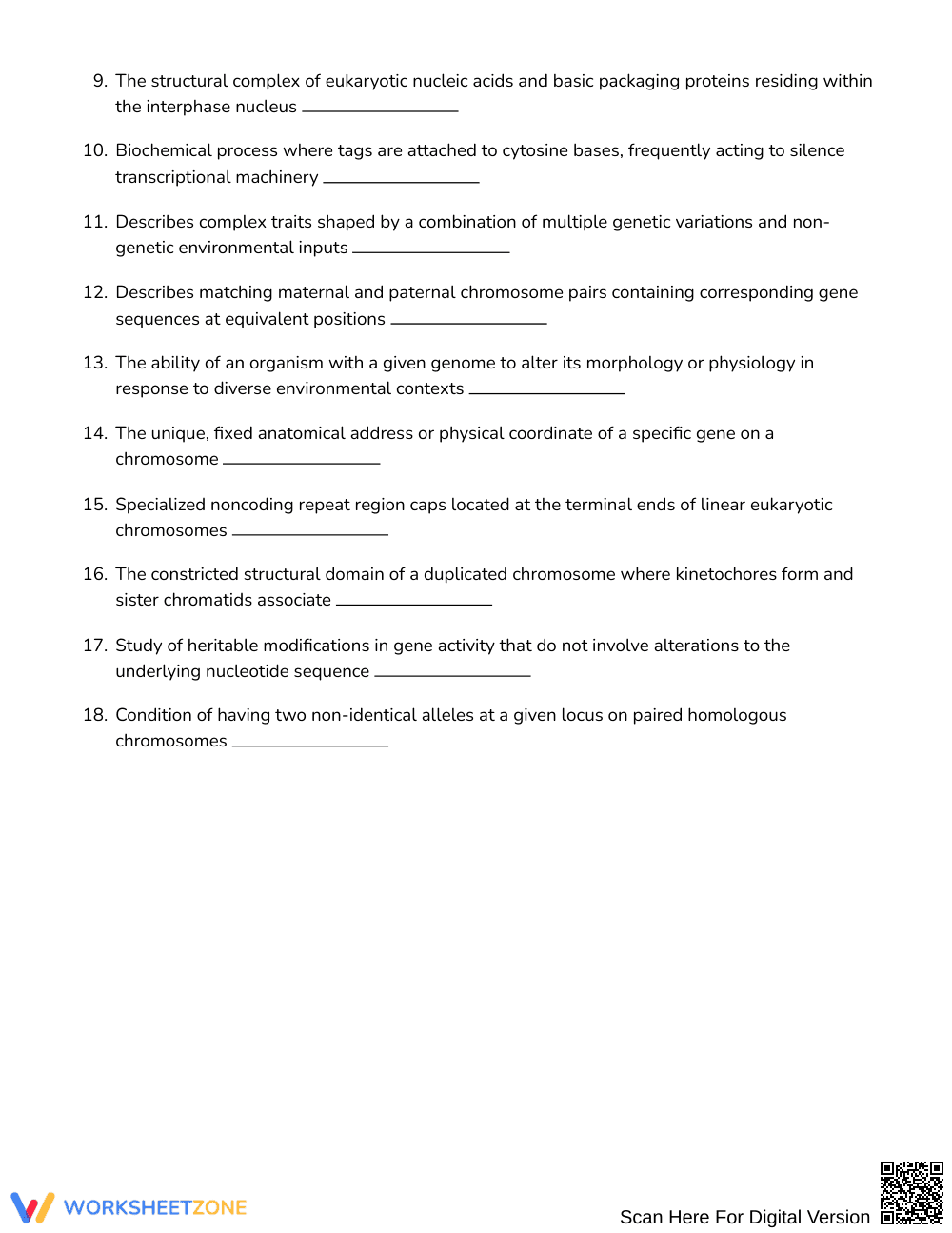
This genetics word search reinforces variation, environment, and trait expression vocabulary for high school science students. Learners identify and locate 18 advanced terms spanning gene-environment interactions, chromosomal structure, and non-Mendelian inheritance patterns. Clue definitions guide students to connect precise biological meanings to key terminology before locating each hidden term across the puzzle grid.
At a Glance
- Grade: Grades 10–12 · Subject: High School Science
- Standard: Not standards-assessed — vocabulary enrichment for genetics
- Skill Focus: Variation, environment, and trait expression terminology
- Format: 3 printable pages · 18 hidden words · Full answer key · PDF
- Best For: Cumulative unit review, fast finishers, and vocabulary retention
- Time: 25–35 instructional minutes
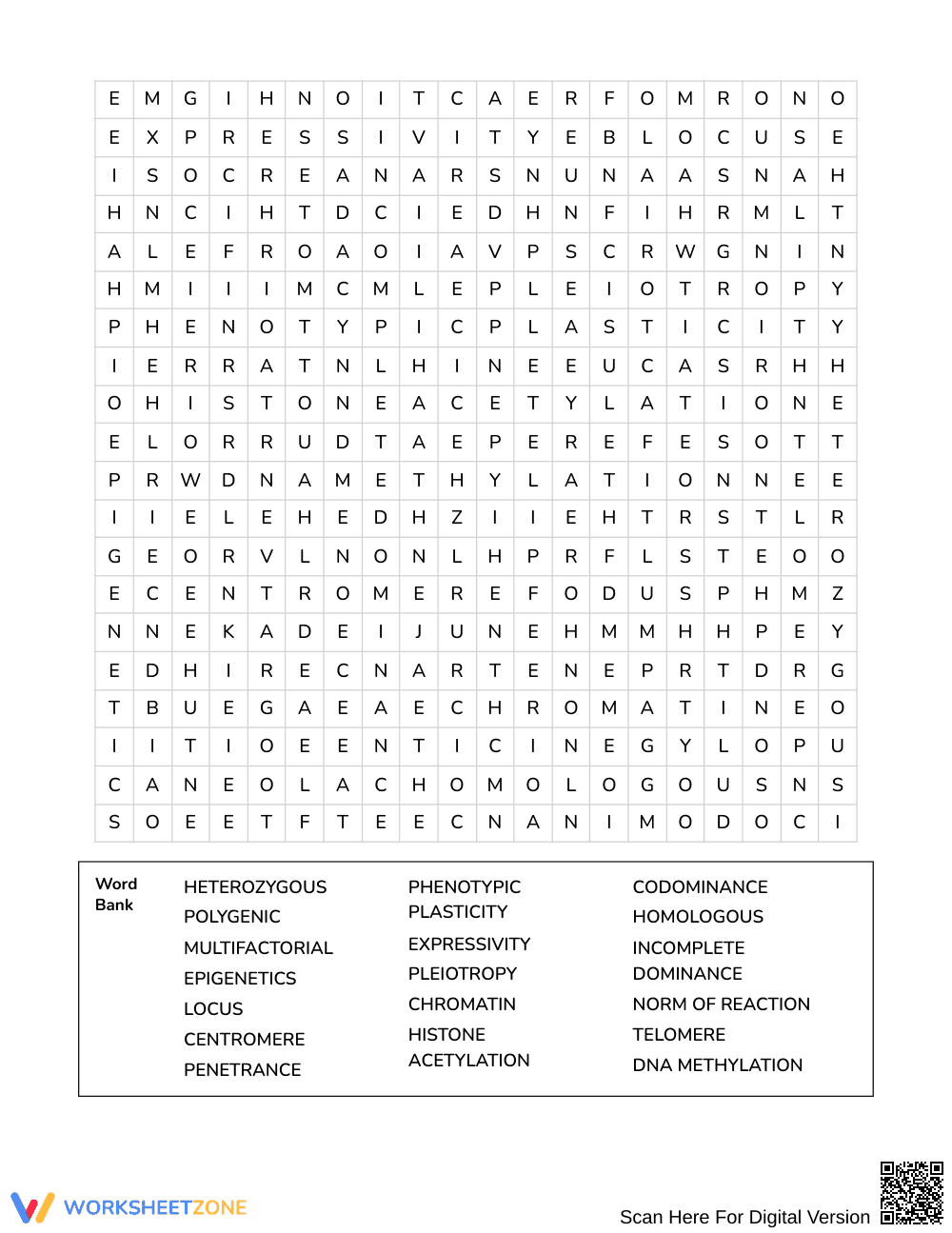
This 3-page printable science resource contains a puzzle worksheet accompanied by a 4-page answer key showing completed word placements. Rather than relying on simple visual scanning, the activity pairs an 18-word shuffled bank with rigorous biological clues. Students read descriptions of mechanisms like DNA methylation and phenotypic plasticity, determine the target vocabulary term, and then trace it through the grid.
Puzzle Structure and Mechanics
The activity features a 20 x 20 letter grid designed to engage high school biology learners. Hidden terms run across all eight compass directions: north, northeast, east, southeast, south, southwest, west, and northwest. To find each of the 18 words, students solve clue descriptions, reference the shuffled word bank, and locate overlapping letter paths across horizontal, vertical, and diagonal lines.
Standards Alignment
This word search serves as vocabulary enrichment and is not aligned to a specific standard. It reinforces foundational scientific terminology, supports disciplinary literacy, and strengthens conceptual understanding of gene-environment interactions across secondary biology courses.
How to Use It
This activity fits two instructional moments. First, assign it as a post-instruction review following lessons on epigenetics to consolidate academic terms before summative exams. Second, use it as a collaborative partner challenge where students discuss clue definitions before searching the puzzle. During work time, observe whether students identify terms from memory or rely solely on scanning the letter grid. Expected completion time is 25 to 35 minutes.
Who It's For
This resource is designed for Grades 10–12 biology and genetics students learning complex molecular terminology. For differentiated support, pair developing readers with an anatomical chromosome diagram, or challenge advanced students to write original sentences explaining how factors like histone acetylation influence gene expression.
Mastery of advanced scientific concepts requires deliberate instruction in disciplinary literacy and technical vocabulary. As highlighted by Fisher & Frey (2014), domain-specific vocabulary acquisition functions as a primary lever for reading comprehension and conceptual development in secondary science classrooms. Providing structured retrieval tasks that pair rigorous conceptual definitions with term recognition encourages active cognitive processing rather than passive memorization. This Grades 10–12 genetics resource addresses vocabulary enrichment in variation, environment, and trait expression, requiring learners to analyze multi-sentence biological clues before locating 18 core terms within a 20 x 20 puzzle grid. By engaging with complex terminology such as histone acetylation, phenotypic plasticity, and incomplete dominance in multiple formats, high school students bridge the gap between abstract molecular mechanisms and precise academic language. Integrating clue-driven vocabulary tasks into regular unit reviews systematically builds the foundational literacy necessary for advanced inquiry and scientific reasoning.


