
































Ready Syntax & Stance Worksheet | Grade 11 English III

Paste this activity's link or code into your existing LMS (Google Classroom, Canvas, Teams, Schoology, Moodle, etc.).
Students can open and work on the activity right away, with no student login required.
You'll still be able to track student progress and results from your teacher account.
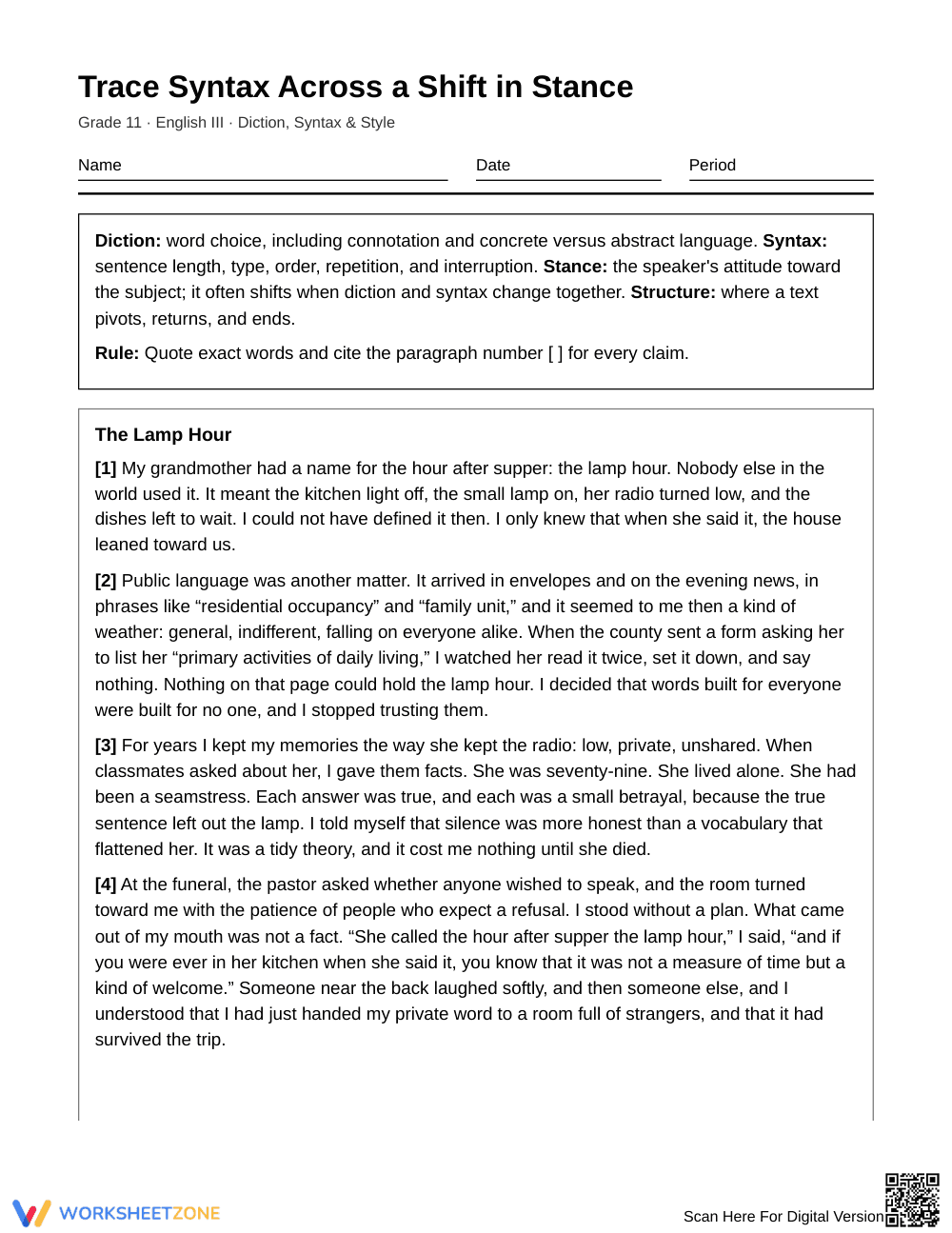
This worksheet teaches Grade 11 students to trace how syntax and diction change across a shift in stance in a personal essay. Students quote exact words, cite paragraph numbers, and explain how sentence structure and word choice together show a narrator moving from guarded distrust to qualified acceptance.
At a Glance
- Grade: 11 · Subject: English III
- Standard:
Not assigned— Quote exact words and explain how sentence structure and word choice reveal a shift- Skill Focus: Tracing syntax across a shift in stance
- Format: 6 pages · 10 problems · Answer key included · PDF
- Best For: Close-reading practice in style units
- Time: 45–60 minutes
What's Inside
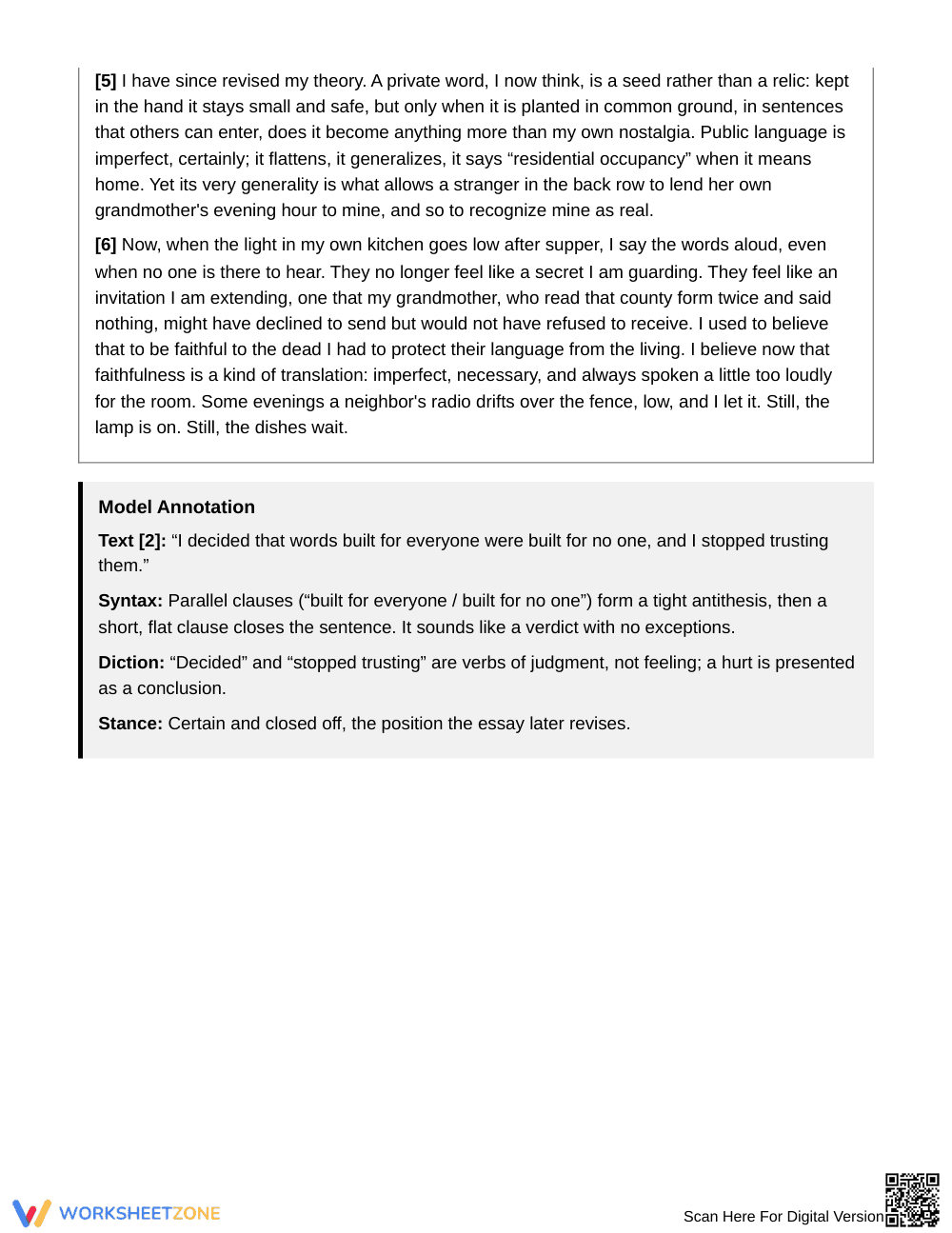
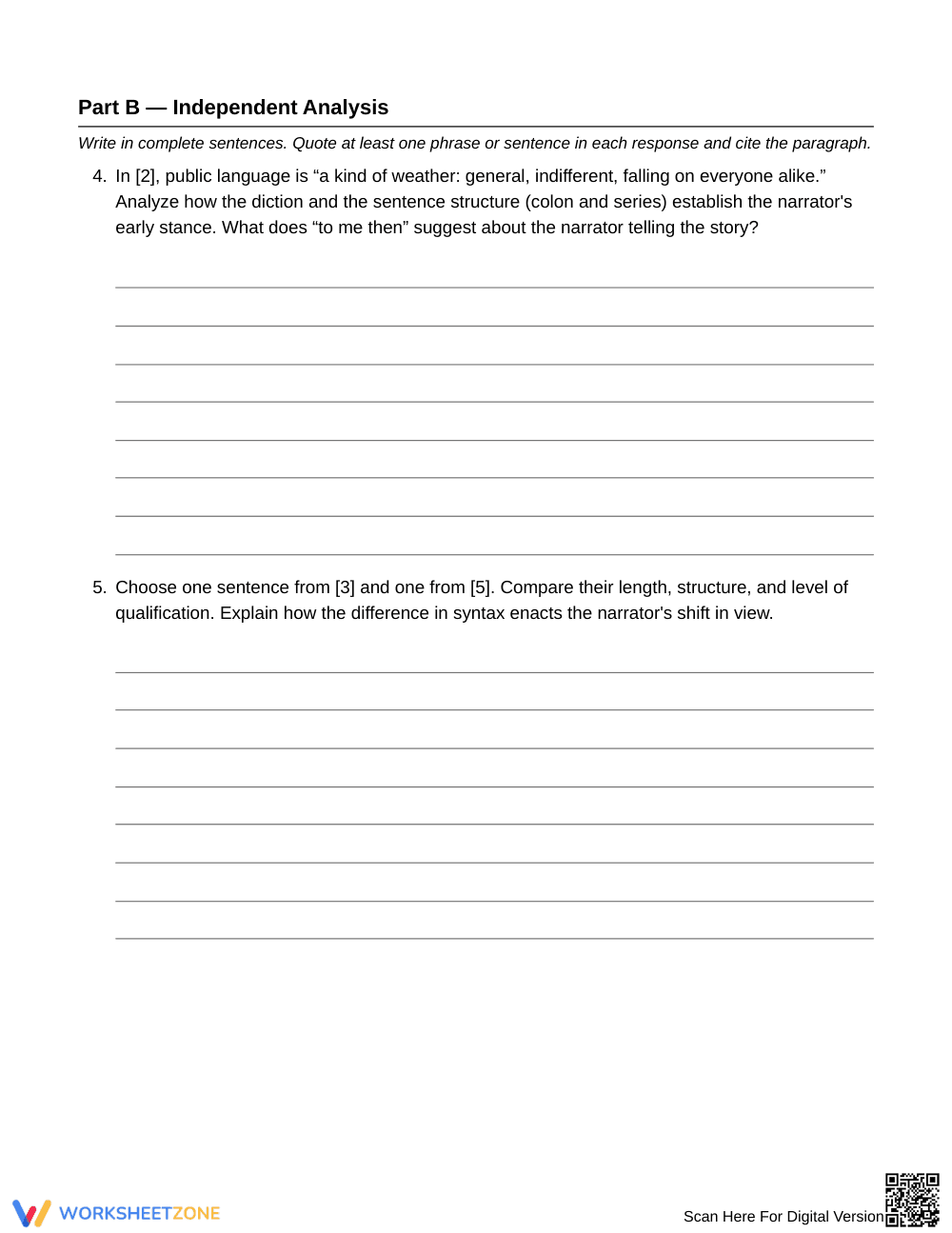
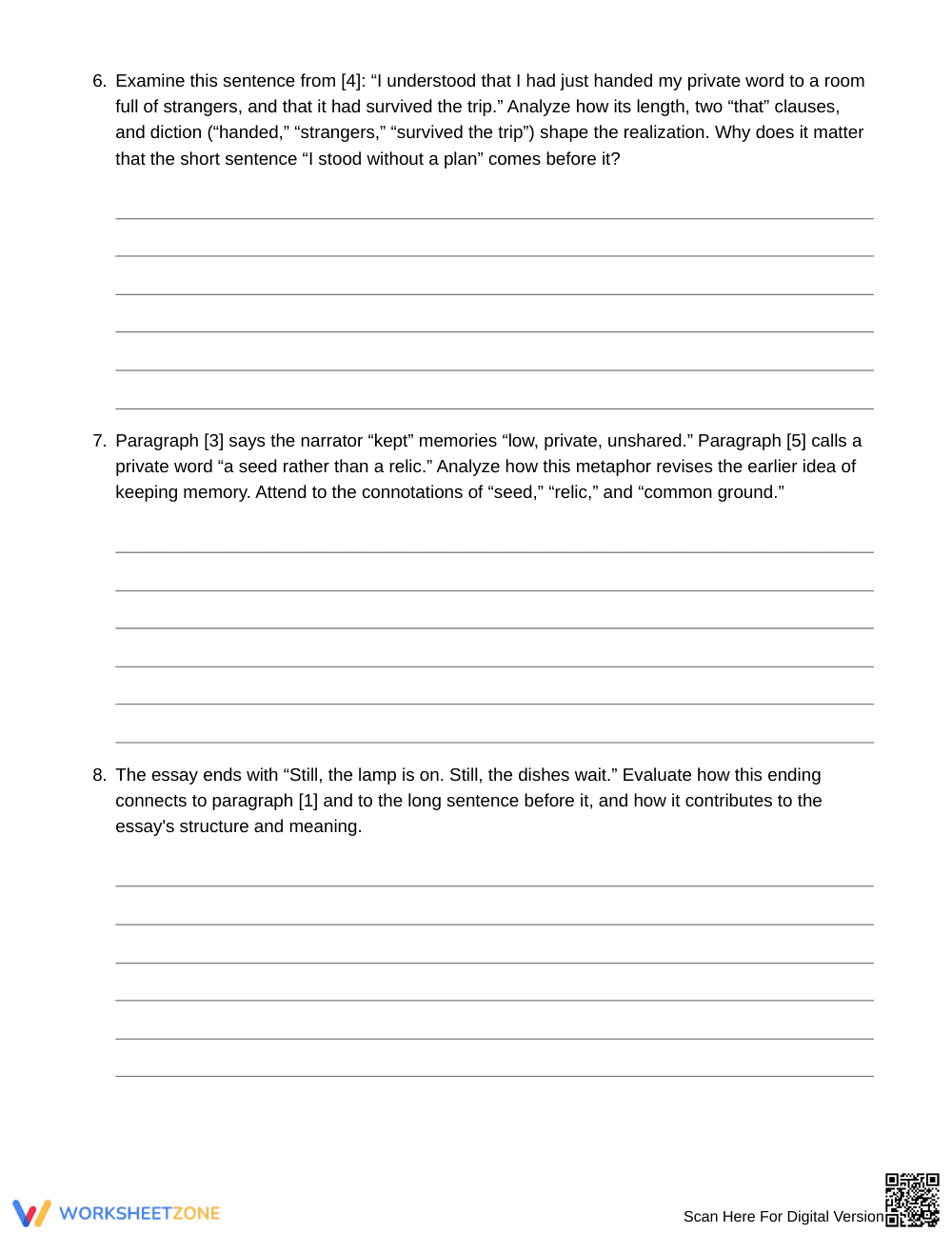
Students read “The Lamp Hour,” a six-paragraph personal essay, then study a model annotation of one sentence. Part A offers sentence frames across 3 tasks, Part B poses 5 open-response analyses, and Part C closes with 2 multiple-choice interpretation checks that require cited evidence. A 3-page answer key is included.
Skill Progression
- Guided practice: Part A, 3 tasks with sentence frames and a model annotation to follow.
- Supported practice: Part C, 2 tasks where answer choices narrow the claim and students still cite evidence.
- Independent practice: Part B, 5 open-response tasks with no frames.
The sequence follows gradual release: I Do (model annotation), We Do (frames), You Do (open analysis). Assign Part C before Part B for more support.
Standards Alignment
No standard code was supplied for this worksheet. It targets the close-reading skill of analyzing how an author's syntax and diction shape meaning and attitude, and how structure marks a pivot. Add the code your district uses when copying it into lesson plans, IEP goals, or curriculum mapping tools.
How to Use It
Use it after direct instruction on diction and syntax: students complete Part A in pairs while you check that quotations are exact and paragraph numbers are cited. Or assign Parts B and C as a post-reading assessment. As you circulate, note which students name syntax features but skip the link to stance. Expect 45–60 minutes.
Who It's For
Built for Grade 11 English III students practicing rhetorical analysis. Students who need support can stay with the Part A frames and the model annotation; advanced students can write Part B in full. Pair it with a mini-lesson on concessive sentences.
In “Trace Syntax Across a Shift in Stance,” Grade 11 English III students analyze how sentence length, structure, and word choice change as a narrator's attitude moves from guarded distrust of public language to qualified acceptance. The 10-task worksheet requires exact quotations and paragraph citations, which keeps claims tied to evidence. Its design reflects Fisher & Frey (2014), who describe gradual release of responsibility as a movement from modeled thinking to guided and then independent practice. Students first study a model annotation, then complete sentence frames, then write open analyses and defend multiple-choice interpretations with textual proof. The worksheet runs 6 pages with an answer key, and fits a 45–60 minute class period within a unit on diction, syntax, and style. No standard code was supplied, so teachers can attach their own.


