




























Ready Seasonal Daylight Word Search | Grades 6–7 Science
Paste this activity's link or code into your existing LMS (Google Classroom, Canvas, Teams, Schoology, Moodle, etc.).
Students can open and work on the activity right away, with no student login required.
You'll still be able to track student progress and results from your teacher account.
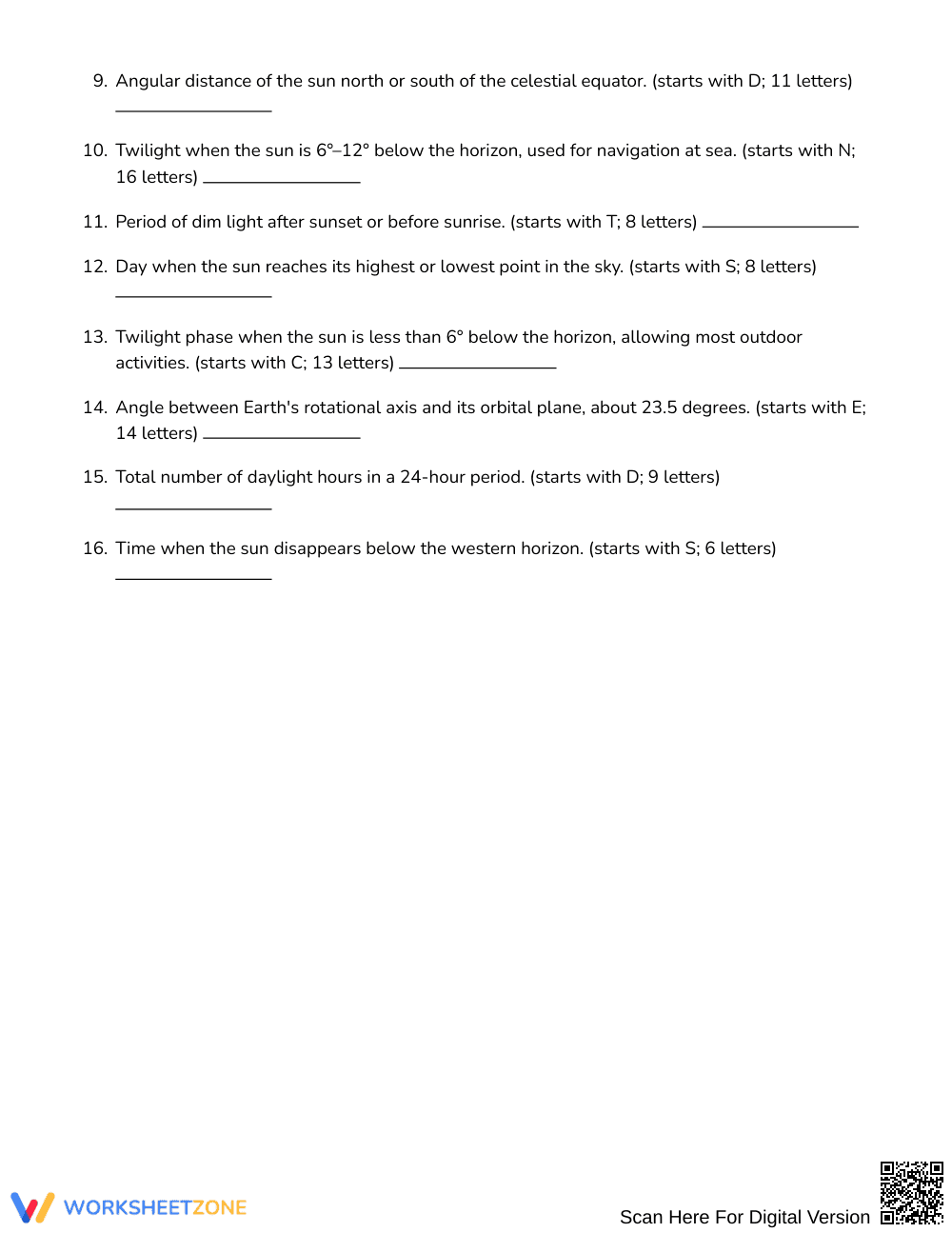
This Grades 6–7 Earth science word search reinforces vocabulary related to seasonal daylight changes, Earth's axial tilt, and orbital revolution. Students apply observational astronomy concepts by reading 16 descriptive clues, determining the correct scientific terms, and locating each word in an expansive letter grid to strengthen domain-specific academic vocabulary.
At a Glance
- Grade: Grades 6–7 · Subject: Science
- Standard: Not standards-assessed — vocabulary enrichment
- Skill Focus: Seasonal daylight changes and orbital mechanics vocabulary
- Format: 3 printable pages · 16 hidden words · Full answer key included · PDF document
- Best For: Earth science unit vocabulary review and fast-finisher enrichment
- Time: 20–30 minutes
What's Inside
This 3-page science resource features an 18-by-18 puzzle grid with 16 hidden vocabulary terms covering daylight cycles and orbital motion. Rather than a standard word bank, it provides 16 definition clues requiring students to deduce terms like equinox, solstice, and photoperiod before finding them. A complete 3-page answer key provides clear solution grids highlighting word placements.
Puzzle Mechanics and Structure
The activity uses an 18-by-18 letter grid built to engage middle school learners without visual clutter. Words run in all 8 compass directions: north, northeast, east, southeast, south, southwest, west, and northwest, including diagonal and reverse placements. Because of the no-bank challenge format, students read scientific descriptions—such as Earth's axial tilt angle, nautical twilight, perihelion, and aphelion—to deduce target words before searching the letter grid.
Standards Alignment
This resource serves as targeted vocabulary enrichment and is not aligned to a formal performance expectation standard. It is designed to reinforce essential domain-specific terminology that supports broader middle school astronomy and Earth science curricula covering planetary motion, seasonal cycles, and solar illumination.
How to Use It
This word search serves as a mid-unit vocabulary check or a post-instruction review after teaching Earth's rotation and revolution. Teachers can assign it as an independent warm-up, partner practice, or an easy sub plan. During the activity, check whether students deduce terms from definitions or need a glossary for concepts like declination. Most learners complete the search within 20 to 30 minutes.
Who It's For
This activity is designed for Grades 6–7 students in Earth and space science. For students needing support, teachers can provide a textbook glossary for specialized terms. It pairs naturally with direct instruction lessons on Earth's 23.5-degree axial tilt and models exploring seasonal variations in day length.
Domain-specific vocabulary acquisition is fundamental to conceptual understanding in middle school Earth and space science, particularly when students examine seasonal daylight changes, solar declination, and orbital mechanics. According to Fisher & Frey (2014), purposeful word-learning routines that pair technical definitions with active retrieval help adolescent learners anchor complex scientific phenomena into long-term memory. While this puzzle serves as vocabulary enrichment rather than an assessment tied to an individual standard code, identifying 16 key terms within an 18-by-18 matrix demands sustained semantic processing. Students must actively evaluate descriptive clues regarding Earth's axial tilt, solstices, twilight phases, and photoperiods before locating terms across eight directional axes. This dual-task retrieval process reinforces scientific literacy, strengthens contextual term recognition, and supports instructional units exploring how planetary revolution drives predictable seasonal illumination patterns and day length variations across different global latitudes throughout the year.


