





























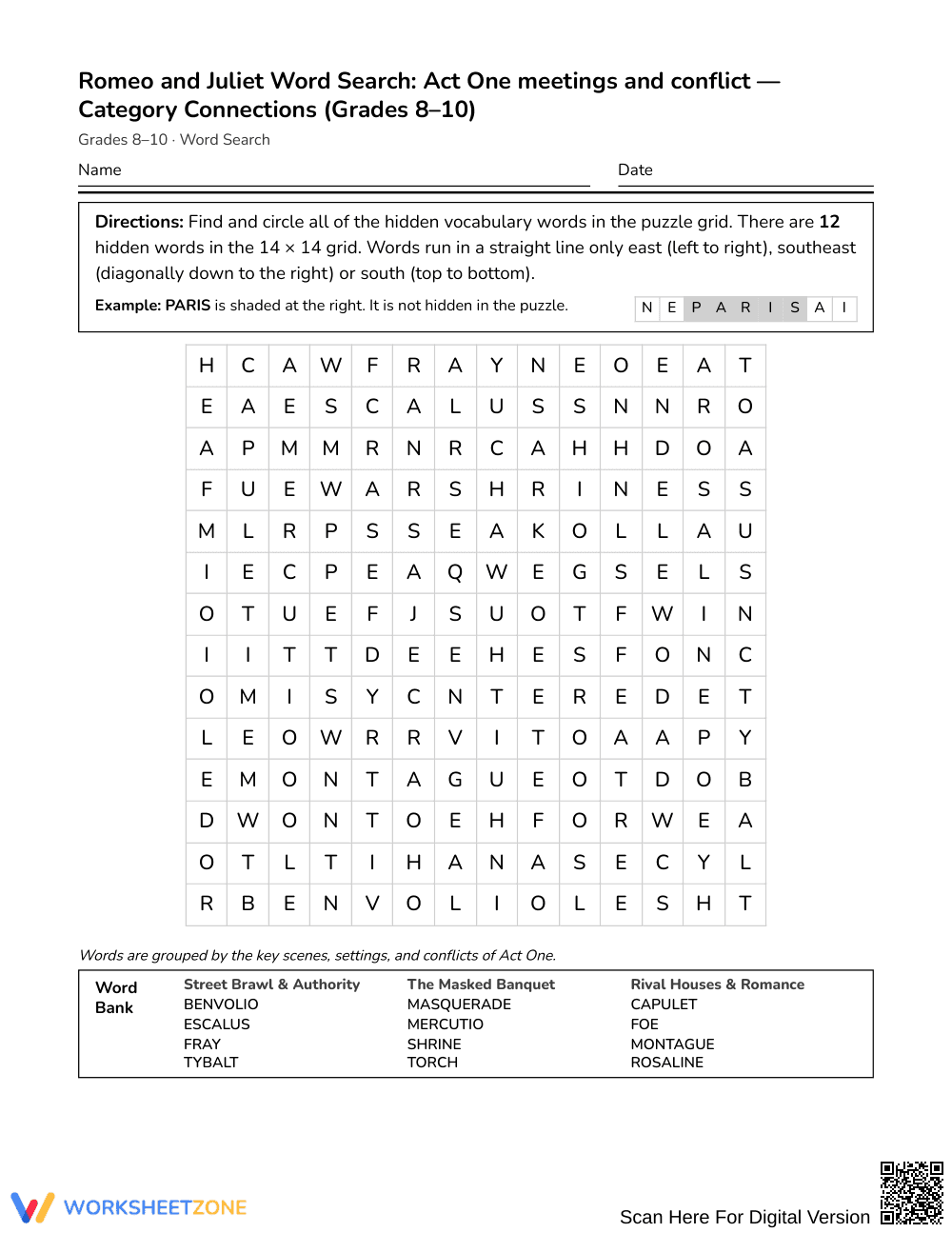


Ready Romeo & Juliet Act 1 Word Search | Grades 8–10 ELA

Paste this activity's link or code into your existing LMS (Google Classroom, Canvas, Teams, Schoology, Moodle, etc.).
Students can open and work on the activity right away, with no student login required.
You'll still be able to track student progress and results from your teacher account.
This Grades 8–10 English Language Arts word search builds recognition of pivotal characters, settings, and tensions across Act One of William Shakespeare's Romeo and Juliet. By locating 12 targeted terms, students reinforce key plot points and character motivations, establishing an accessible foundation for deeper dramatic analysis and class discussion.
At a Glance
- Grade: Grades 8–10 secondary students · Subject: English Language Arts (ELA)
- Standard: Not standards-assessed — vocabulary enrichment
- Skill Focus: Act One character relationships, thematic motifs, and dramatic conflict
- Format: 1 printable page · 12 hidden words · 3-page answer key · PDF
- Best For: Introductory drama review, literacy centers, and sub plans
- Time: 15–25 minutes of active classroom engagement
What's Inside
This resource features a 1-page puzzle sheet accompanied by a 3-page answer key. The activity organizes 12 vocabulary terms into three thematic categories: Street Brawl & Authority, The Masked Banquet, and Rival Houses & Romance. Students encounter key dramatic figures including Prince Escalus, Tybalt, and Mercutio. The comprehensive 3-page answer key provides full solution grids for rapid teacher verification.
How the Puzzle Works
Students locate terms placed across a 14 x 14 letter grid. Hidden words run in three specific directions: East (horizontal), Southeast (diagonal), and South (vertical). The word bank arranges items by dramatic context rather than a standard alphabetical list. In addition, detailed clues define each term within its Act One scene context, connecting character actions directly to the search.
Standards Alignment
This word search serves strictly as vocabulary enrichment and is not aligned to a formal standard. The puzzle reinforces character names, settings, and thematic conflict to build reading familiarity before students analyze the primary text.
How to Use It
Use this activity before direct instruction as an engaging preview of Act One vocabulary, or assign it after reading Scene 5 to consolidate plot comprehension. As students search, circulate to observe how easily they connect characters like Benvolio to the opening fray, noting any misconceptions about family loyalties for class discussion. The puzzle takes 15 to 25 minutes to complete.
Who It's For
This worksheet is crafted for Grades 8–10 English Language Arts students beginning Shakespeare's tragedy. The categorized structure supports developing readers and English language learners by pairing words with narrative context. It pairs naturally with an Act One character tracking anchor chart or an introductory lesson on the Montague-Capulet feud.
Building foundational familiarity with dramatic vocabulary and character conflicts in Shakespeare's Romeo and Juliet Act One supports reading comprehension and analytical discussion for secondary literature students. According to Fisher & Frey (2014), intentional exposure to domain-specific literary vocabulary and structured semantic categorization accelerates student acquisition of complex historical texts. By organizing 12 key dramatic terms, including Benvolio, Tybalt, Escalus, and masquerade, into three meaningful thematic categories, this 1-page word search activity lowers cognitive load while reinforcing essential text-based knowledge. Rather than presenting isolated terms, the structured 14 x 14 grid format allows learners across Grades 8 through 10 to actively connect specific characters and events with overarching dramatic conflicts, including the feud between the Capulet and Montague households. This targeted vocabulary enrichment provides an accessible entry point that effectively prepares adolescent readers for rigorous, evidence-based literary analysis during introductory Shakespeare units.


