




























Views
Downloads
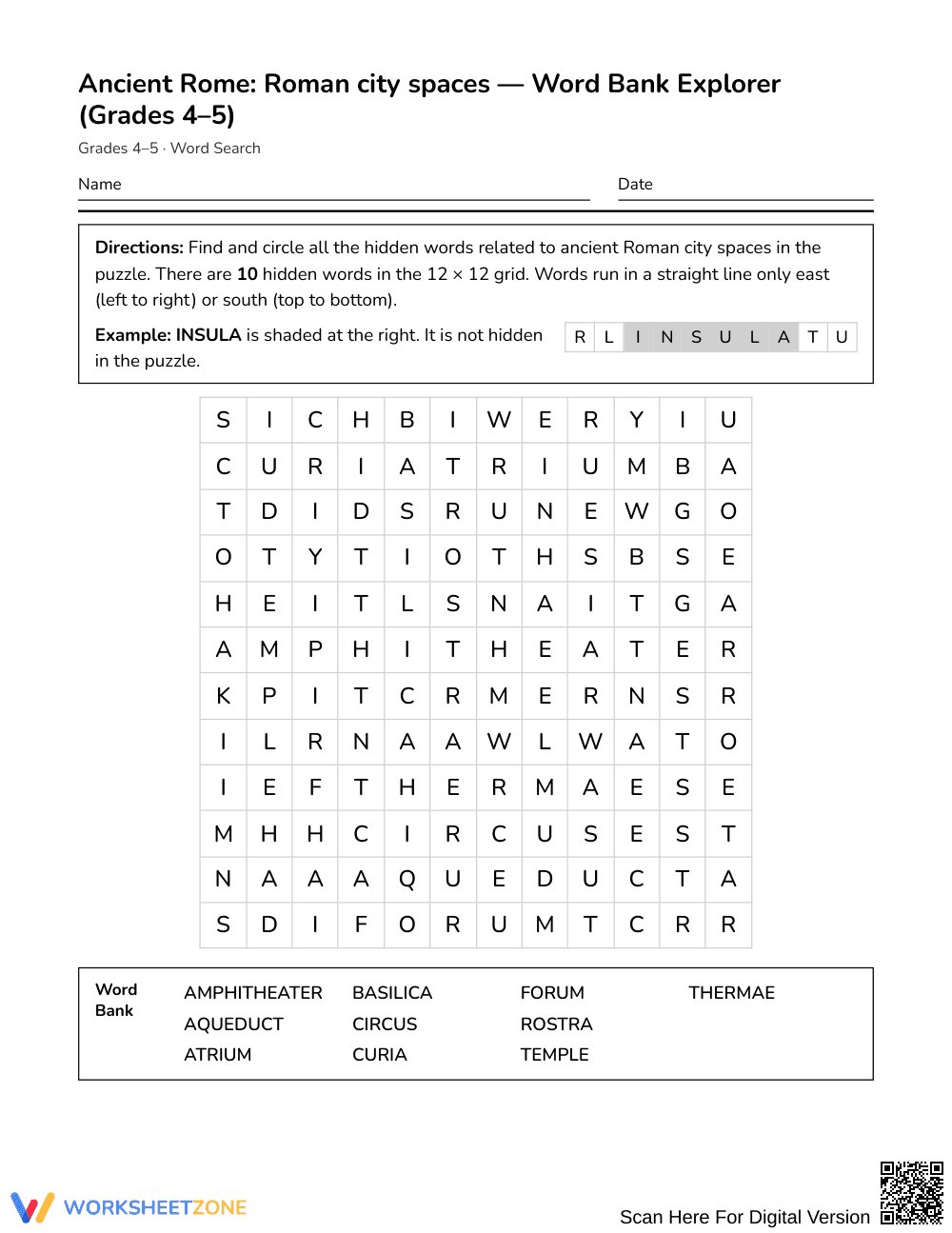

Ready Roman City Word Search | Grades 4–5 Social Studies

Paste this activity's link or code into your existing LMS (Google Classroom, Canvas, Teams, Schoology, Moodle, etc.).
Students can open and work on the activity right away, with no student login required.
You'll still be able to track student progress and results from your teacher account.
This Grades 4–5 Social Studies word search reinforces student recognition of key ancient Roman architectural and civic locations. Learners identify 10 essential architectural terms related to Roman city spaces, connecting classical history terminology with visual word-finding practice to solidify domain-specific vocabulary retention during your ancient civilizations unit.
At a Glance
- Grade: Grades 4–5 · Subject: Social Studies
- Standard: Not standards-assessed — vocabulary enrichment
- Skill Focus: Roman city spaces
- Format: 1 page · 10 words · Answer key included · PDF
- Best For: Vocabulary review and fast-finisher activity
- Time: 15–20 minutes
This 1-page printable activity features a clean, student-friendly layout centered on ancient Roman civic spaces. The resource includes a full alphabetical word bank featuring 10 architectural terms alongside a dedicated answer key that highlights word placements across 3 reference pages for effortless teacher verification.
How the Puzzle Works
This puzzle presents a structured 12 x 12 grid where hidden terms run in two primary orientations: East (left-to-right) and South (top-to-bottom). Students consult an alphabetical word bank containing 10 key terms—such as basilica, aqueduct, and forum—and locate each entry within the grid. The horizontal and vertical design provides an accessible, frustration-free search suitable for intermediate elementary learners.
Standards Alignment
This educational word search is designed strictly as vocabulary enrichment and is not aligned to a specific state or national content standard. It functions as a supplemental resource to reinforce historical terms and support reading comprehension within upper-elementary World History curricula.
How to Use It
Introduce this word search after direct instruction on Roman architecture to solidify key terms, or assign it as an independent station during social studies rotations. For a quick formative assessment observation, check whether students can verbally define selected terms like curia or rostra when circling them. The activity requires approximately 15 to 20 minutes to complete.
Who It's For
This activity is designed for Grades 4–5 students studying ancient Mediterranean civilizations. For learners needing additional support, have them highlight terms in the word bank as they locate them, or pair this activity naturally with an illustrated Roman forum diagram or non-fiction reading passage on Roman civic life.
Vocabulary acquisition in upper-elementary social studies relies on repeated, meaningful exposure to domain-specific terminology. While this Roman city spaces word search is non-standards-assessed vocabulary enrichment rather than a formal assessment tool, it reinforces specialized historical vocabulary essential for content comprehension. According to Fisher & Frey (2014), intentional word exposure through structured print routines significantly aids intermediate learners in consolidating technical vocabulary across content disciplines. By identifying 10 key terms—including forum, aqueduct, and amphitheater—within a 12 x 12 grid, Grades 4–5 students strengthen orthographic mapping and lexical familiarity. This focused visual engagement relieves extraneous cognitive load, providing an accessible entry point for students before they encounter these complex architectural concepts in informational texts and historical source readings. Consequently, educators can deploy this print-and-go supplemental activity to support long-term term retention and historical literacy effectively.


