


























Views
Downloads




Ready Rhetorical Analysis Worksheet | Grade 11 English III
Paste this activity's link or code into your existing LMS (Google Classroom, Canvas, Teams, Schoology, Moodle, etc.).
Students can open and work on the activity right away, with no student login required.
You'll still be able to track student progress and results from your teacher account.
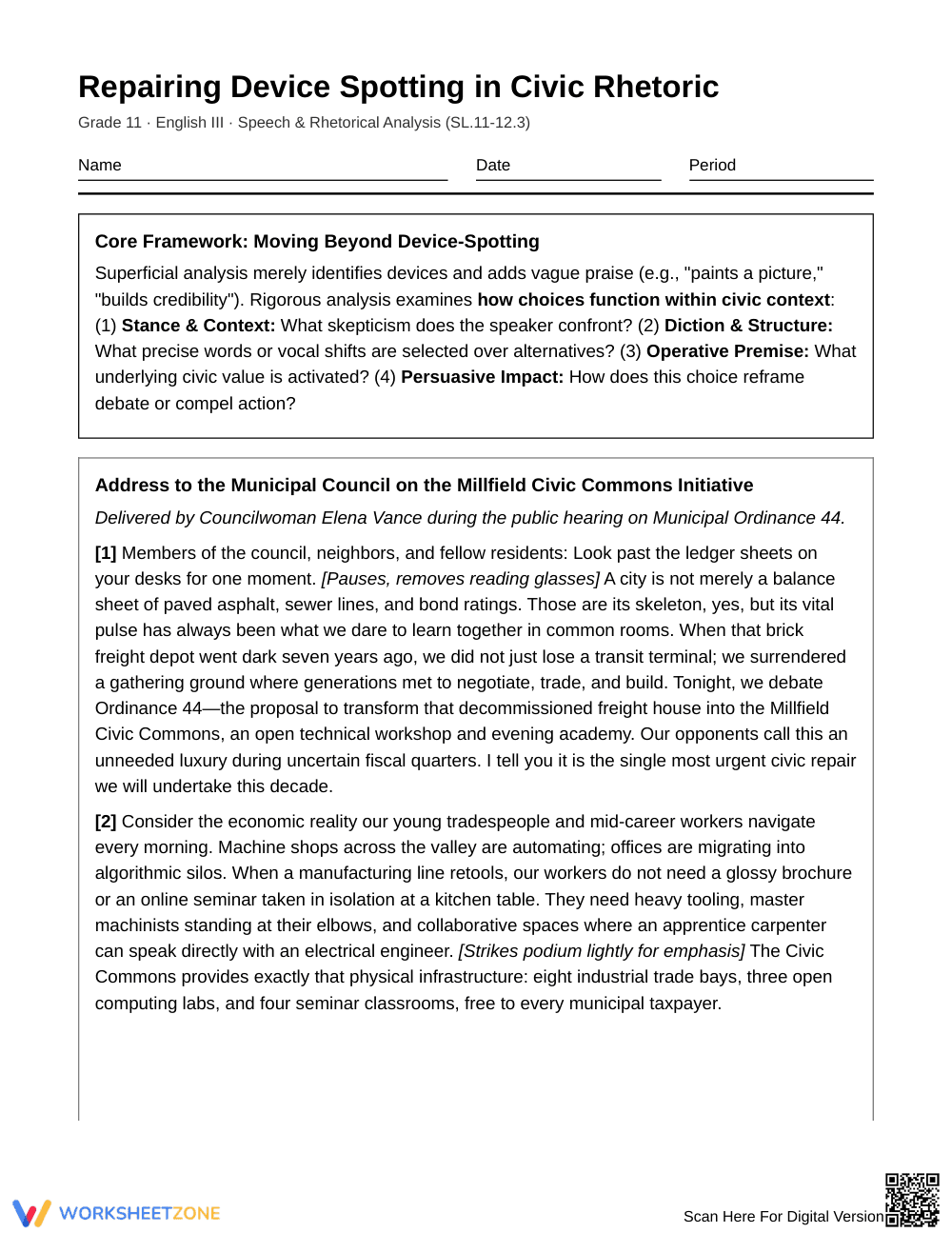
This Grade 11 speech analysis worksheet trains students to move beyond superficial rhetorical device-spotting and evaluate how civic speakers construct arguments. Working with an authentic civic address, learners diagnose flawed analyses, unpack structural choices, and write rigorous evaluations connecting rhetorical techniques directly to speaker purpose, municipal context, and civic values.
At a Glance
- Grade: 11 · Subject: English III
- Standard:
SL.11-12.3— Evaluate a speaker's point of view, reasoning, stance, premises, and rhetoric- Skill Focus: Repairing superficial device-spotting with evidence-based rhetorical analysis
- Format: 6 pages · 10 problems · Answer key included · PDF
- Best For: High school rhetorical analysis speech units
- Time: 45–60 minutes
What's Inside
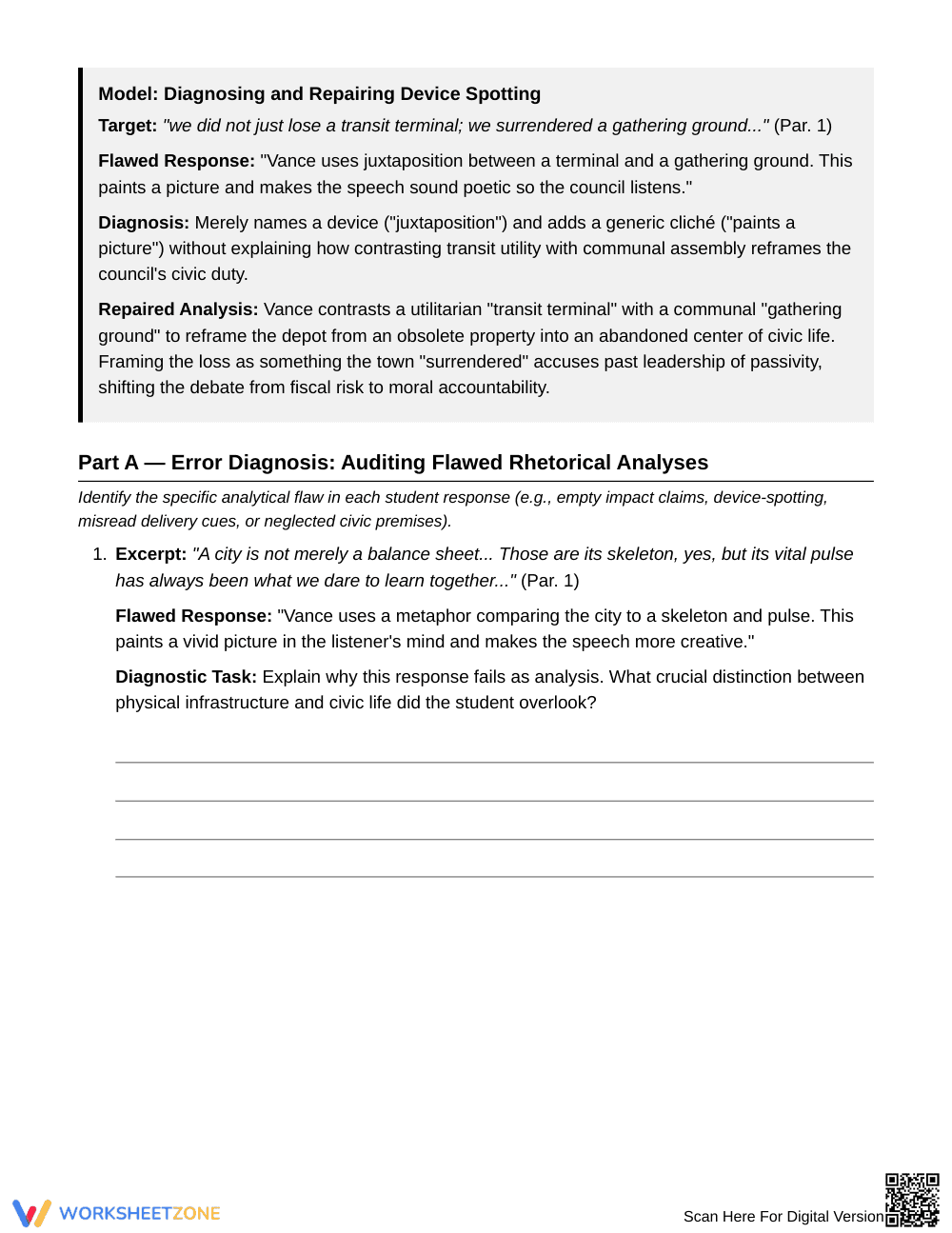
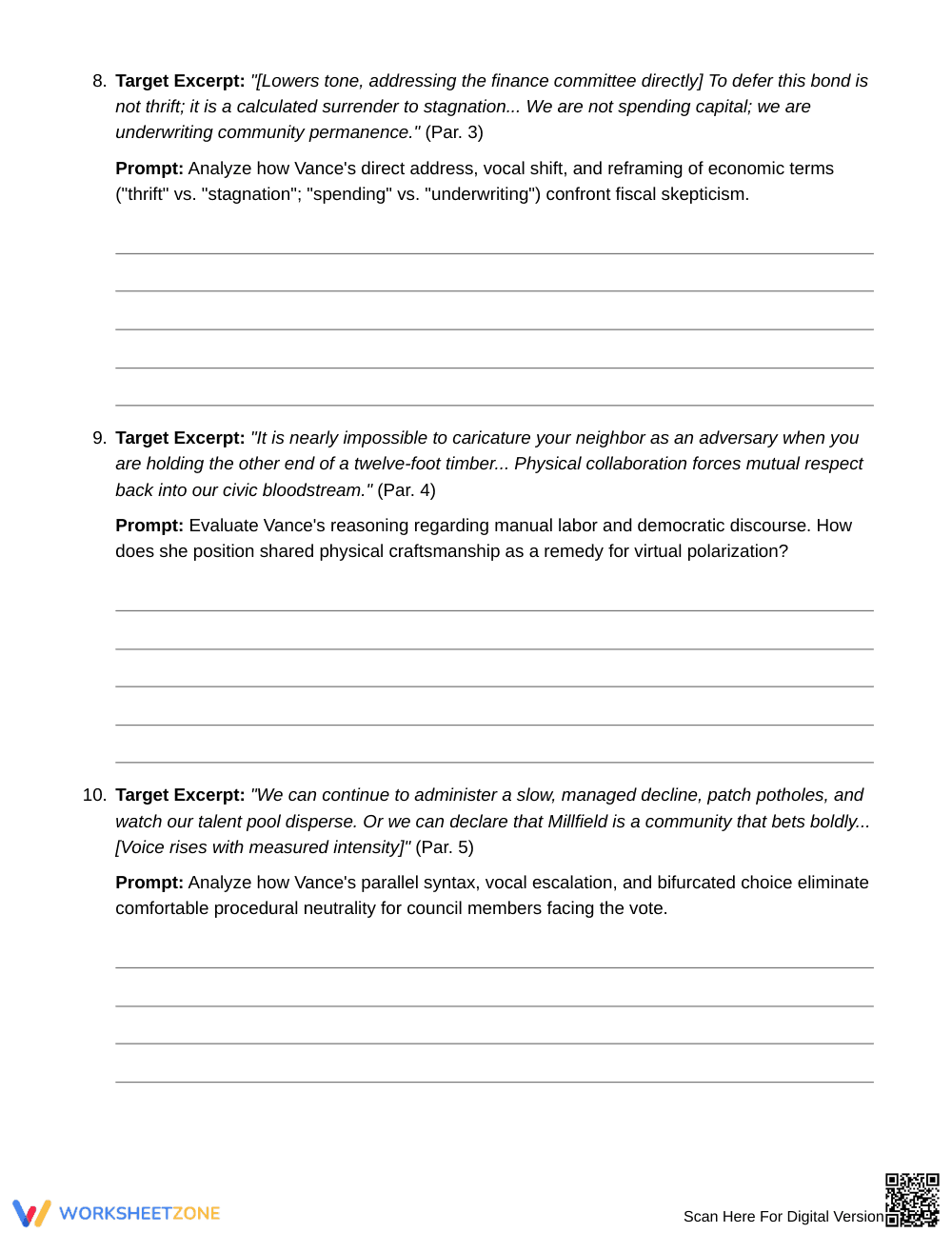
The worksheet centers on a 5-paragraph civic speech, Councilwoman Elena Vance's address on Municipal Ordinance 44. Students review a four-part analytical framework and an annotated model contrasting a flawed response with an expert repair. The resource provides 10 exercises across 6 pages: 5 error-diagnosis tasks auditing weak claims and 5 evidence-supported repair prompts, backed by a 4-page answer key.
Skill Progression
- Guided Practice: Students review an explicit four-part framework and an annotated model dissecting empty device labeling.
- Supported Practice (Tasks 1–5): Learners audit five flawed student responses in Part A, identifying issues like misread delivery cues and circular logic.
- Independent Practice (Tasks 6–10): Students draft original, evidence-backed rhetorical analyses for five speech excerpts in Part B.
This sequence implements gradual release, moving students from recognizing analytical pitfalls to generating substantive written critique.
Standards Alignment
This resource aligns with `SL.11-12.3`, requiring students to evaluate a speaker's point of view, reasoning, stance, premises, and rhetoric. It also supports `RI.11-12.6` by evaluating how authorial style and structure contribute to persuasive power. Both standard codes can be copied directly into lesson plans, IEP goals, or district curriculum mapping tools.
How to Use It
Deploy this worksheet after initial instruction on rhetorical devices to push students toward analytical depth. You can also use Part A as a collaborative check before students independently complete Part B. During class, observe whether students identify Vance's civic premises or revert to naming devices. Anticipate 45 to 60 minutes for completion.
Who It's For
Ideal for Grade 11 English III and Advanced Placement Language courses, this resource aids learners breaking formulaic habits. Scaffolds support developing writers, while advanced prompts challenge students to evaluate vocal cues and ideological premises. Pair this lesson with an anchor chart on active rhetorical verbs.
According to Fisher & Frey (2014), explicit modeling combined with guided error analysis accelerates student acquisition of complex literacy skills far more effectively than unassisted practice. This Grade 11 English III instructional resource directly operationalizes that research to eliminate superficial device-spotting, advancing the core competencies mandated by standard SL.11-12.3. Rather than rewarding students for merely labeling metaphors or rhetorical appeals, the curriculum requires learners to evaluate how specific rhetorical choices, vocal inflections, and underlying civic premises function within an authentic municipal argument. By auditing defective analytical claims before constructing original, evidence-based evaluations across 10 structured tasks, students bridge the gap between basic reading comprehension and sophisticated rhetorical critique. The accompanying 4-page answer key provides rigorous exemplar responses that establish explicit success criteria, ensuring upper secondary students develop the evaluative depth demanded by college-level analytical writing and civic literacy standards.


