


























Views
Downloads




Ready Rhetoric & Evidence Worksheet | Grade 11 English III
Paste this activity's link or code into your existing LMS (Google Classroom, Canvas, Teams, Schoology, Moodle, etc.).
Students can open and work on the activity right away, with no student login required.
You'll still be able to track student progress and results from your teacher account.
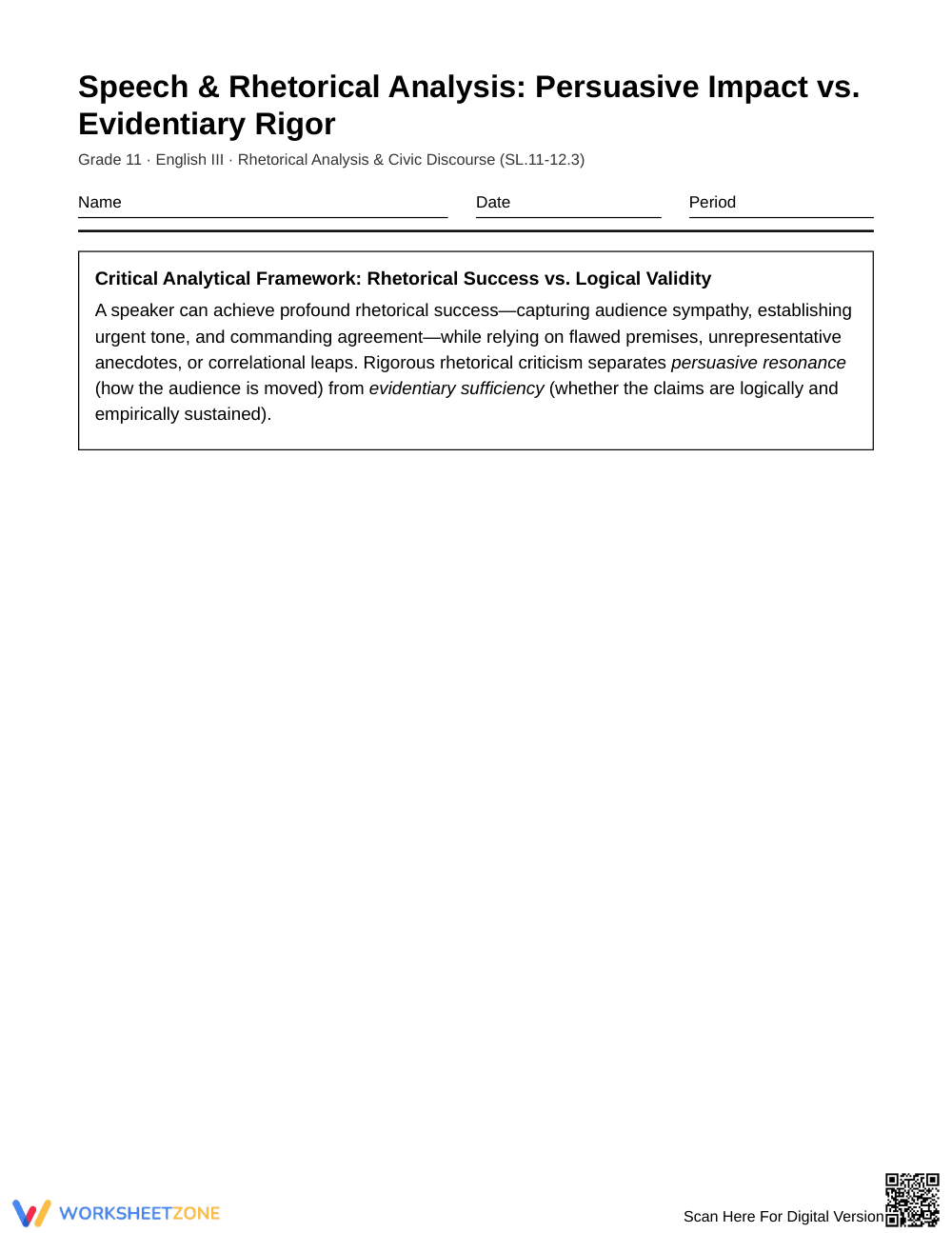
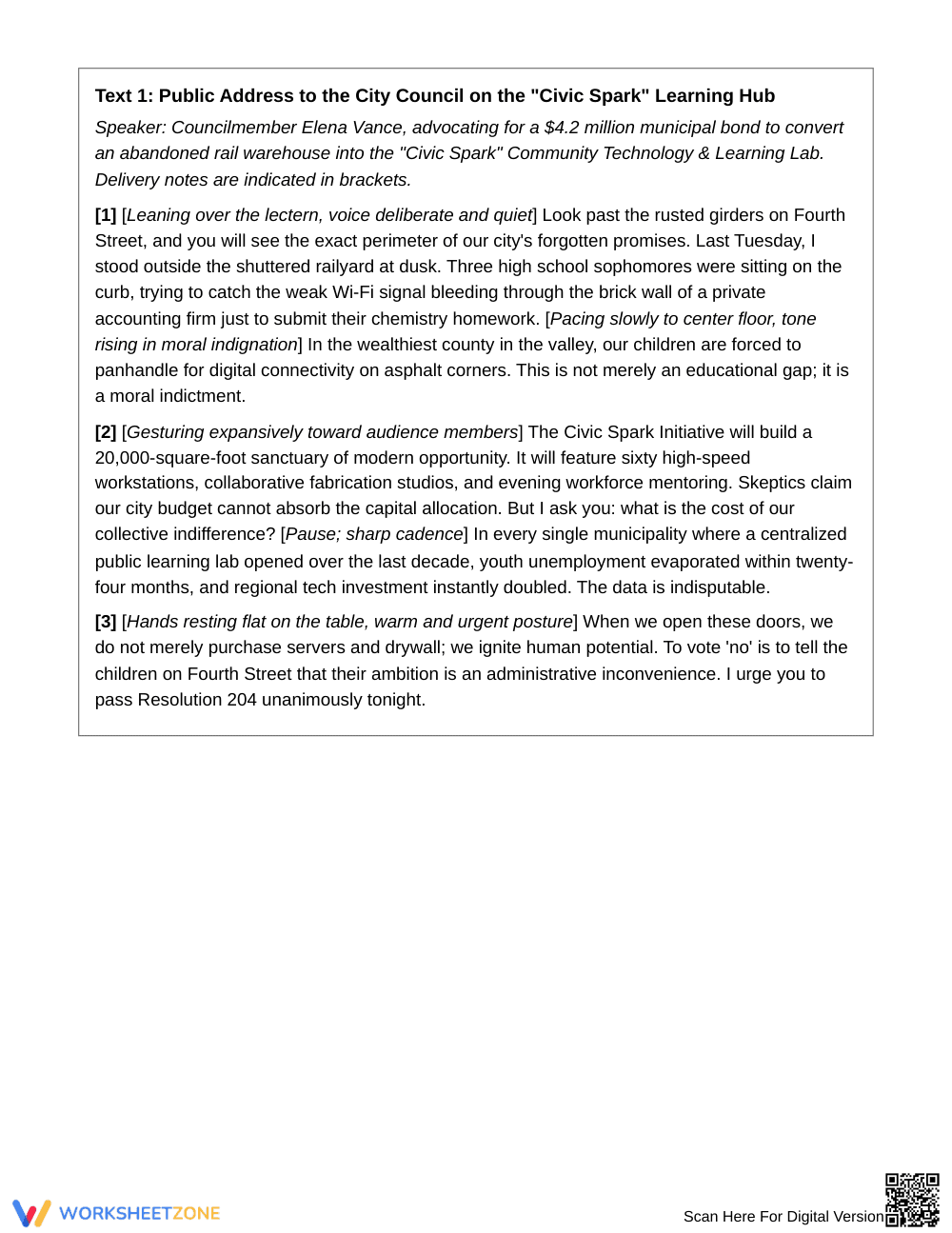
This Grade 11 English III worksheet trains students to critique the gap between rhetorical appeal and evidentiary support. Analyzing a municipal speech alongside an official fiscal audit, learners examine logical fallacies, dissect delivery cues, and demonstrate how persuasive resonance can mask significant factual deficits.
At a Glance
- Grade: 11 · Subject: English III
- Standard:
SL.11-12.3— Evaluate a speaker's point of view, reasoning, stance, and evidence validity- Skill Focus: Persuasive Success with Evidentiary Weakness
- Format: 6 pages · 8 problems · Answer key included · PDF
- Best For: High school rhetorical analysis and debate
- Time: 45–60 minutes
What's Inside
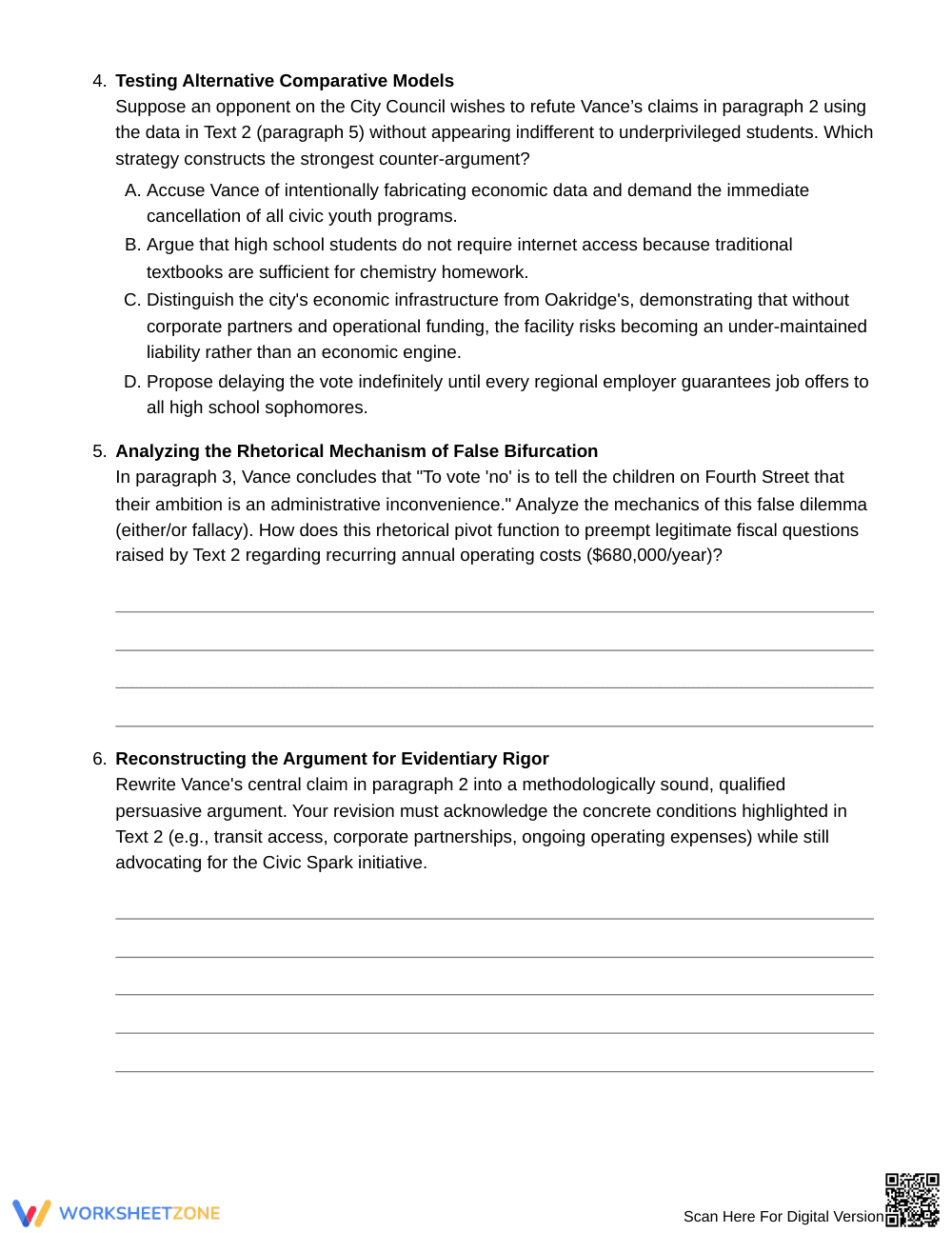
The 6-page printable features two paired texts: a persuasive speech by Councilmember Elena Vance and an objective legislative audit. Across 8 analytical tasks, students unpack delivery choices, identify fallacies, evaluate counter-arguments, and rewrite claims with evidentiary rigor. A complete 3-page answer key provides annotated rationales and textual evidence.
Skill Progression
- Guided practice (Tasks 1–2): Students deconstruct rhetorical framing and contrast Vance's employment assertions with audit data.
- Supported practice (Tasks 3–6): Students critique anecdotal proof, analyze false bifurcations, and rewrite claims using qualified evidence.
- Independent practice (Tasks 7–8): Students evaluate delivery cues and compose an analytical thesis on persuasive efficacy.
This sequence implements the gradual-release model to build analytical autonomy.
Standards Alignment
This resource aligns with CCSS SL.11-12.3: Evaluate a speaker's point of view, reasoning, and use of evidence and rhetoric, assessing the stance, premises, word choice, and tone. It also supports CCSS RI.11-12.8 by requiring students to evaluate argument validity and evidentiary sufficiency. Both standard codes can be copied directly into lesson plans, IEP goals, or district curriculum mapping tools.
How to Use It
Use this worksheet following instruction on rhetorical appeals and fallacies. Assign Parts A and B for paired analysis, then have students complete Part C independently as an exit ticket or writing assessment. For formative assessment, check Task 5 to ensure students recognize false dilemmas without confusing emotional resonance with sound reasoning. Total completion time is 45 to 60 minutes.
Who It's For
This worksheet serves Grade 11 English III and AP English Language classrooms studying civic discourse. Scaffold for struggling readers by annotating data points in Text 2, or challenge advanced students to draft formal auditor rebuttals. Pair this lesson with an anchor chart on logical fallacies.
According to Fisher & Frey (2014), structured close reading of paired informational texts accelerates critical evaluation skills by requiring students to cross-examine claims across distinct communicative registers. This worksheet operationalizes standard SL.11-12.3 by challenging Grade 11 learners to evaluate a speaker's point of view, reasoning, and evidentiary validity when persuasive impact diverges from empirical proof. By comparing a dynamic political transcript against an objective municipal audit across 8 rigorous analytical tasks, high school students move beyond superficial comprehension to detect hasty generalizations, inspect false bifurcations, and articulate qualified evaluative arguments. Grounded in gradual-release instructional scaffolding, the 6-page learning material prompts students to examine specific delivery cues, distinguish between systemic proof and emotional anecdotes, and reconstruct flawed claims with academic rigor. As research demonstrates, explicit practice in identifying evidentiary weaknesses prepares adolescents for analytical writing and thoughtful civic engagement.


