





























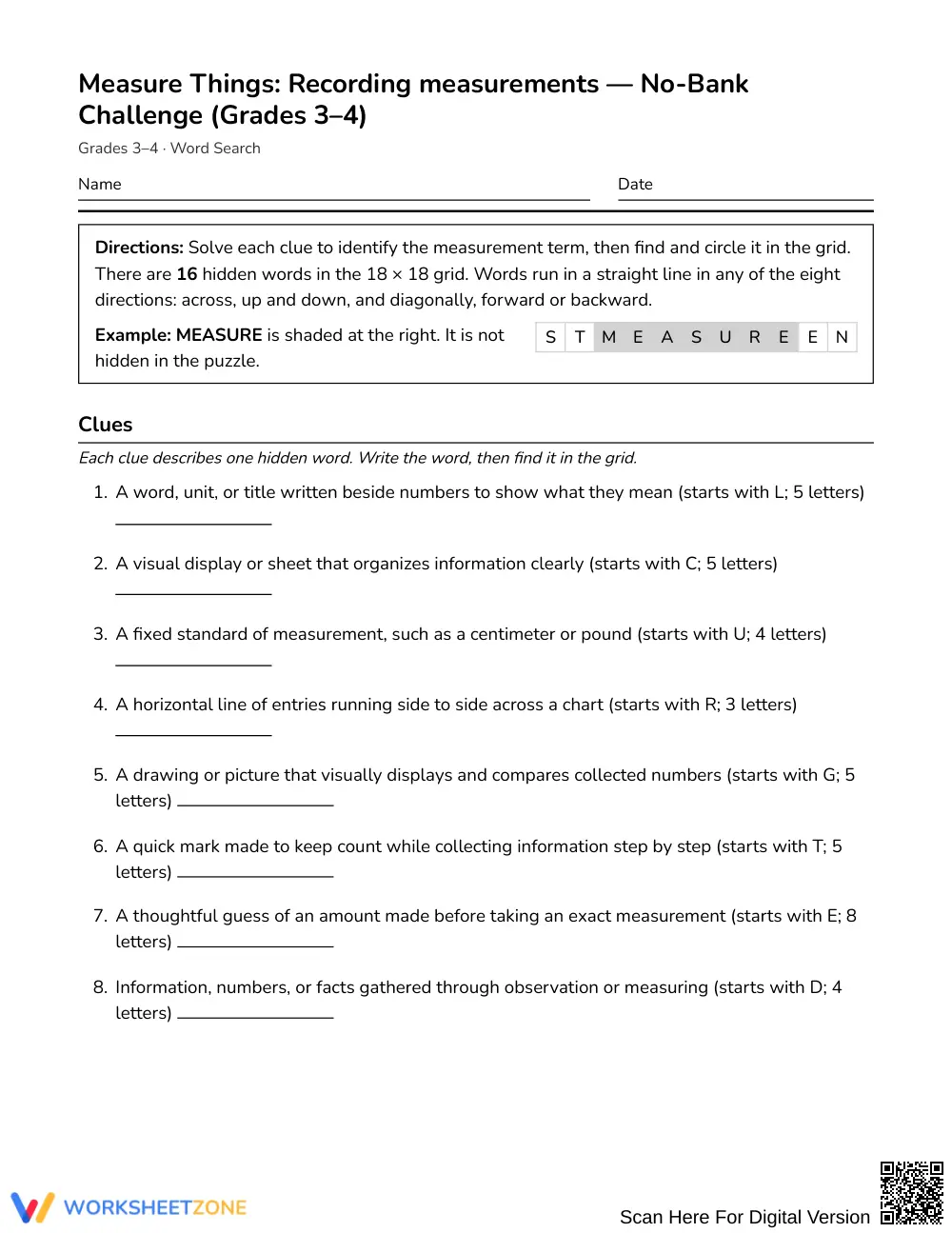


Ready Recording Measurements Word Search | Grades 3–4 Math

Paste this activity's link or code into your existing LMS (Google Classroom, Canvas, Teams, Schoology, Moodle, etc.).
Students can open and work on the activity right away, with no student login required.
You'll still be able to track student progress and results from your teacher account.
This recording measurements word search strengthens math vocabulary for Grades 3–4 learners by connecting precise definitions to visual word hunting. Students solve 16 clue-based prompts to deduce essential measurement terms before locating them in the puzzle grid. The activity reinforces foundational math language, supporting both conceptual understanding and reading comprehension in measurement units.
At a Glance
- Grade: Grades 3–4 · Subject: Math
- Standard: Not standards-assessed — supplemental vocabulary enrichment to reinforce math terms without formal testing pressure
- Skill Focus: recording measurements and data vocabulary
- Format: 3 pages · 16 words · Answer key included · Printable PDF format
- Best For: Math stations, measurement review, and independent early finishers
- Time: 20–30 minutes of focused classroom work
What's Inside: The 3-page printable activity features 16 content-rich vocabulary clues paired with a dense puzzle grid, eliminating passive copying by omitting a traditional word list. Rather than scanning for pre-listed terms, students actively read descriptive math clues defining concepts such as data, scale, estimate, and metric. A complete 3-page answer key provides full puzzle solutions alongside identified terms, enabling rapid student self-checking or immediate teacher evaluation.
Puzzle Mechanics: Designed as a rigorous no-bank challenge, this word search operates on an 18 x 18 letter grid containing 16 hidden measurement terms. Words run across all 8 compass directions, including north, northeast, east, southeast, south, southwest, west, and northwest. Because no word bank is supplied, learners must actively decode clue prompts to derive each target word before searching the multi-directional grid.
Standards Alignment: This resource is designed strictly for supplemental vocabulary enrichment and is not aligned to a specific state or national content standard. It serves to reinforce academic vocabulary and domain-specific terminology that underpin elementary data and measurement standards without imposing formal standardized testing criteria.
How to Use It: Deploy this puzzle immediately after direct instruction on data collection to reinforce key terms before students build tables and charts. Alternatively, place it in an independent math station during a measurement unit. For formative assessment, observe whether students identify terms directly from the clue definitions or require peer collaboration to deduce the correct vocabulary. Most learners complete the activity in 20 to 30 minutes.
Who It's For: This activity is built for Grades 3–4 math students who benefit from engaging vocabulary reinforcement. The clue-driven structure provides built-in scaffolding for developing readers while offering an enriching challenge for advanced learners. Pair this printable directly with a hands-on measurement lab or a classroom anchor chart displaying charts, tables, and metric units.
Academic vocabulary acquisition plays a decisive role in elementary mathematics achievement, particularly when students learn foundational skills like recording measurements and organizing data. According to Fisher & Frey (2014), intentional exposure to domain-specific language through contextual clues bridges the gap between basic everyday communication and formal academic discourse. Rather than relying on rote memorization, requiring learners to derive 16 measurement terms from descriptive definitions stimulates active cognitive processing before visual scanning begins. This dual-demand task strengthens orthographic mapping, reinforces semantic associations, and embeds essential concepts such as tables, scales, units, and estimates into long-term memory. As students engage with complex terminology in multi-directional puzzle environments, they develop the precise lexicon necessary for higher-level data interpretation and scientific reasoning. Integrating targeted vocabulary challenges into regular math instruction solidifies foundational comprehension while sustaining high student engagement during independent or collaborative learning routines.


