




























Views
Downloads


Ready Orbital Elements Worksheet | Grade 12 Earth Science

Paste this activity's link or code into your existing LMS (Google Classroom, Canvas, Teams, Schoology, Moodle, etc.).
Students can open and work on the activity right away, with no student login required.
You'll still be able to track student progress and results from your teacher account.
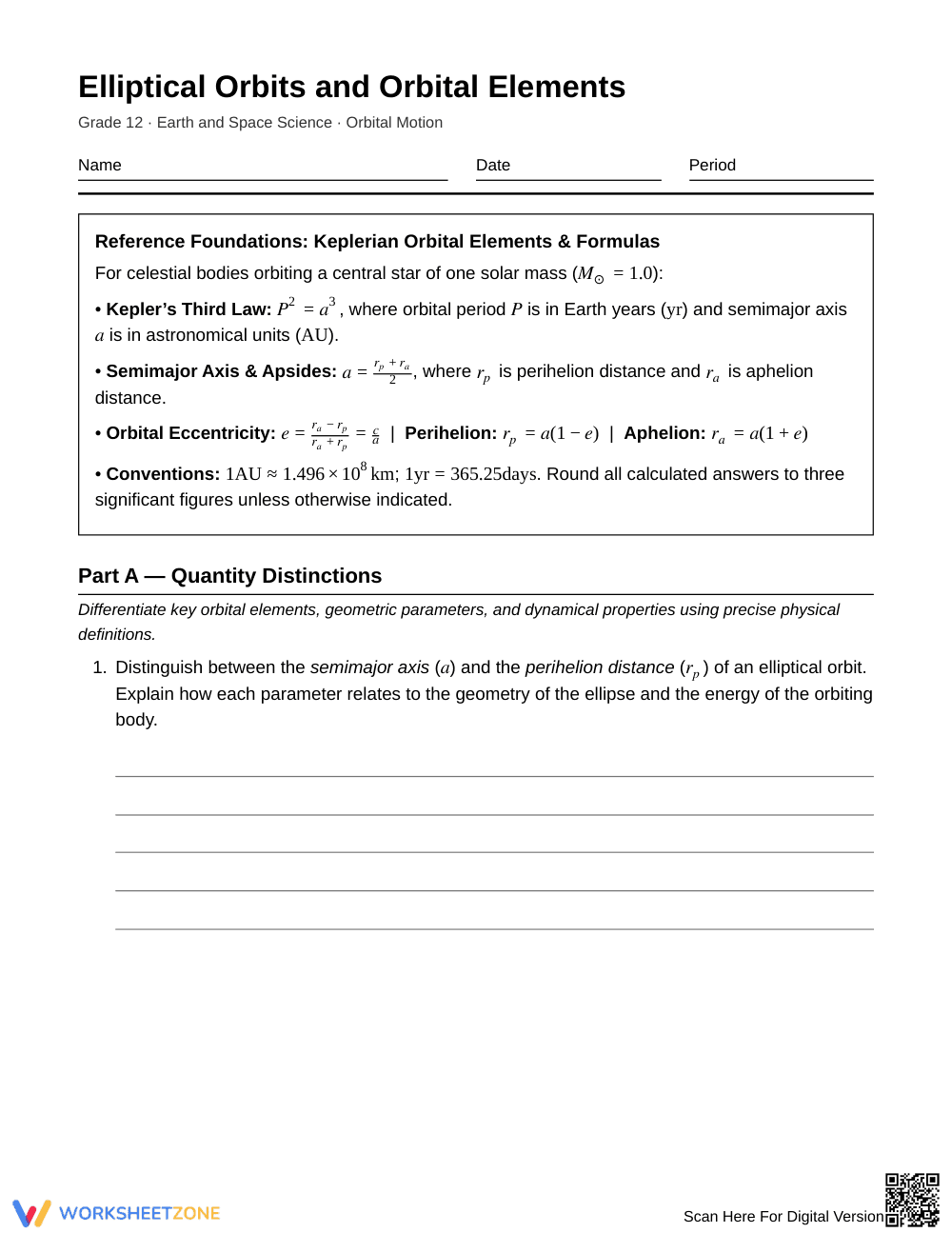
Mastering elliptical orbits and orbital elements enables twelfth-grade science students to quantitatively describe celestial trajectories. This five-page worksheet delivers 12 rigorous tasks that guide learners to differentiate Keplerian orbital parameters, compute semimajor axes and eccentricities from astronomical data, and evaluate anomalous observational claims with mathematical proofs.
At a Glance
- Grade: 12 · Subject: Earth & Space Science
- Standard: Orbital Mechanics — Analyze Keplerian orbital elements and apply geometric formulas to bound planetary systems
- Skill Focus: Elliptical Orbits and Orbital Elements
- Format: 5 pages · 12 problems · Answer key included · PDF
- Best For: Advanced mechanics practice and quantitative verification
- Time: 45–60 minutes
What's Inside
The activity provides an instructional pathway featuring a reference box with Keplerian equations and physical constants. Across five student pages, learners encounter four conceptual differentiation prompts, six direct calculation scenarios with synthetic surveys, and two data verification proofs. An included three-page answer key provides complete mathematical steps and explanatory solutions for every problem.
Skill Progression
- Guided Practice: Part A offers four conceptual tasks defining apsides, eccentricity classifications, and Keplerian orbital elements using physical definitions.
- Supported Practice: Part B presents six quantitative problems applying Kepler's third law and eccentricity equations to asteroids, comets, and exoplanets.
- Independent Practice: Part C challenges learners with two verification proofs requiring mathematical refutation of physically impossible orbital telemetry.
This sequence follows a gradual-release framework, transitioning students from foundational definitions to autonomous analytical evaluation.
Standards Alignment
This worksheet aligns with high school Earth and Space Science standards governing orbital mechanics, Kepler's laws, and gravitational trajectories. Students use mathematical models to explain how orbital elements determine planetary motion around central masses. Both standard codes can be copied directly into lesson plans, IEP goals, or district curriculum mapping tools.
How to Use It
Implement this resource following direct instruction on Keplerian geometry. First, assign Part A as a mid-unit conceptual check. Next, have students complete Parts B and C during independent practice or paired lab stations. Formatively assess whether students recognize that an eccentricity of 1.0 or greater indicates an unbound trajectory. Target completion time is 45 to 60 minutes.
Who It's For
Designed for Grade 12 Earth and Space Science, astrophysics, and advanced physics courses. Teachers can differentiate by providing pre-calculated values for struggling learners or assigning orbital velocity derivations to advanced students. This resource pairs naturally with an interactive solar system simulation or an orbital mechanics anchor chart.
Secondary science curricula require students to bridge qualitative physical models and rigorous quantitative problem-solving. This Grade 12 orbital mechanics resource guides students through elliptical orbits and orbital elements, reinforcing foundational Keplerian relationships through systematic mathematical modeling and data verification. According to research on structured instructional delivery by Fisher & Frey (2014), the gradual release of responsibility model significantly improves student autonomy and conceptual retention in complex STEM domains. By structuring tasks from qualitative parameter distinctions through formulaic calculations to rigorous physical verification proofs, this worksheet develops higher-order critical thinking. Students move beyond passive formula substitution to actively interrogate observational telemetry, evaluating mathematical contradictions in reported eccentricities and orbital radii. As documented by Fisher & Frey (2014), scaffolding problem sets with explicit reference anchors prior to independent evaluation ensures that twelfth-grade learners achieve robust mastery of advanced celestial mechanics and planetary kinematics.


