




























Views
Downloads



Ready Nucleic-Acid Tables Worksheet | Grade 9 Biology

Paste this activity's link or code into your existing LMS (Google Classroom, Canvas, Teams, Schoology, Moodle, etc.).
Students can open and work on the activity right away, with no student login required.
You'll still be able to track student progress and results from your teacher account.
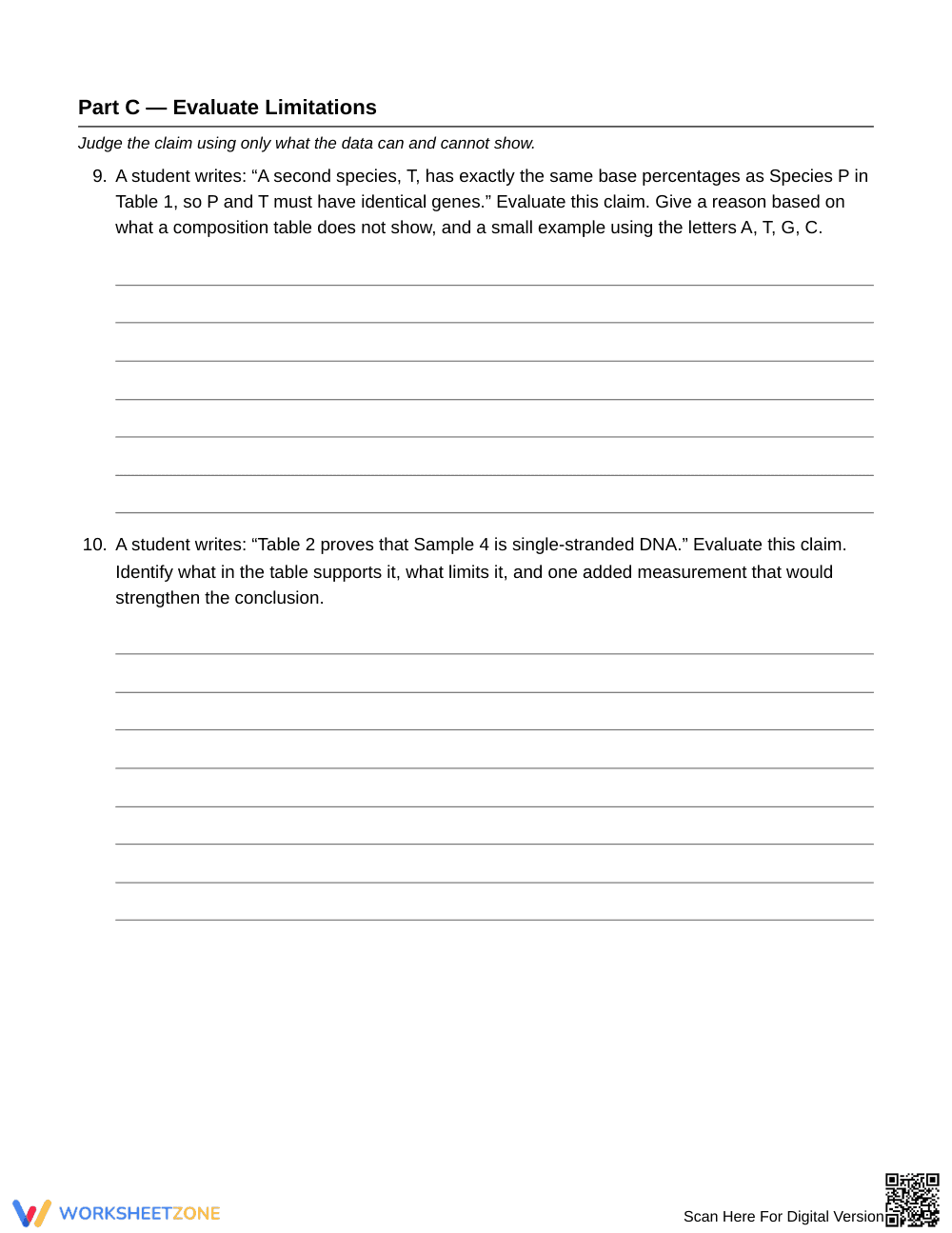
This worksheet teaches Grade 9 Biology students to read nucleic-acid composition tables and turn the numbers into evidence. Students find values, spot base-pairing patterns such as A = T and G = C, calculate G + C and purine totals, and judge claims about what composition data can and cannot show.
At a Glance
- Grade: 9 · Subject: Biology
- Standard: DNA & RNA unit practice — read tables, find patterns, and judge data claims
- Skill Focus: Interpreting nucleic-acid composition tables
- Format: 5 pages · 10 problems · Answer key included · PDF
- Best For: Data-reading practice in a DNA unit
- Time: 30–40 minutes
What's Inside
The worksheet has three parts on 3 student pages, plus a 2-page answer key. A reference box lists sugar, base, and pairing facts. Two synthetic tables and a seven-base information-flow model supply the data. Tasks include reading values, calculating G + C and purine totals, writing an RNA copy, and evaluating two student claims. Workspace is provided for calculations.
Skill Progression
- Guided practice: 2 problems (Part A) where students read single values from the tables with the reference box open.
- Supported practice: 6 problems (Part B) where students calculate, compare, and explain using Model M and hydrogen-bond facts.
- Independent practice: 2 problems (Part C) where students evaluate claims by naming the limits of the data.
This sequence follows gradual release: I Do, We Do, You Do.
Standards Alignment
No standard code is attached to this worksheet. It supports high school biology goals for analyzing data and explaining how DNA and RNA differ in sugar, bases, and strands, and how complementary base pairing shapes composition. Add your own district's code when copying it into lesson plans, IEP goals, or curriculum maps.
How to Use It
- After direct instruction on base pairing: assign Parts A and B as independent practice.
- Before a unit quiz: use Part C as a pair discussion and review.
While students work, watch whether they cite specific numbers from the tables instead of making general statements. Expect 30–40 minutes.
Who It's For
Written for Grade 9 Biology students in a DNA & RNA unit. Students who need support can use the reference box and finish Parts A and B first, while stronger students can spend more time on Part C. Pair it with an anchor chart on base pairing or a lesson on transcription.
The Grade 9 Biology worksheet Reading Nucleic-Acid Composition Tables teaches students to interpret base-composition data for DNA and RNA. Across 10 tasks and 5 pages, including a 2-page answer key, learners read values from two synthetic tables, calculate G + C content and purine and pyrimidine totals, and apply base-pairing rules to a seven-base model. They then evaluate two flawed claims about what composition tables can show. The sequence follows the gradual-release model described by Fisher & Frey (2014), moving from guided reading to supported analysis to independent judgment. Because all data are invented, students practice evidence-based reasoning without relying on memorized species facts. Teachers can use the worksheet to check whether students connect A = T and G = C equality in double-stranded DNA to complementary base pairing, and why single-stranded RNA does not follow that pattern.


