































Ready Newton's Second Law Worksheet | Grade 8-12 Science

Paste this activity's link or code into your existing LMS (Google Classroom, Canvas, Teams, Schoology, Moodle, etc.).
Students can open and work on the activity right away, with no student login required.
You'll still be able to track student progress and results from your teacher account.
This comprehensive physics worksheet helps secondary physical science and physics students master the core mathematical relationships and conceptual foundations of Newton's second law of motion. Through structured problem sets, graphical analysis, and misconception checks, learners build fluency calculating acceleration, force, and mass while developing a precise understanding of how unbalanced forces dictate changes in motion.
At a Glance
- Grade: Grades 8–12 · Subject: Science
- Standard: Science Inquiry — Apply Newton's second law to calculate net force, mass, and acceleration
- Skill Focus: Newton's second law vocabulary, free-body diagrams, and proportional reasoning
- Format: 4 pages · 24 problems · Answer key included · PDF
- Best For: Conceptual physics introduction and guided practice
- Time: 45–60 minutes
What's Inside
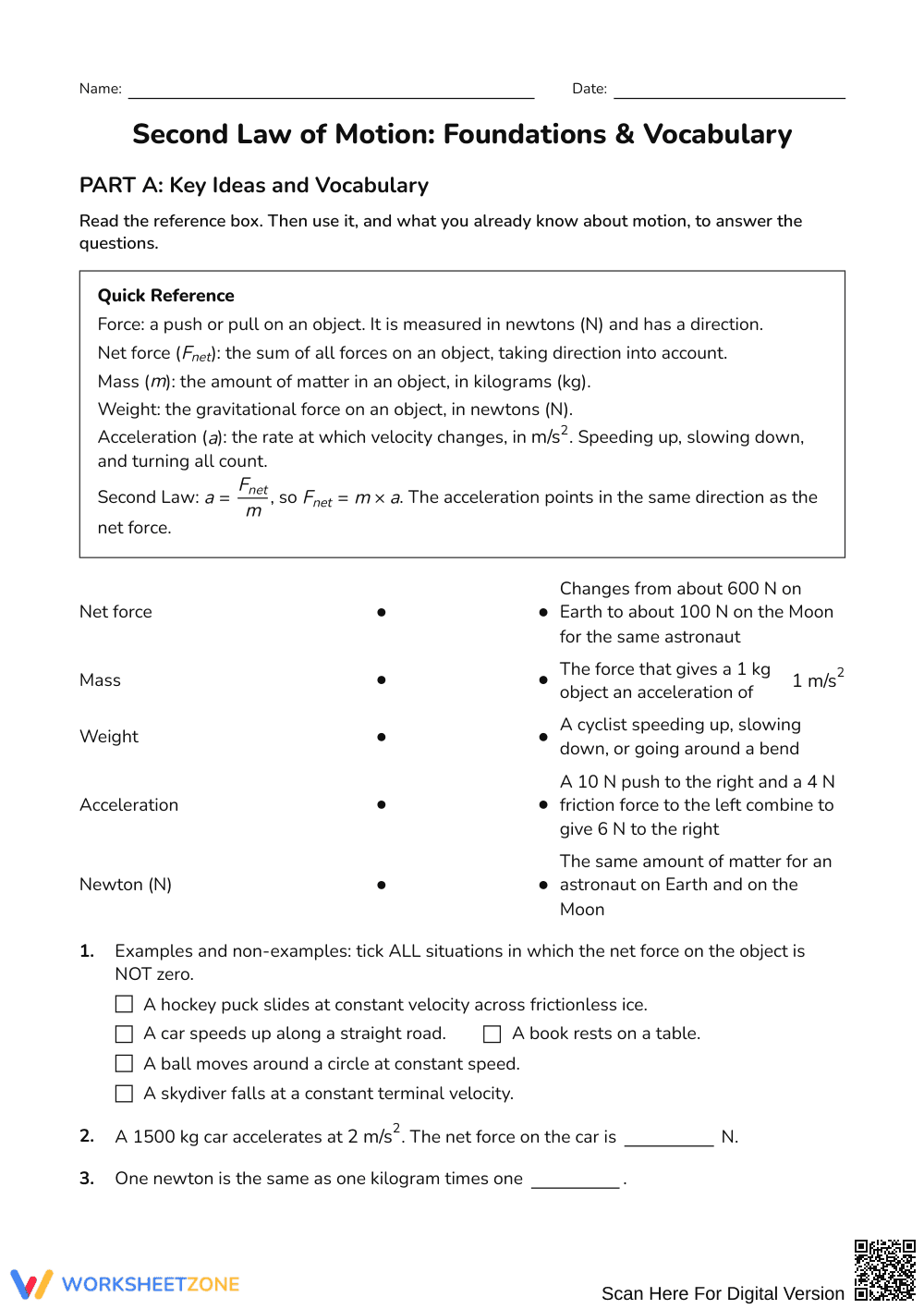
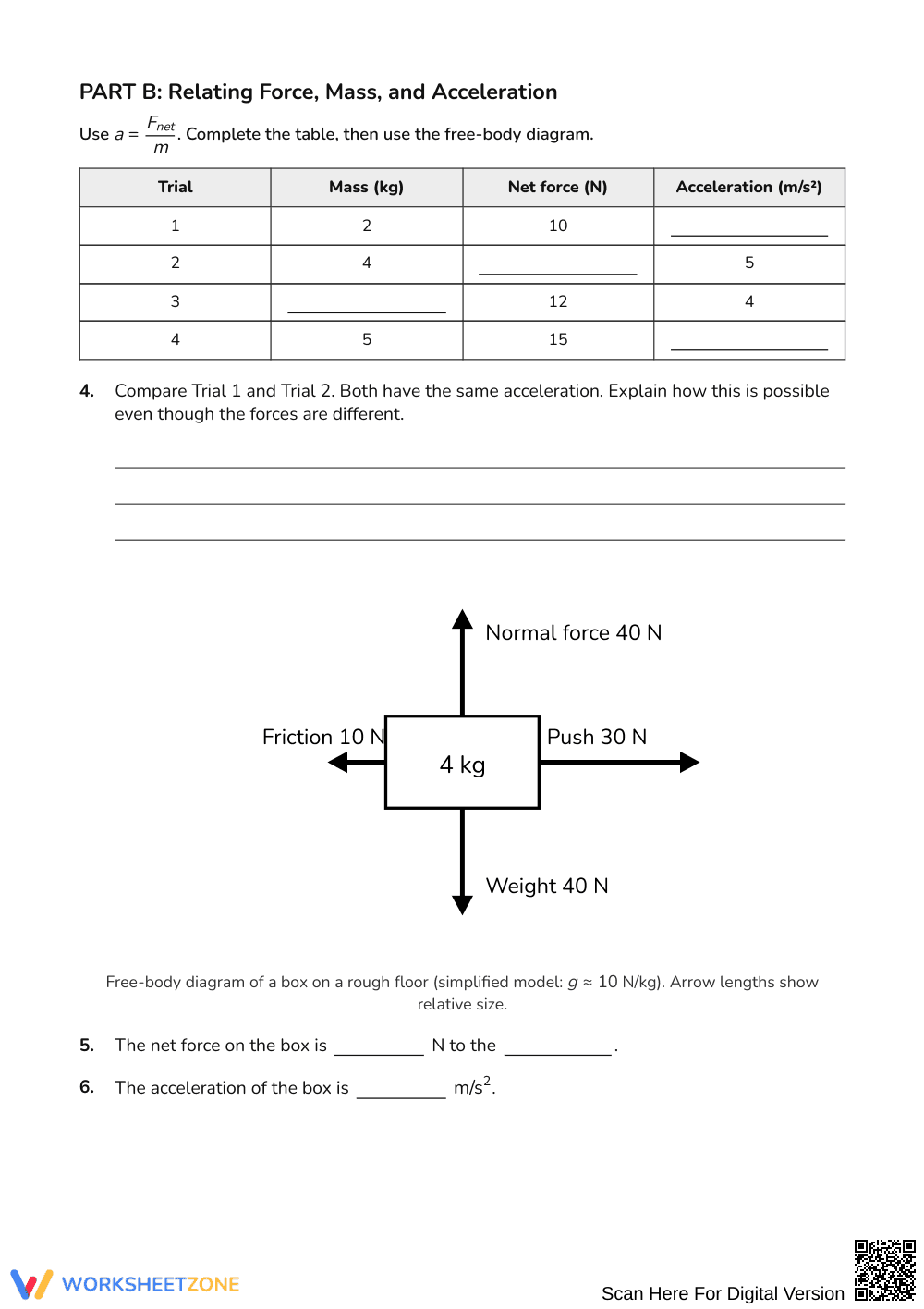
Across four student pages, this resource delivers 24 targeted tasks designed to eliminate common physics misconceptions. Students engage with a detailed quick-reference formula box, vocabulary matching, multi-step calculation tables, free-body diagram interpretations, and graph analysis tasks. A complete 4-page answer key provides step-by-step mathematical reasoning and exemplar explanations for qualitative questions.
Skill Progression
- Guided Practice (Part A): Establishes core vocabulary (mass vs. weight, net force, acceleration) through matching, definition checks, and identifying non-zero net force scenarios using a built-in formula reference box.
- Supported Practice (Part B): Steps students through comparative data tables and free-body diagrams, prompting learners to isolate variables and explain how vertical equilibrium contrasts with horizontal acceleration.
- Independent Practice (Part C): Challenges students to interpret acceleration-force graphs, calculate unit rates of change (1/m slope), and write extended explanations resolving classic misconceptions about friction and inertia.
This structured progression reflects the gradual release of responsibility model, ensuring students build conceptual certainty before tackling unassisted proportional calculations.
Standards Alignment
This worksheet aligns directly with physical science standards requiring students to analyze data to support the claim that Newton's second law of motion describes the mathematical relationship among net force, mass, and acceleration. Students quantitatively evaluate how acceleration varies directly with net force and inversely with mass. This standard expectation can be copied directly into lesson plans, IEP goals, or district curriculum mapping tools.
How to Use It
Introduce this packet during the initial guided practice phase following direct instruction on force vectors and balanced versus unbalanced forces. Alternatively, utilize Parts B and C as a mid-unit formative assessment station to identify whether students still confuse mass with weight. Plan for a 45- to 60-minute instructional block.
Who It's For
Designed for middle school physical science through introductory high school physics classrooms, this worksheet includes clear scaffolding for emerging bilingual learners and students receiving Tier 2 math support. Pair this resource with hands-on dynamics cart demonstrations or digital vector simulations to bridge concrete observations and quantitative problem-solving.
Secondary science educators frequently observe that students struggle to separate the everyday definition of force from its strict physical definition as a vector quantity causing acceleration. According to research on conceptual science learning from Fisher & Frey (2014), explicit vocabulary scaffolding combined with paired non-examples prevents entrenched misunderstandings regarding inertial motion and friction. This 24-task worksheet addresses that exact challenge by integrating free-body diagram interpretation directly alongside ratio calculations. Students systematically evaluate how mass resists changes in motion while calculating proportional rates from graphical data points. By establishing firm distinctions between constant velocity and zero net force across 4 structured pages, the resource equips Grades 8–12 learners with the durable conceptual framework required for advanced mechanics and physics problem-solving.


