





























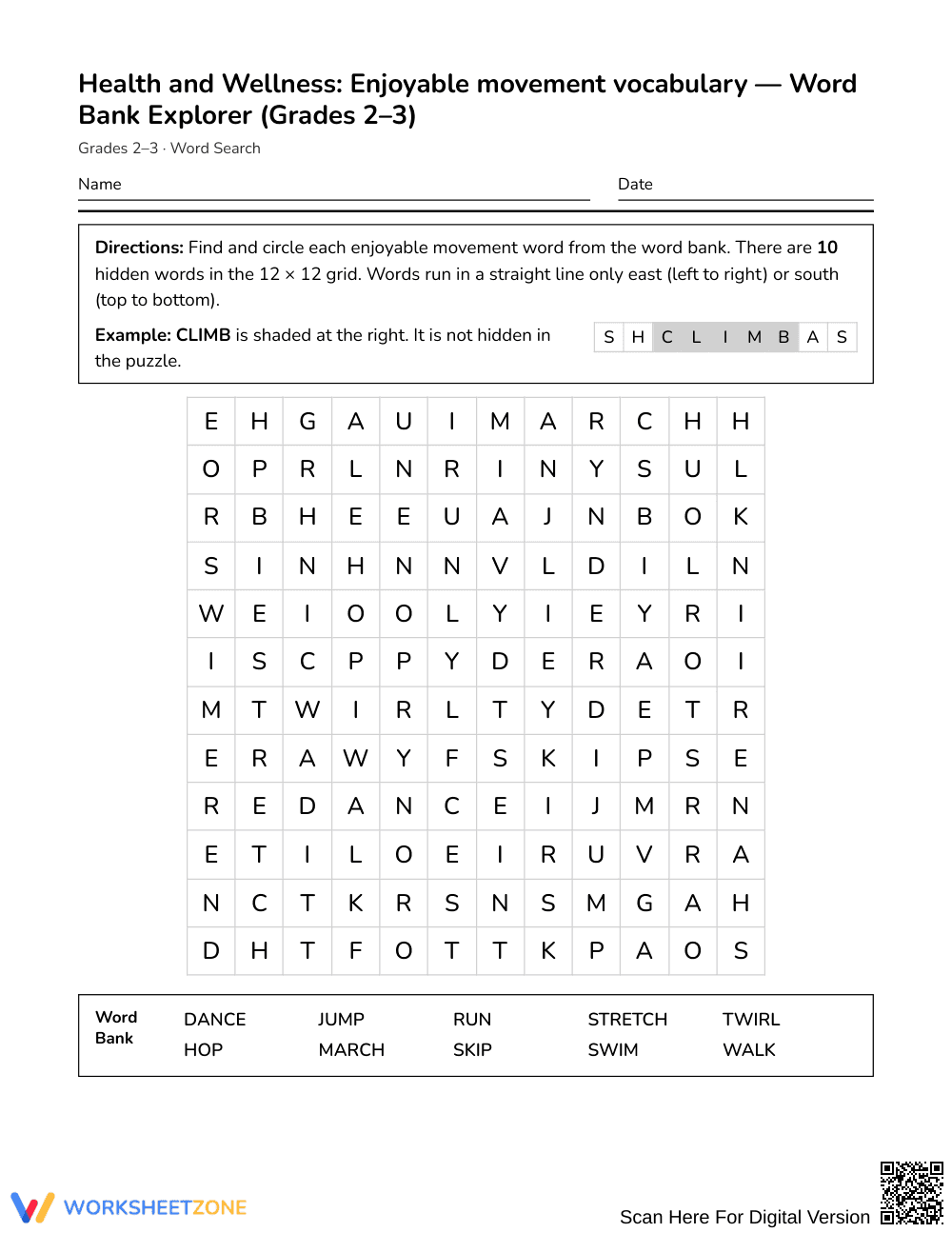


Ready Movement Vocabulary Word Search | Grades 2–3 Science

Paste this activity's link or code into your existing LMS (Google Classroom, Canvas, Teams, Schoology, Moodle, etc.).
Students can open and work on the activity right away, with no student login required.
You'll still be able to track student progress and results from your teacher account.
This science word search helps elementary students build enjoyable movement vocabulary within a healthy habits unit. Learners identify and locate ten foundational physical activity terms, connecting gross-motor actions to healthy lifestyle concepts. The engaging format promotes print recognition, reinforces spelling patterns, and establishes positive associations with everyday active movement.
At a Glance
- Grade: Grades 2–3 · Subject: Science
- Standard: Not standards-assessed — vocabulary enrichment focusing on active motion terms
- Skill Focus: Enjoyable movement vocabulary recognition and spelling
- Format: 1 student page · 10 hidden words · 2 answer key pages · PDF
- Best For: Early finisher work, physical health warm-ups, sub plans
- Time: 15–20 minutes
What's Inside
The resource includes a clean, single-page student activity sheet paired with a comprehensive two-page answer key. The puzzle presents a clear alphabetical word bank listing ten movement terms: dance, hop, jump, march, run, skip, stretch, swim, twirl, and walk. Large, legible lettering supports developing readers as they track letter sequences, while the accompanying answer key highlights all word paths for rapid, effortless verification.
Puzzle Mechanics
This word search is structured around a focused 12 by 12 letter grid tailored to primary learners. All 10 hidden words run in two accessible directions: East (horizontally from left to right) and South (vertically from top to bottom). By excluding backward and diagonal placements, the puzzle reduces visual crowding and cognitive frustration for early elementary students. Learners scan the 12 by 12 matrix systematically using the alphabetical bank to locate each movement verb.
Standards Alignment
This supplementary science activity is designed purely for vocabulary enrichment and is not aligned to a formal content standard. It reinforces interdisciplinary literacy by connecting health-related physical activity concepts to foundational word identification and reading development.
How to Use It
Deploy this activity during your healthy habits unit as a calming post-recess transition or as an introductory hook before a physical education lesson. Students typically require 15 to 20 minutes to complete the search independently. For formative observation, watch whether students scan the grid using initial letters or random searching, noting which learners demonstrate organized letter-tracking habits.
Who It's For
This word search is designed for students in Grades 2–3 who are learning about personal wellness and physical activity. It accommodates diverse learners by limiting search directions to horizontal and vertical paths. Pair this print-and-go puzzle with a healthy habits anchor chart or a gross-motor movement break to reinforce verb meanings through kinesthetic practice.
Vocabulary acquisition in early elementary science relies on contextual exposure and active retrieval to secure functional definitions in working memory. According to Fisher & Frey (2014), intentional word exposure embedded across thematic domains accelerates domain-specific language retention and supports developing reading fluency. This Grades 2–3 word search strengthens enjoyable movement vocabulary by prompting young learners to recognize, spell, and track ten essential physical activity terms across a 12 by 12 matrix. Engaging with high-frequency action verbs such as march, stretch, skip, and twirl fosters positive attitudes toward daily movement while expanding foundational health literacy. By providing structured orthographic practice without backward or diagonal orientations, the puzzle builds visual scanning efficiency and phonemic familiarity. Teachers can deploy this supplementary resource as a zero-prep vocabulary reinforcement tool that bridges literacy development and physical wellness education effectively.


