




























Ready Kindness Word Search | Grades 7–8 Behavior Worksheets
Paste this activity's link or code into your existing LMS (Google Classroom, Canvas, Teams, Schoology, Moodle, etc.).
Students can open and work on the activity right away, with no student login required.
You'll still be able to track student progress and results from your teacher account.
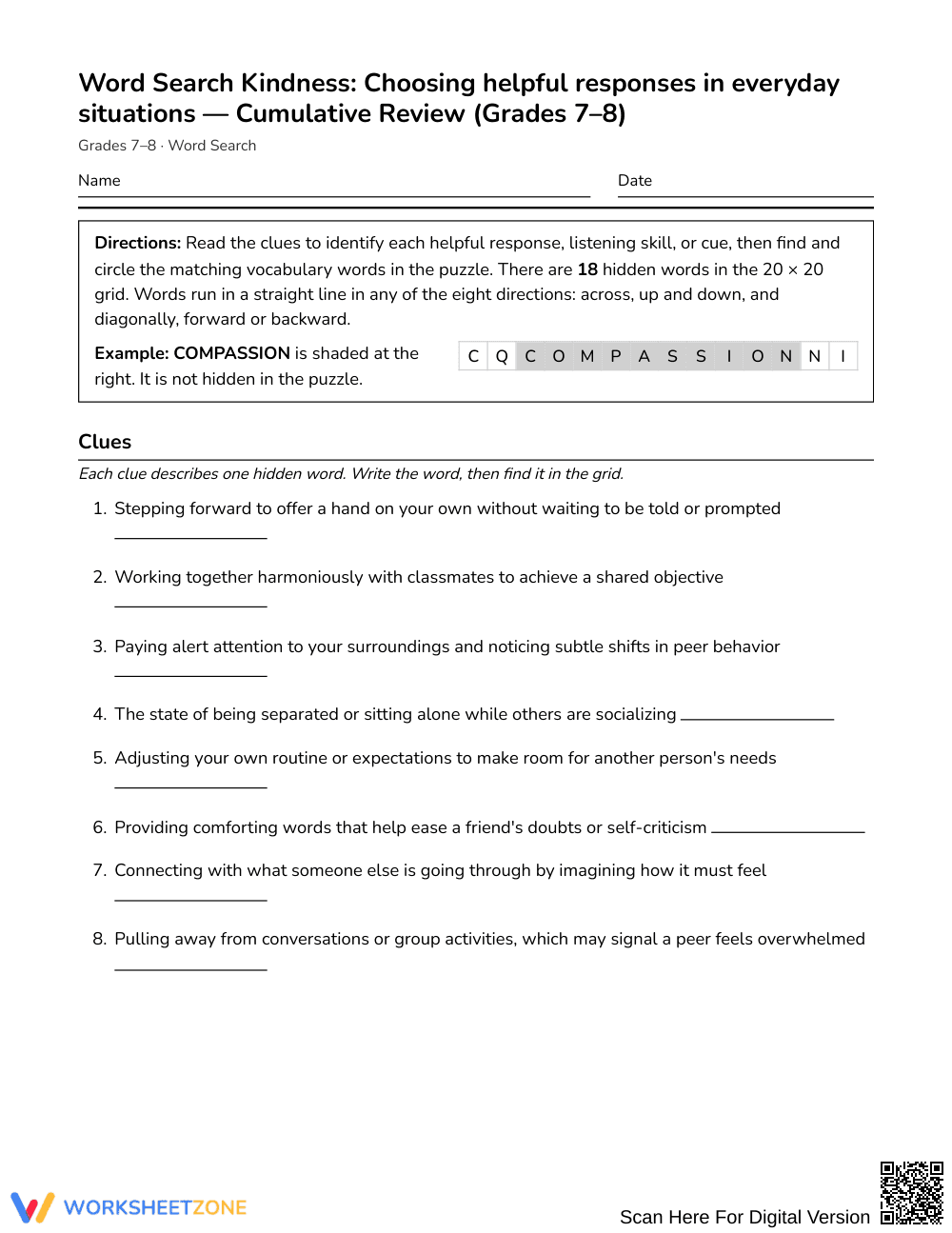
This Grades 7–8 word search reinforces essential vocabulary for choosing helpful responses in everyday social situations. Students connect definitions of peer support, active listening, and social awareness to target terms while locating each entry in a grid puzzle. The activity builds practical behavioral literacy and empathy through engaging, self-directed vocabulary reinforcement.
At a Glance
- Grade: Grades 7–8 · Subject: Behavior Worksheets
- Standard: Not standards-assessed — vocabulary enrichment
- Skill Focus: Choosing helpful responses in everyday situations
- Format: 3 pages · 18 words · Answer key included · PDF
- Best For: Advisory, homeroom, or independent behavioral review
- Time: 20–30 minutes
What's Inside
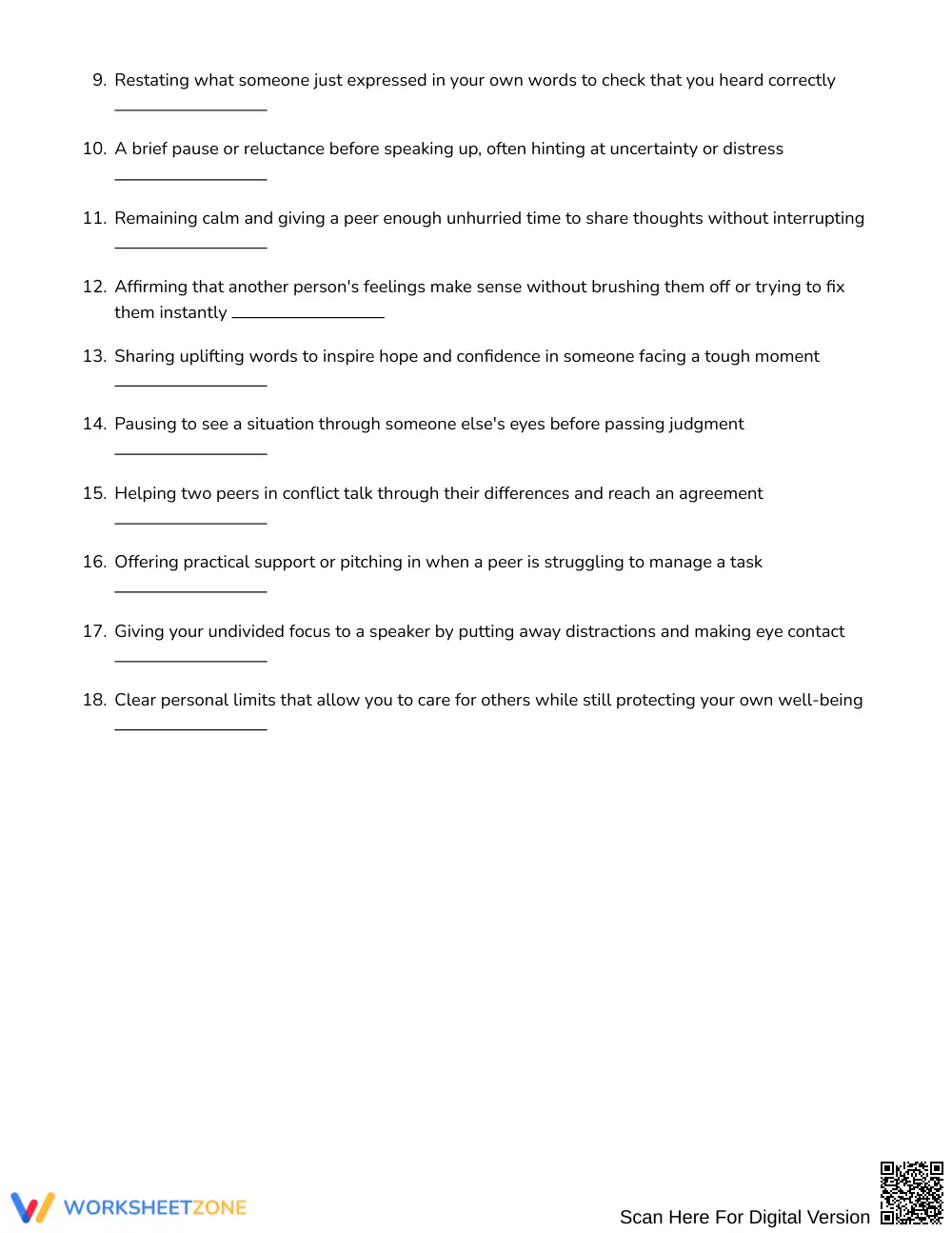
Inside this 3-page printable set, students receive an 18-word puzzle accompanied by contextual clues and a shuffled word bank. Rather than merely scanning for letters, learners read descriptive clues defining actions like mediation, validation, and attentiveness before tracking down each hidden term. A comprehensive 4-page answer key provides clear grid solutions for effortless verification.
Puzzle Mechanics
The puzzle is constructed on an expansive 20 x 20 grid designed to challenge middle school learners. Words are placed in all eight directions: North, Northeast, East, Southeast, South, Southwest, West, and Northwest. Students use the clue list to identify concepts, cross-reference the shuffled word bank, and scan the dense letter matrix horizontally, vertically, and diagonally.
Standards Alignment
This resource serves as targeted vocabulary enrichment and is not aligned to an academic content standard. Instead, it supports character education and social-emotional development by defining 18 foundational interpersonal skills. Counselors and classroom educators can use this terminology to establish shared behavioral expectations across advisory and counseling environments.
How to Use It
Use this word search after direct instruction on active listening to reinforce communication concepts, or assign it during advisory periods as a reflective opener. During completion, circulate to observe whether students recognize subtle social cue terms like withdrawal and hesitation. Most middle school learners finish the search within 20 to 30 minutes of focused independent work.
Who It's For
This resource is tailored for general education students in Grades 7–8, advisory groups, and peer mediation teams exploring conflict resolution. For students needing support, encourage highlighting clue keywords before searching the grid. Pair this activity with a classroom role-play scenario on choosing supportive responses to bridge vocabulary into real-world practice.
Explicit instruction in social-emotional vocabulary equips middle school learners with the language necessary for resolving peer conflict, demonstrating empathy, and choosing helpful responses in everyday situations. According to research from Fisher & Frey (2014), intentional word exposure paired with meaningful definitions significantly strengthens conceptual retention and enables students to transfer interpersonal concepts into daily social interactions. When adolescents learn to identify specific behaviors such as active listening, peer validation, and personal boundaries, they develop higher social awareness and emotional self-regulation. Structuring these competencies into clue-based puzzle activities reinforces cognitive recognition while providing a non-threatening, self-paced learning environment. By engaging with 18 distinct communication terms across an extensive grid, students internalize essential strategies for positive school climate interactions. This vocabulary-building foundation ensures that secondary students possess both the expressive language and the behavioral awareness needed to handle complex peer dynamics with confidence.


