




























Ready Juneteenth Word Search | Grades 4–5 Social Studies
Paste this activity's link or code into your existing LMS (Google Classroom, Canvas, Teams, Schoology, Moodle, etc.).
Students can open and work on the activity right away, with no student login required.
You'll still be able to track student progress and results from your teacher account.
This Juneteenth word search strengthens Grades 4–5 students' understanding of historical documents and primary sources through vocabulary retrieval. By reading contextual clues and identifying Civil War and Reconstruction terms, learners build background knowledge about emancipation, General Order No. 3, and nineteenth-century freedom struggles.
At a Glance
- Grade: Grades 4–5 · Subject: Social Studies · African American History
- Standard: Not standards-assessed — vocabulary enrichment and primary source literacy
- Skill Focus: Historical documents, primary sources, and emancipation vocabulary
- Format: 3 pages · 14 words · Answer key included · PDF
- Best For: Juneteenth history units, introductory vocabulary review, and holiday enrichment
- Time: 20–30 minutes
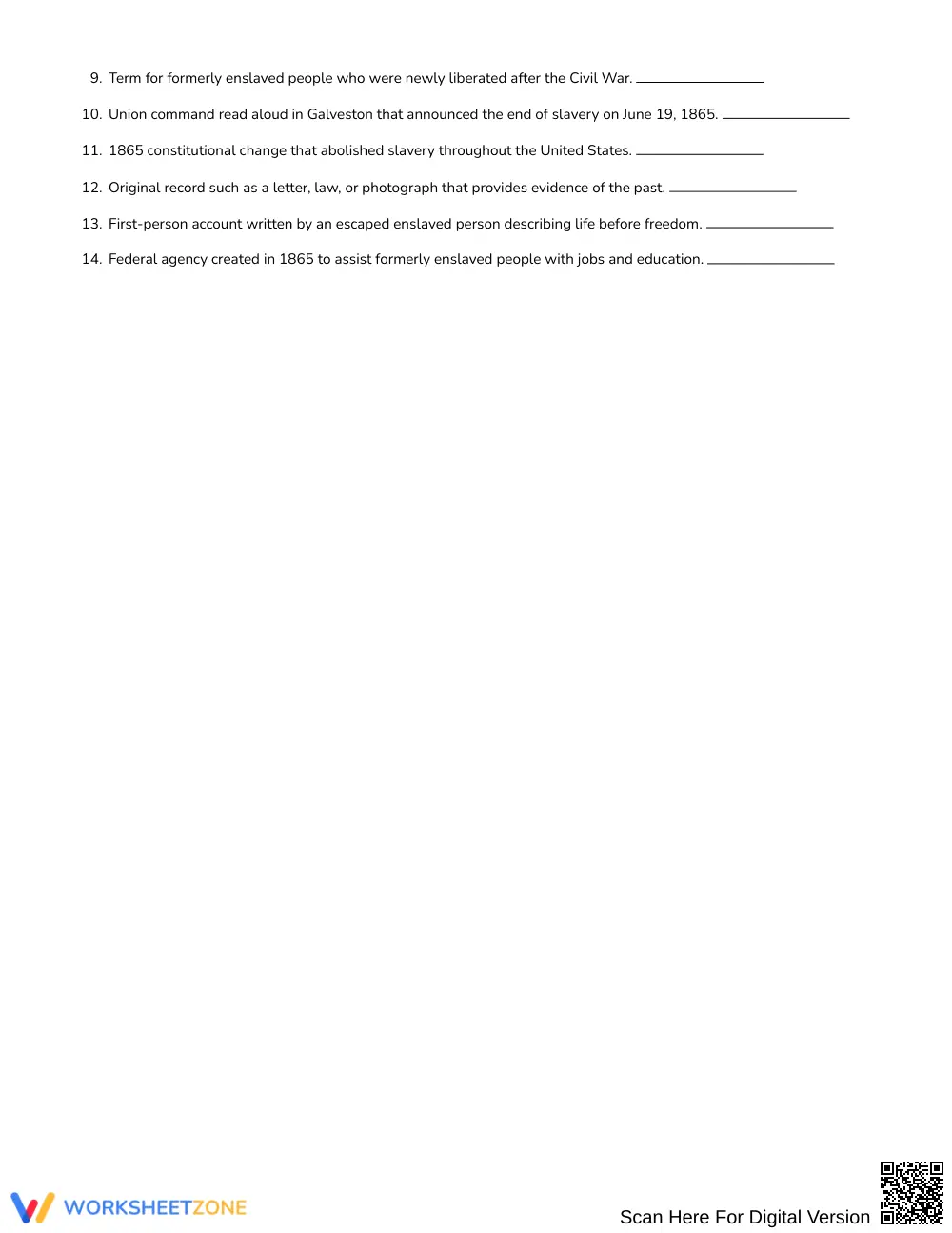
This 3-page printable resource includes a student puzzle page, a definition clue sheet, and a 3-page answer key. The activity challenges learners to find 14 words hidden in the grid. Rather than scanning a plain list, students read clue definitions covering historical concepts like the Emancipation Proclamation and Thirteenth Amendment before locating each term.
The puzzle features a 24 x 24 letter grid where 14 words run in four distinct directions: northeast, east, southeast, and south. A shuffled word bank pairs each entry with an informative historical clue, prompting students to interpret primary source concepts before scanning the grid for target vocabulary.
This resource provides vocabulary enrichment and is not aligned to a standard. It supports upper elementary social studies units by strengthening content-area vocabulary related to African American history and primary source analysis, reinforcing historical comprehension without formal standardized testing constraints.
Use this word search before direct instruction to introduce key concepts or after direct instruction to consolidate vocabulary following a Juneteenth lesson. While learners work, observe which clues cause hesitation to gauge understanding of specific historical documents. Most students complete the activity within 20 to 30 minutes.
This activity is designed for Grades 4–5 social studies classes, enrichment blocks, and Juneteenth celebrations. Support emerging readers by reading clues aloud in small groups, while advanced learners write summaries using selected terms. Pair this puzzle with an anchor chart timeline of emancipation or a primary source reading.
Building domain-specific vocabulary around historical documents and primary sources directly enhances content comprehension in upper elementary social studies classrooms. Although designed as an unaligned enrichment activity rather than a formal assessment of a specific standard code, this 14-word Juneteenth puzzle reinforces essential academic terminology, including constitutional amendments, federal agencies, and historical decrees. Research from Fisher & Frey (2014) emphasizes that intentional exposure to content-area vocabulary through paired informational clues and interactive tasks strengthens conceptual retention and contextual understanding. By connecting concise historical definitions to visual search exercises, students actively process core concepts surrounding emancipation and Reconstruction rather than memorizing isolated facts. This structured vocabulary enrichment bridges critical background knowledge gaps, effectively preparing Grades 4–5 learners to analyze complex informational texts, evaluate authentic primary source evidence, and engage meaningfully with nineteenth-century American history across varied classroom learning environments.


