































Ready Genotype & Phenotype Worksheet | Grades 8-12 Science

Paste this activity's link or code into your existing LMS (Google Classroom, Canvas, Teams, Schoology, Moodle, etc.).
Students can open and work on the activity right away, with no student login required.
You'll still be able to track student progress and results from your teacher account.
Mastering genetic inheritance requires learners to connect molecular alleles to observable traits. This comprehensive 4-page genetics worksheet guides middle and high school students through 34 structured tasks to construct, complete, and revise scientific models showing how genotypes dictate phenotypes across diverse inheritance patterns and real-world environmental conditions.
At a Glance
- Grade: Grades 8–12 · Subject: Science
- Standard: Developing and Using Models — Construct and revise scientific models illustrating components, interactions, and observable traits
- Skill Focus: Construct, complete, and revise biological models
- Format: 4 pages · 34 problems · Answer key included · PDF
- Best For: Direct genetics instruction and practice
- Time: 45–60 minutes
What's Inside
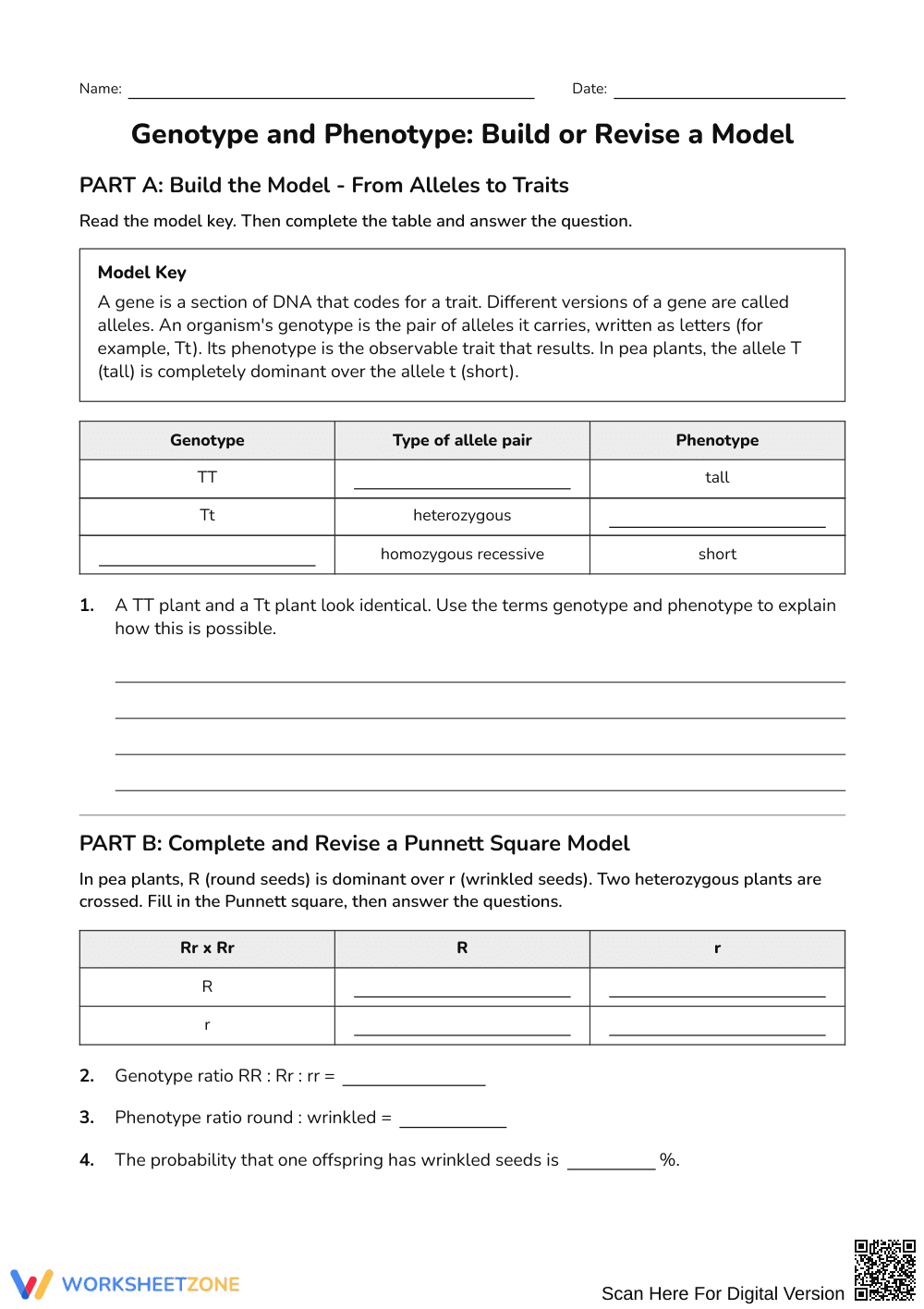
The activity spans four sequential sections moving from conceptual model keys to quantitative data analysis. Students complete allele-to-trait lookup tables, fill out and critique a monohybrid Punnett square, expand models to accommodate incomplete dominance and codominance, and trace a biochemical flowchart from DNA to functional proteins. A complete 4-page teacher answer key provides sample explanations and error analyses.
Skill Progression
- Guided Practice (Part A): 8 introductory tasks anchor core vocabulary using a model key, prompting students to differentiate homozygous from heterozygous genotypes and explain phenotype masking.
- Supported Practice (Parts B & C): 16 scaffolded tasks require students to calculate 3:1 and 1:2:1 ratios, revise a flawed student claim, and extend inheritance models to snapdragons and human ABO blood types.
- Independent Practice (Part D): 10 evaluation tasks challenge students to trace transcription and translation through a flow diagram, contrast genetic versus environmental factors, and test theoretical ratios against empirical class data.
This structured progression follows the gradual-release framework, moving learners purposefully from teacher-modeled principles to independent scientific evaluation.
Standards Alignment
This worksheet targets core secondary science standards for developing and using models to predict inheritance outcomes and describe structural relationships. It supports related life science objectives concerning gene expression and protein synthesis. Both standard descriptions can be copied directly into lesson plans, IEP goals, or district curriculum mapping tools.
How to Use It
Implement this resource immediately after direct instruction on Mendelian genetics, or utilize it as a mid-unit formative check. During seatwork, observe how students approach the Part B model critique to identify misconceptions regarding dominance versus deterministic frequency. Most students complete the full 34-task worksheet in 45 to 60 minutes.
Who It's For
Designed for general biology, life science, and introductory genetics courses in grades 8 through 12, this resource includes explicit visual keys that support English language learners and striving readers. Pair this activity directly with a hands-on allele simulation or an introductory lecture on monohybrid crosses.
According to Fisher & Frey (2014), scaffolded modeling activities facilitate cognitive transfer by explicitly bridging conceptual definitions and quantitative application. By constructing Punnett squares, revising flawed peer claims, and evaluating empirical pea plant counts against theoretical expectations, students systematically deepen their grasp of genotype-to-phenotype expression. The 34 targeted prompts prompt learners to articulate how DNA sequences dictate protein synthesis while recognizing environmental influences on final morphology. Educational research demonstrates that structured modeling tasks combined with clear corrective feedback accelerate scientific literacy and analytical reasoning across diverse secondary science learning environments.


