































Ready Genotype & Phenotype Worksheet | Grades 8–12 Science

Paste this activity's link or code into your existing LMS (Google Classroom, Canvas, Teams, Schoology, Moodle, etc.).
Students can open and work on the activity right away, with no student login required.
You'll still be able to track student progress and results from your teacher account.
This Grades 8–12 science worksheet guides students through scientific inquiry by isolating independent and dependent variables in genotype and phenotype experiments. Students differentiate environmental from genetic trait influences, interpret experimental plant growth data, and use genetic crosses to predict phenotype frequencies with precision.
At a Glance
- Grade: Grades 8–12 · Subject: Science
- Standard: Investigate how genetic factors and environmental conditions interact to influence observable physical traits
- Skill Focus: Investigation & Variables in genotype and phenotype
- Format: 4 student pages · 31 structured problems · Full answer key included · Printable PDF
- Best For: Mid-unit lab synthesis and summative assessment practice
- Time: 45–60 minutes
What's Inside
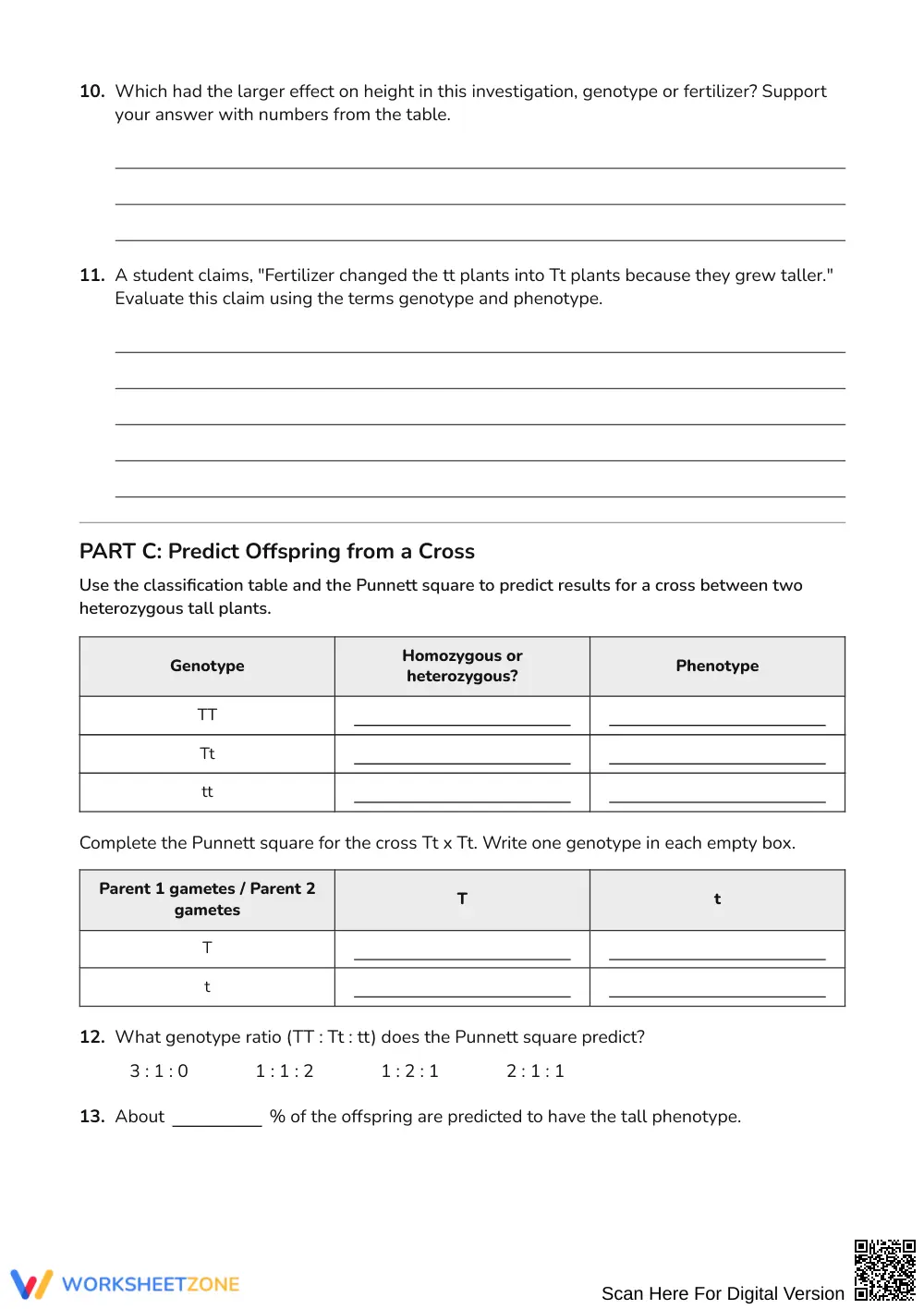
The 4-page student activity features 31 targeted items across four investigative stages. It combines a pea plant growth scenario, data tables, variable identification questions, Punnett squares, and claim-evaluation prompts. A 4-page teacher answer key provides full model responses and quantitative justifications for fast grading.
Skill Progression
- Guided practice (Part A – 7 problems): Students analyze a botanical experiment, identifying independent variables, dependent variables, constants, and controls under guided scenario prompts.
- Supported practice (Parts B & C – 16 problems): Learners evaluate plant data tables, assess inheritance claims, and complete Punnett squares to calculate phenotypic ratios.
- Independent practice (Part D – 8 problems): Students independently examine non-Mendelian inheritance, predicting traits for incomplete dominance and codominance.
This sequence follows a gradual-release model, shifting from structured experimental design to autonomous genetic analysis.
Standards Alignment
This investigation directly aligns with middle and high school life science standards addressing heredity and gene expression. Students analyze how environmental and genetic factors interact to influence phenotype. These standard alignment descriptions can be copied directly into lesson plans, IEP goals, or district curriculum mapping tools.
How to Use It
Use this resource after direct instruction on Mendelian inheritance and experimental design. It serves effectively as a paired lab-analysis activity before independent assessment. Formatively assess students during Part B by checking whether they recognize that fertilizer alters physical phenotype without modifying plant genotype. Expected completion time is 45 to 60 minutes.
Who It's For
This resource supports middle and high school biology students learning experimental variables and genetics. Scaffolds help struggling learners interpret data tables, while extension prompts challenge advanced students with non-Mendelian crosses. Pair this worksheet with direct instruction on Punnett squares or a live plant experiment.
Scientific inquiry in genetics requires students to isolate experimental variables, interpret quantitative phenotypic data, and evaluate how environmental factors influence observable physical characteristics. According to Fisher & Frey (2014), structuring secondary science tasks through intentional gradual release accelerates conceptual understanding by transitioning students from guided experimental deconstruction to independent analysis of inheritance patterns. When secondary science students actively differentiate between genetic inheritance and environmental influences using structured data tables and Punnett squares, they develop critical scientific argumentation skills that prevent common misconceptions regarding trait inheritance. The 31 structured tasks in this 4-page resource ensure learners systematically analyze independent variables, calculate theoretical phenotypic ratios, and critique scientific claims. By integrating quantitative data analysis with qualitative biological reasoning, educators provide rigorous, evidence-based instruction that prepares students in grades 8 through 12 for advanced life science investigations.


