































Ready Genetic vs Environmental Worksheet | Grade 9 Biology

Paste this activity's link or code into your existing LMS (Google Classroom, Canvas, Teams, Schoology, Moodle, etc.).
Students can open and work on the activity right away, with no student login required.
You'll still be able to track student progress and results from your teacher account.
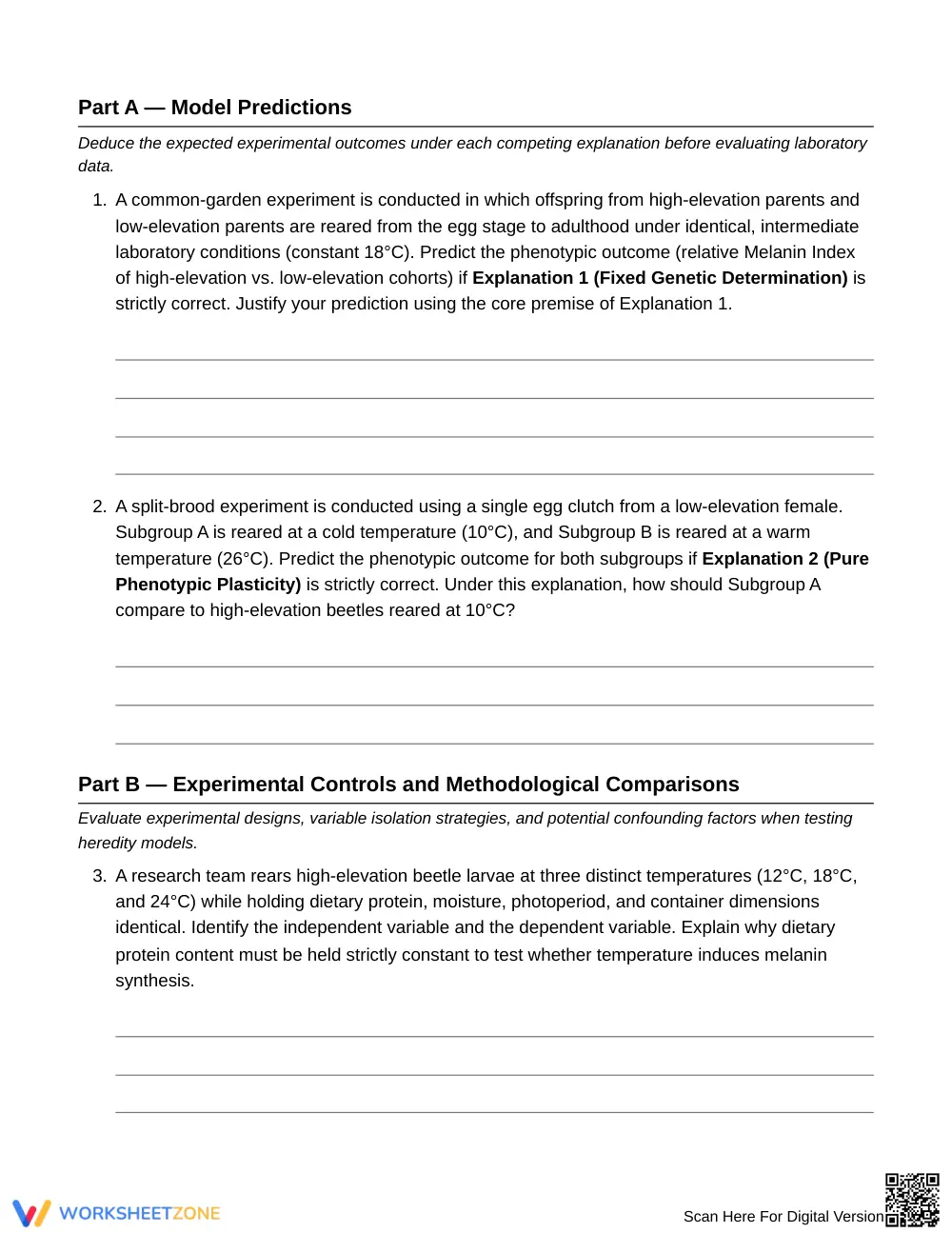
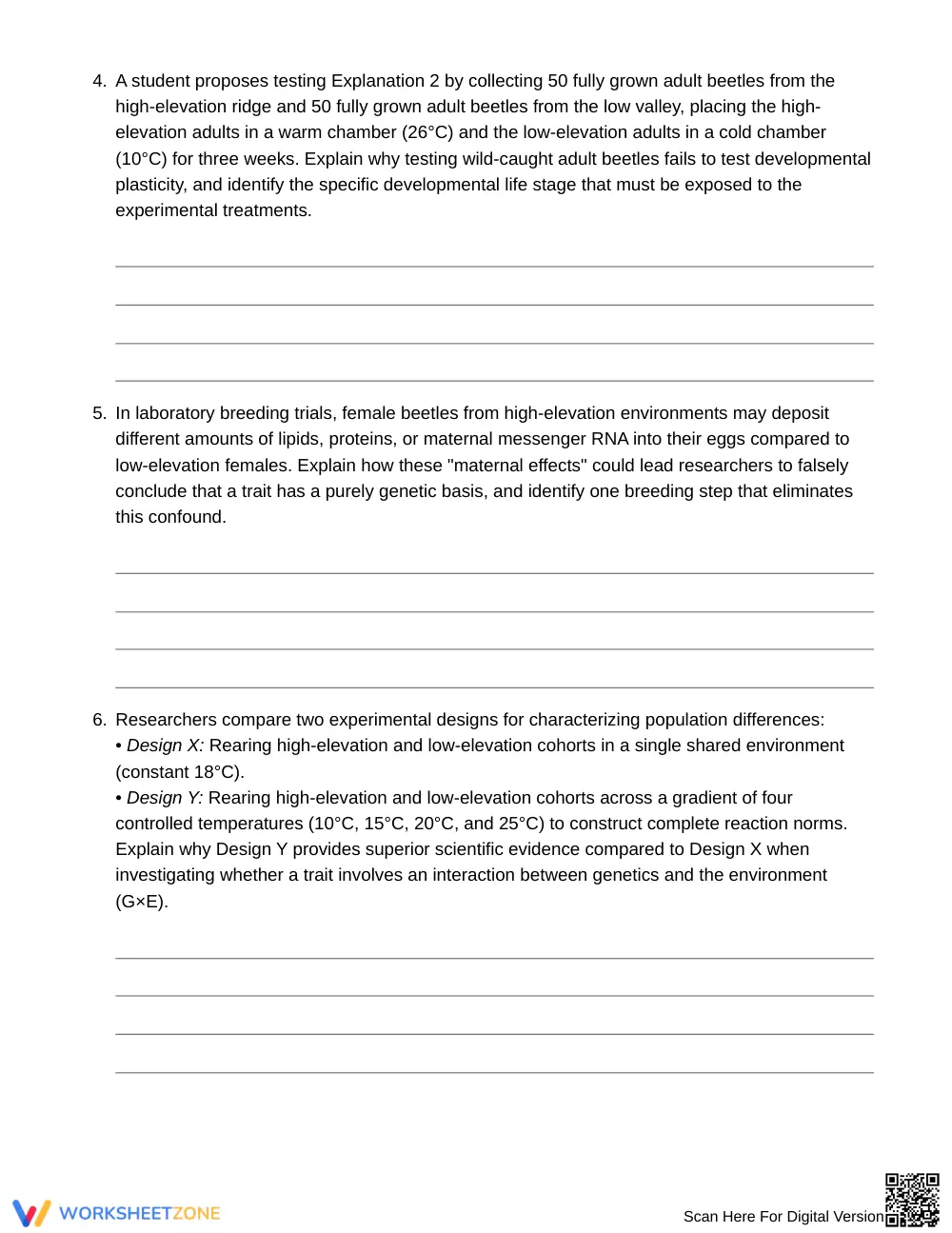
This Grade 9 biology worksheet equips students to evaluate genetic factors versus environmental phenotypic plasticity. Anchored in a subalpine beetle case study, learners analyze controls, assess split-clutch trials, and formulate scientific explanations demonstrating how genotype and developmental temperature interact to shape organism coloration.
At a Glance
- Grade: 9 · Subject: Biology
- Standard: Heredity Modeling — Compare genetic and environmental factors that produce phenotypic variation in biological systems
- Skill Focus: Compare Genetic and Environmental Explanations
- Format: 5 pages · 10 problems · Full answer key included · PDF
- Best For: Genetics and phenotypic plasticity core unit instruction
- Time: 45–60 minutes
This 5-page worksheet provides 10 analytical problems set within a biological model organism. Students evaluate common-garden tests, maternal effects, reaction norms, and a synthetic F2 data matrix. A complete 4-page answer key provides comprehensive theoretical explanations and sample student justifications.
Skill Progression
- Guided Practice (Problems 1–2): Students apply theoretical premises to predict phenotypic outcomes in common-garden and split-brood setups under competing genetic and plasticity models.
- Supported Practice (Problems 3–8): Learners evaluate variable isolation, developmental timing, maternal confounds, and reaction norms across six experimental design tasks.
- Independent Practice (Problems 9–10): Students analyze quantitative F2 thermal rearing data to refute binary models and discriminate between thermal-induction and UV-induction hypotheses.
This sequence follows a gradual release of responsibility model, guiding students from conceptual prediction to autonomous empirical data evaluation.
Standards Alignment
Aligned with high school life science standards for Heredity and Biological Evolution, this activity guides students to construct evidence-based explanations for how environmental and genetic factors jointly shape phenotypes. Learners evaluate experimental protocols that isolate genetic variation from environmental triggers. Both standard codes can be copied directly into lesson plans, IEP goals, or district curriculum mapping tools.
How to Use It
Implement this worksheet after direct instruction on heredity and phenotypic variation. Have students work through the beetle investigation in pairs during a 50-minute class period. Formatively check Part C responses to verify that students recognize intermediate phenotypes as evidence against pure genetic determinism. This resource also functions effectively as a summative post-lab assessment.
Who It's For
This activity suits Grade 9 biology, honors biology, and AP Biology students analyzing biological data. Provide sentence frames for students interpreting reaction norms, or prompt advanced learners to graph the F2 data table. Pair this worksheet with an instructional lesson on gene expression or an anchor chart on gene-environment interactions.
According to Fisher & Frey (2014), structured progression from conceptual modeling to complex data analysis deepens secondary science comprehension by scaffolding disciplinary reasoning. This Grade 9 worksheet targets comparing genetic and environmental explanations of phenotypic variation through rigorous multi-step inquiry. Students examine model assumptions, evaluate controlled variables, and interpret split-clutch rearing data to deduce how environmental temperature and inherited traits jointly determine organism traits. Rather than accepting simplified nature-versus-nurture dichotomies, learners engage directly with reaction norms, maternal effects, and empirical evidence to construct sophisticated biological conclusions. The resource includes 10 structured analytical problems spanning 5 student pages, prompting rigorous scientific discourse. Furthermore, the accompanying 4-page answer key provides explicit reasoning criteria, enabling educators to diagnose misconceptions regarding phenotypic plasticity and genetic architecture with precision across 45 to 60 minutes of focused classroom work.


