



























Ready Frog Dissection Variables Worksheet | Grade 7 Science
Paste this activity's link or code into your existing LMS (Google Classroom, Canvas, Teams, Schoology, Moodle, etc.).
Students can open and work on the activity right away, with no student login required.
You'll still be able to track student progress and results from your teacher account.
This comprehensive science resource guides middle and high school students through scientific inquiry, experimental design, and digestive anatomy. Students examine frog organ systems and analyze a controlled digestion thought experiment to isolate independent variables, controls, and measurable outcomes without requiring live animal specimens.
At a Glance
- Grade: Grades 7–12 · Subject: Life Science / Biology
- Standard: Scientific Inquiry — Define testable questions, identify experimental variables, and evaluate biological models
- Skill Focus: Experimental design, variable identification, and anatomical structure-function analysis
- Format: 4 pages · 25 problems · Answer key included · PDF
- Best For: Lab prep, inquiry unit practice, sub plan
- Time: 45–60 minutes
What's Inside
Across four student pages, learners engage with labeled anatomical diagrams, controlled experiment scenarios, quantitative data tables, and open-ended modeling tasks. A four-page complete teacher answer key provides sample explanations, variable classifications, and target response criteria.
Skill Progression
- Guided practice (Part A): Students identify internal frog anatomy from a ventral view and connect digestive structures to physiological functions using clear visual cues.
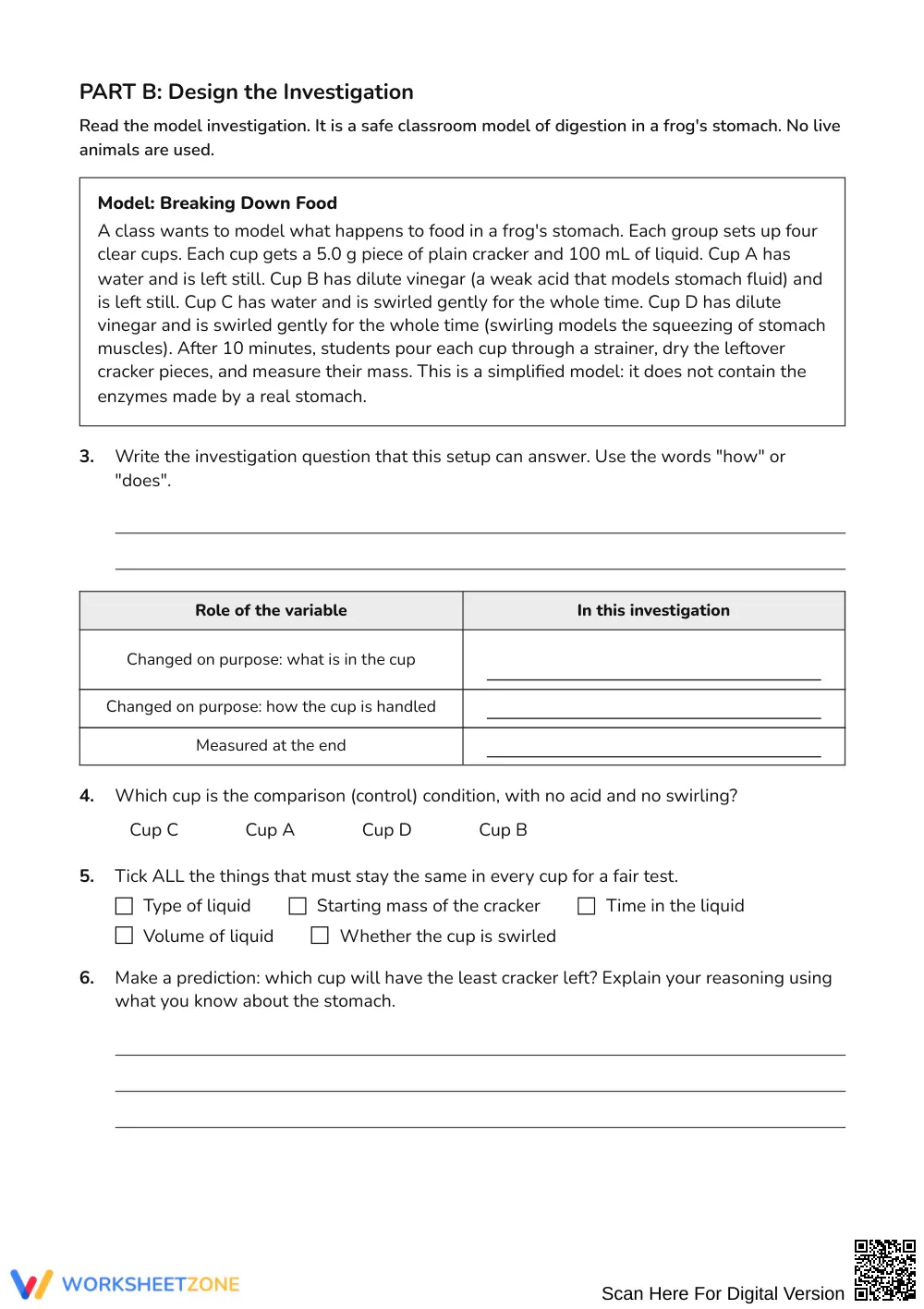
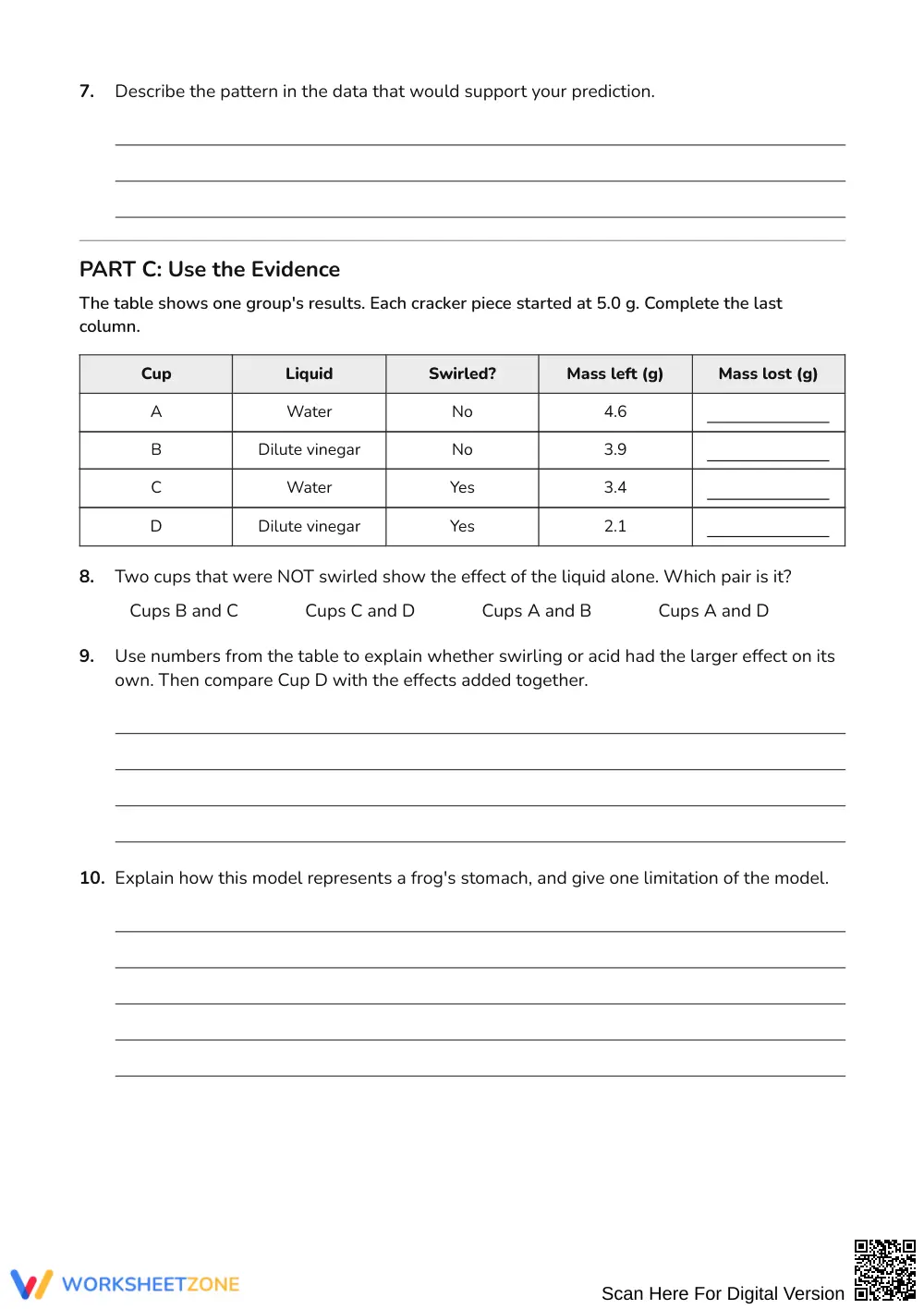
- Supported practice (Parts B & C): Learners analyze a four-cup digestion investigation, identifying independent variables, dependent measures, constants, and quantitative mass-loss patterns.
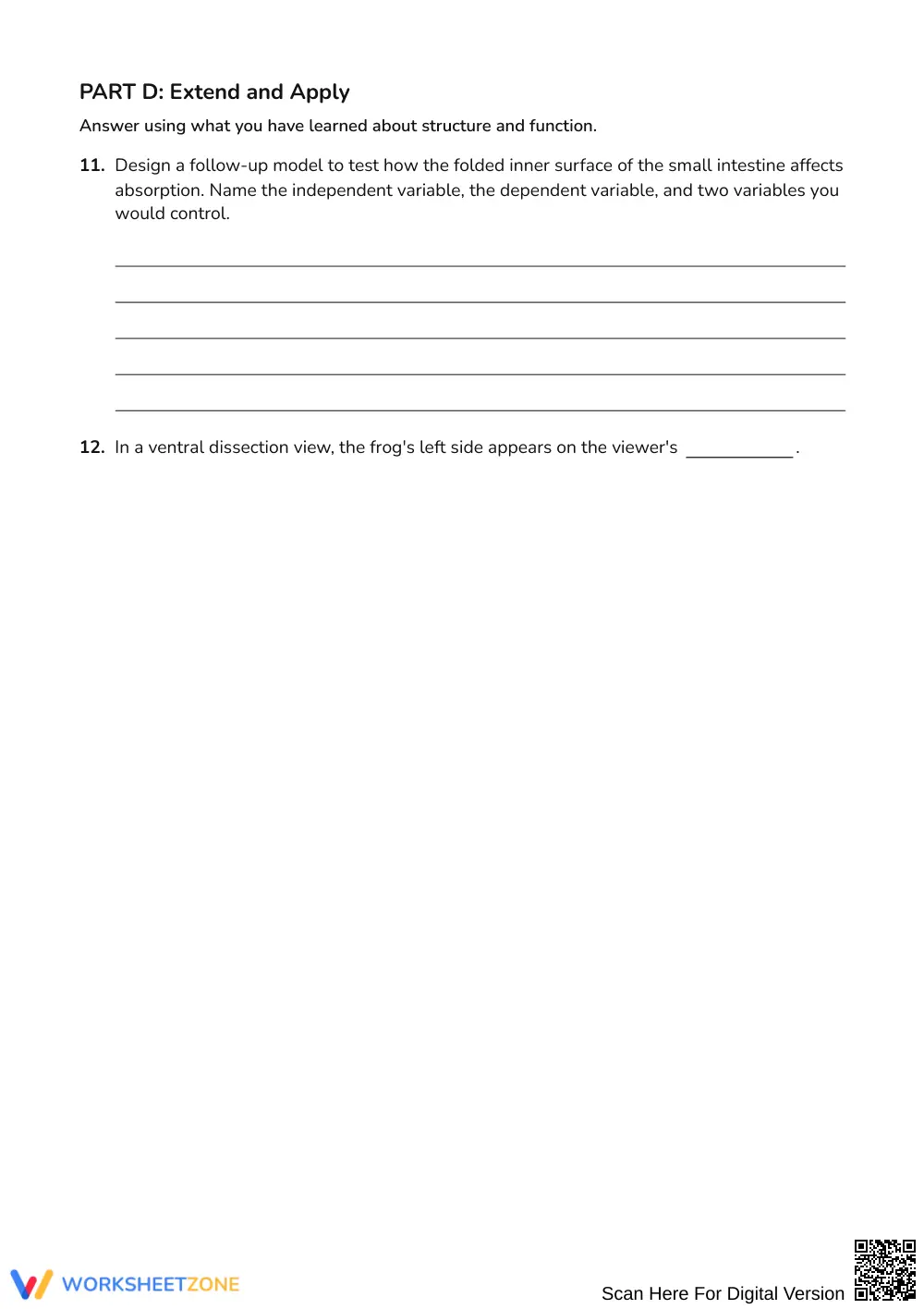
- Independent practice (Part D): Students independently formulate a follow-up experimental model testing how folded intestinal surface area impacts liquid absorption.
This sequence reinforces student independence through a structured gradual-release model of inquiry instruction.
Standards Alignment
This activity aligns with middle and high school life science inquiry objectives focusing on developing and using models to demonstrate animal digestive systems, as well as planning and carrying out investigations. Students formulate testable questions, identify controlled variables, and interpret experimental evidence to support scientific explanations. These learning targets can be copied directly into lesson plans, IEP goals, or district curriculum mapping tools.
How to Use It
Assign Part A immediately following direct instruction on organ systems as an anatomical check for understanding. Use Parts B through D during guided inquiry practice to reinforce how physical churning and chemical breakdown interact. For formative assessment, observe whether students identify Cup A as the baseline control condition before calculating cracker mass loss. Expect completion within 45 to 60 minutes.
Who It's For
This worksheet serves general biology and life science students in grades 7 through 12, offering an ethical alternative or conceptual pre-lab before physical dissections. Pair this resource directly with an interactive organ system anchor chart or a hands-on chemical digestion lab.
According to Fisher & Frey (2014), student mastery of complex scientific practices accelerates when instructional tasks transition systematically from guided anatomical observations to independent experimental design. This four-page science worksheet operationalizes that pedagogical framework by first establishing anatomical literacy before challenging secondary learners to define testable hypotheses, isolate independent variables, and evaluate experimental limitations in digestive modeling. By bridging concrete organ structure with quantitative investigation analysis, learners build durable conceptual understandings of biological systems and empirical scientific methods across every structured exercise. Furthermore, integrating controlled simulated trials enables students to practice isolating constants without the management demands or ethical constraints of traditional wet specimen dissections. As students evaluate cracker mass loss across simulated digestive fluids, they gain essential practice translating qualitative anatomical diagrams into rigorous empirical data. Ultimately, this scaffolded sequence ensures all students master core biological inquiry fundamentals effectively.


