



























Ready Flower Life Cycles Word Search | Grades 3–4 Science
Paste this activity's link or code into your existing LMS (Google Classroom, Canvas, Teams, Schoology, Moodle, etc.).
Students can open and work on the activity right away, with no student login required.
You'll still be able to track student progress and results from your teacher account.
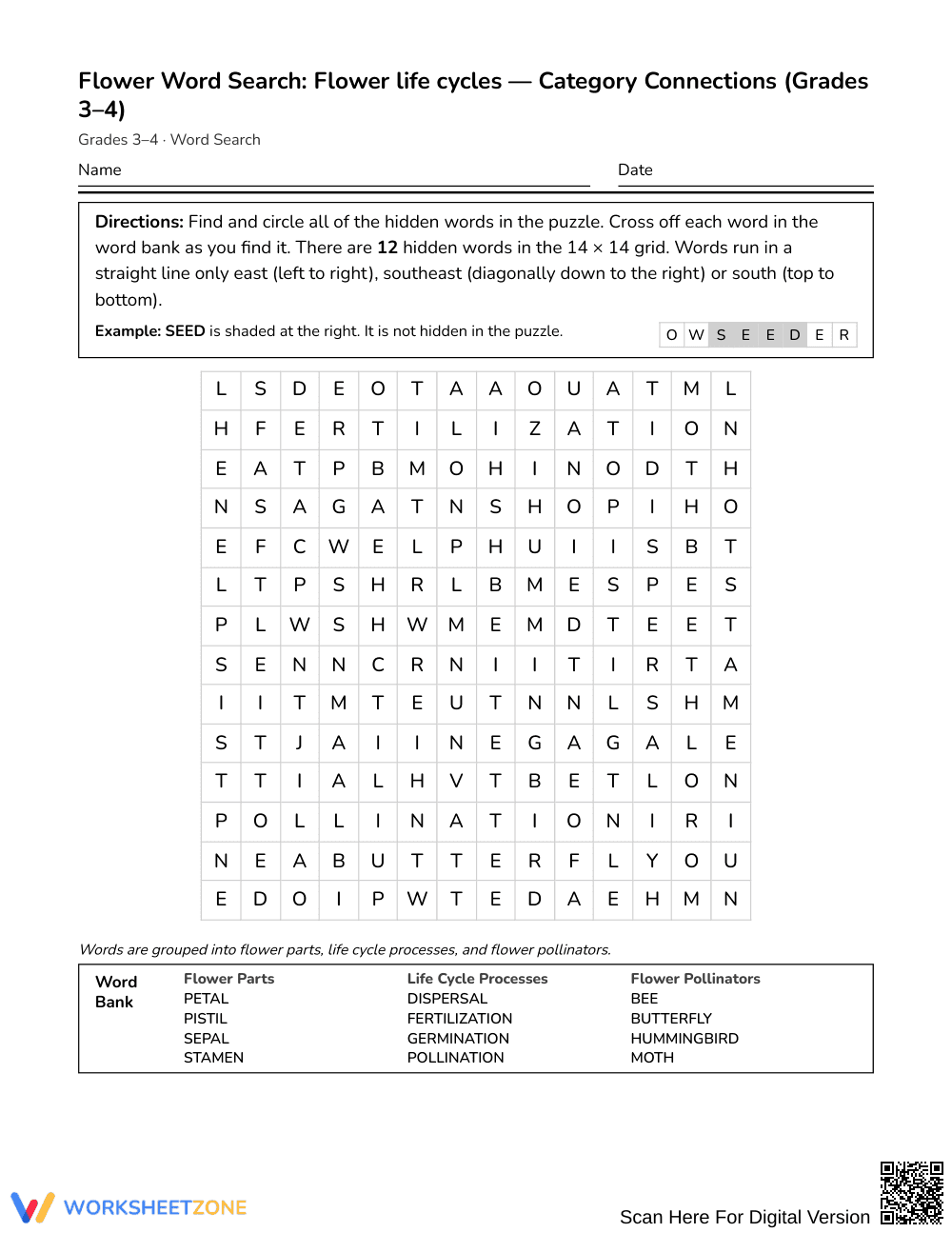
This Grades 3–4 science word search reinforces essential flower life cycles terminology through focused vocabulary recognition. Students identify and circle 12 foundational botanical terms organized into thematic categories, helping young learners connect plant anatomy, reproductive processes, and pollination partners to deepen conceptual comprehension across elementary life science units.
At a Glance
- Grade: Grades 3–4 · Subject: Science
- Standard: Not standards-assessed — vocabulary enrichment and botanical concept reinforcement
- Skill Focus: Flower life cycles and plant reproduction vocabulary
- Format: 1 page · 12 words · Full 3-page answer key included · Printable PDF
- Best For: Science centers, fast finishers, and emergency sub plans
- Time: 15–25 instructional minutes
What's Inside
The single-page printable student activity sheet features a 12-word search puzzle supported by an organized category word bank and concise definition clues. The resource includes a thorough 3-page answer key displaying full letter-grid solutions for immediate teacher verification or student self-checking. Vocabulary terms are arranged into three botanical domains: flower parts, life cycle processes, and flower pollinators.
How the Puzzle Works
The activity centers on a 14 x 14 letter grid configured for accessible elementary problem-solving. Words run in three predictable reading directions: East (left to right), Southeast (diagonal downward), and South (top to bottom). Because letters do not run backward or upward, third and fourth graders maintain visual traction while scanning. Students cross off words from categorized lists while reviewing definitions that explain biological roles.
Standards Alignment
This learning activity provides targeted vocabulary enrichment rather than formal standards-assessed skill measurement. While not aligned to an individual state or national science standard code, the activity strengthens domain-specific academic vocabulary that underpins third- and fourth-grade life science instruction regarding plant traits, structures, and reproductive cycles.
How to Use It
Deploy this word search during your plant reproduction unit immediately following direct instruction on pollination and seed dispersal, or place it in an independent science center for spiral review. As students work, circulate formatively to ensure they can connect terms like stamen and pistil to their respective reproductive roles rather than merely scanning letters. Most students complete the activity within 15 to 25 minutes.
Who It's For
This resource is tailored for Grades 3–4 elementary science classrooms, environmental science clubs, and homeschool settings. Visual learners and multilingual students benefit from the categorized word bank, which groups related concepts logically. Pair this puzzle with an authentic flowering plant dissection lesson or an illustrated plant life cycle diagram to reinforce structural understanding.
Elementary science achievement depends heavily on mastery of domain-specific vocabulary, as unfamiliar botanical terminology frequently impedes reading comprehension during complex informational science units. According to Fisher & Frey (2014), intentional exposure to disciplinary vocabulary through contextual categorization and visual scanning solidifies conceptual associations before students encounter demanding informational texts and assessments. This Grades 3–4 flower life cycles word search targets 12 foundational botanical terms across plant anatomy, reproductive processes, and ecological pollinators within an accessible 14 x 14 grid. By pairing categorized word banks with explicit descriptive clues, the activity bridges passive vocabulary recognition and active scientific reasoning. Students reinforce critical biological connections among floral structures, pollination agents, and life cycle stages, establishing cognitive schema necessary for sustained academic growth in elementary life science inquiry, reading fluency, and long-term scientific literacy development.


