




























Views
Downloads



Ready Examples & Qualifications Worksheet | Grade 8 ELA

Paste this activity's link or code into your existing LMS (Google Classroom, Canvas, Teams, Schoology, Moodle, etc.).
Students can open and work on the activity right away, with no student login required.
You'll still be able to track student progress and results from your teacher account.
This Grade 8 informational text worksheet equips students to evaluate how authors develop arguments by connecting concrete data, qualifying conditions, and refined conclusions. Working with a policy report on municipal learning centers, students analyze how structural constraints reshape initial claims, preparing them to evaluate rhetorical cohesion in complex texts.
At a Glance
- Grade: 8 · Subject: English Language Arts
- Standard:
RI.8.5— Analyze how particular sentences and paragraphs develop and refine a key concept- Skill Focus: Connect Examples, Qualifications, and Refined Conclusions
- Format: 5 pages · 12 problems · Comprehensive answer key included · PDF
- Best For: Informational text structure and argument analysis
- Time: 40–50 instructional minutes
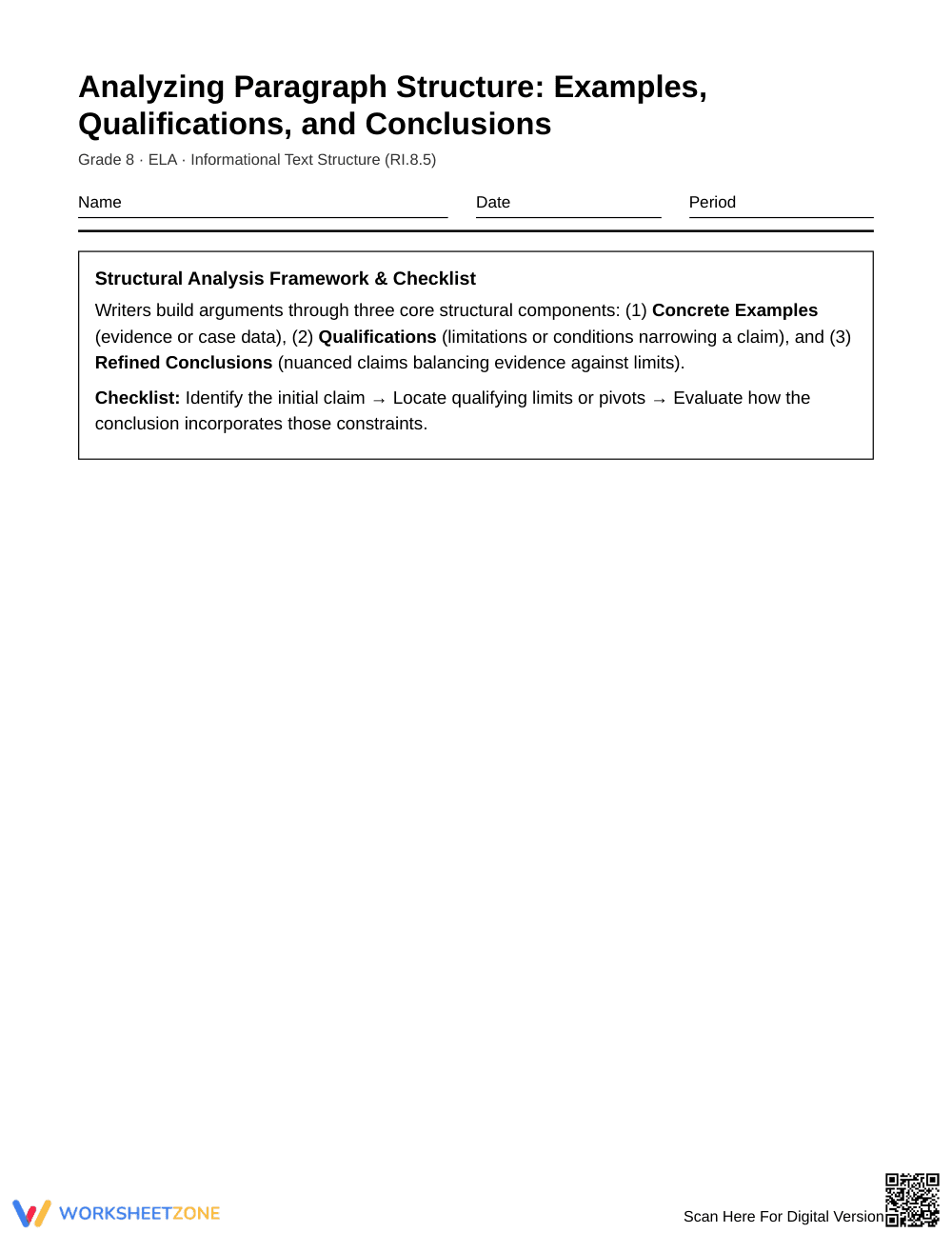
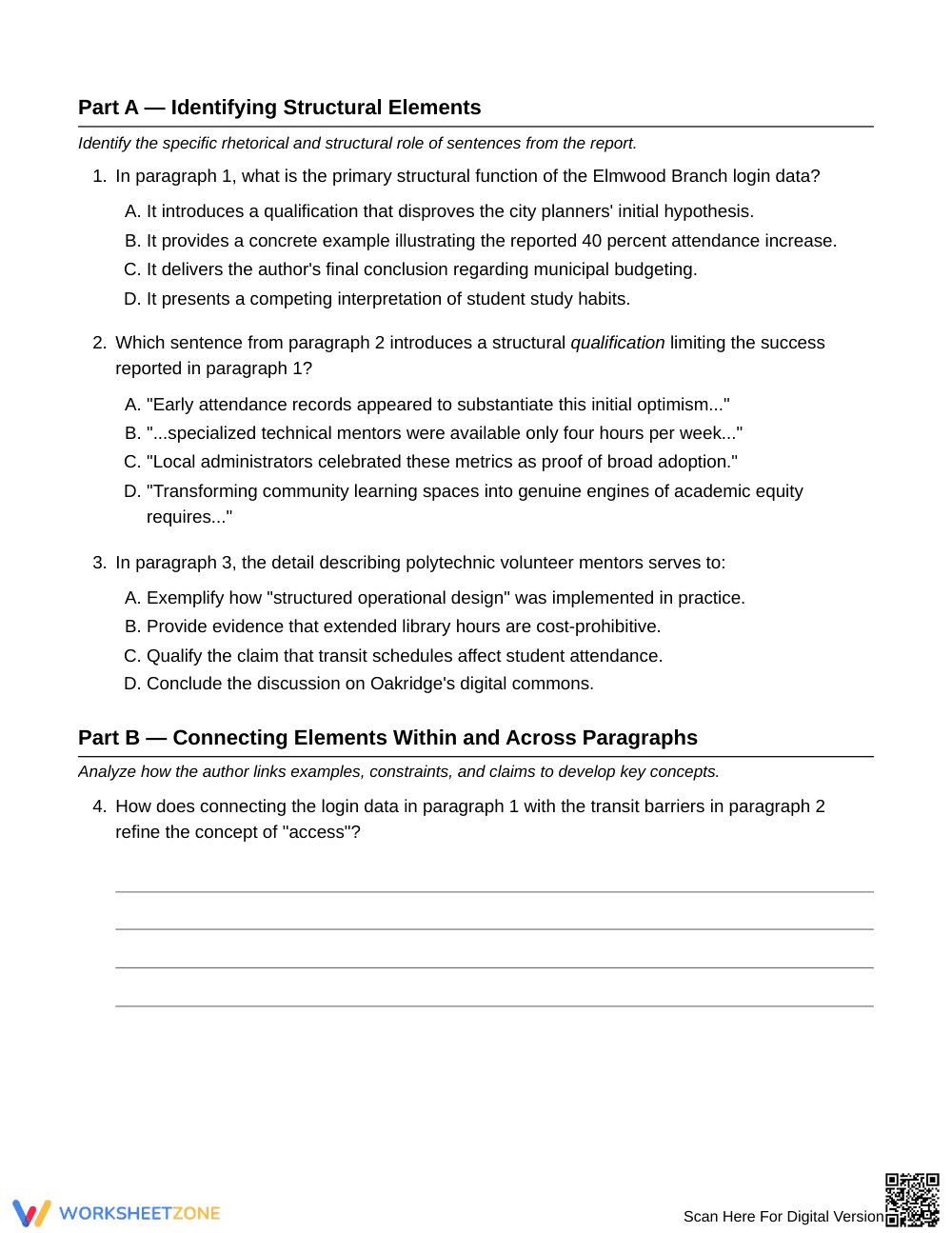
The 5-page packet features an informational passage detailing municipal learning spaces alongside a Structural Analysis Framework and Checklist. Across 12 tasks, students complete multiple-choice element identification, short-answer structural connections, and paragraph evaluations. A 3-page answer key provides complete exemplar justifications for each item.
Skill Progression
- Guided Practice (Part A, Problems 1–3): Multiple-choice questions prompt students to categorize sentences as data, qualifications, or operational examples using the checklist.
- Supported Practice (Part B, Problems 4–9): Open-ended and targeted prompts require students to explain how pivot words and limiting data connect concepts across paragraphs.
- Independent Practice (Part C, Problems 10–12): Synthesis prompts ask learners to evaluate whole-text structural effects and justify how balanced reasoning supports policy claims.
This sequence follows an explicit gradual-release model, building student independence from basic component labeling to advanced rhetorical evaluation.
Standards Alignment
This worksheet aligns to RI.8.5: "Analyze in detail the structure of a specific paragraph in a text, including the role of particular sentences in developing and refining a key concept." It also supports RI.8.8 by evaluating argument validity. Both standard codes can be copied directly into lesson plans, IEP goals, or district curriculum mapping tools.
How to Use It
Use this activity during guided close reading or as an after-instruction formative assessment. During independent practice, observe how students interpret transitions such as "however" and "even so" in Part B to verify they distinguish qualifications from primary evidence. The full worksheet takes 40 to 50 minutes to complete.
Who It's For
This resource serves Grade 8 ELA classrooms, advanced Grade 7 readers, and intervention groups targeting informational analysis. The integrated framework checklist supports English learners by defining core structural roles. Pair this printable with an anchor chart on transition signals or a direct instruction mini-lesson on text organization.
Under Common Core standard RI.8.5, Grade 8 students analyze how specific sentences and paragraph structures develop and refine central concepts. According to research in Fisher & Frey (2014), structured gradual-release frameworks significantly strengthen secondary reading comprehension by transitioning students from scaffolded feature identification to independent argumentative evaluation. Without deliberate instruction in structural functions, adolescent readers frequently mistake qualifying conditions for contradictory evidence. This 5-page educational resource applies those principles across 12 focused tasks, guiding learners through an evidence-based report on municipal learning hubs. By examining how authors link empirical attendance data, operational transit limits, and refined policy conclusions, students master the rhetorical architecture of complex informational texts. Complete with a 3-page explanatory answer key and an integrated analysis checklist, this printable packet provides verified instructional materials that directly measure and advance eighth-grade informational reading proficiency.


