
































Ready Endocrine System Word Search | Grades 8–10 Science

Paste this activity's link or code into your existing LMS (Google Classroom, Canvas, Teams, Schoology, Moodle, etc.).
Students can open and work on the activity right away, with no student login required.
You'll still be able to track student progress and results from your teacher account.
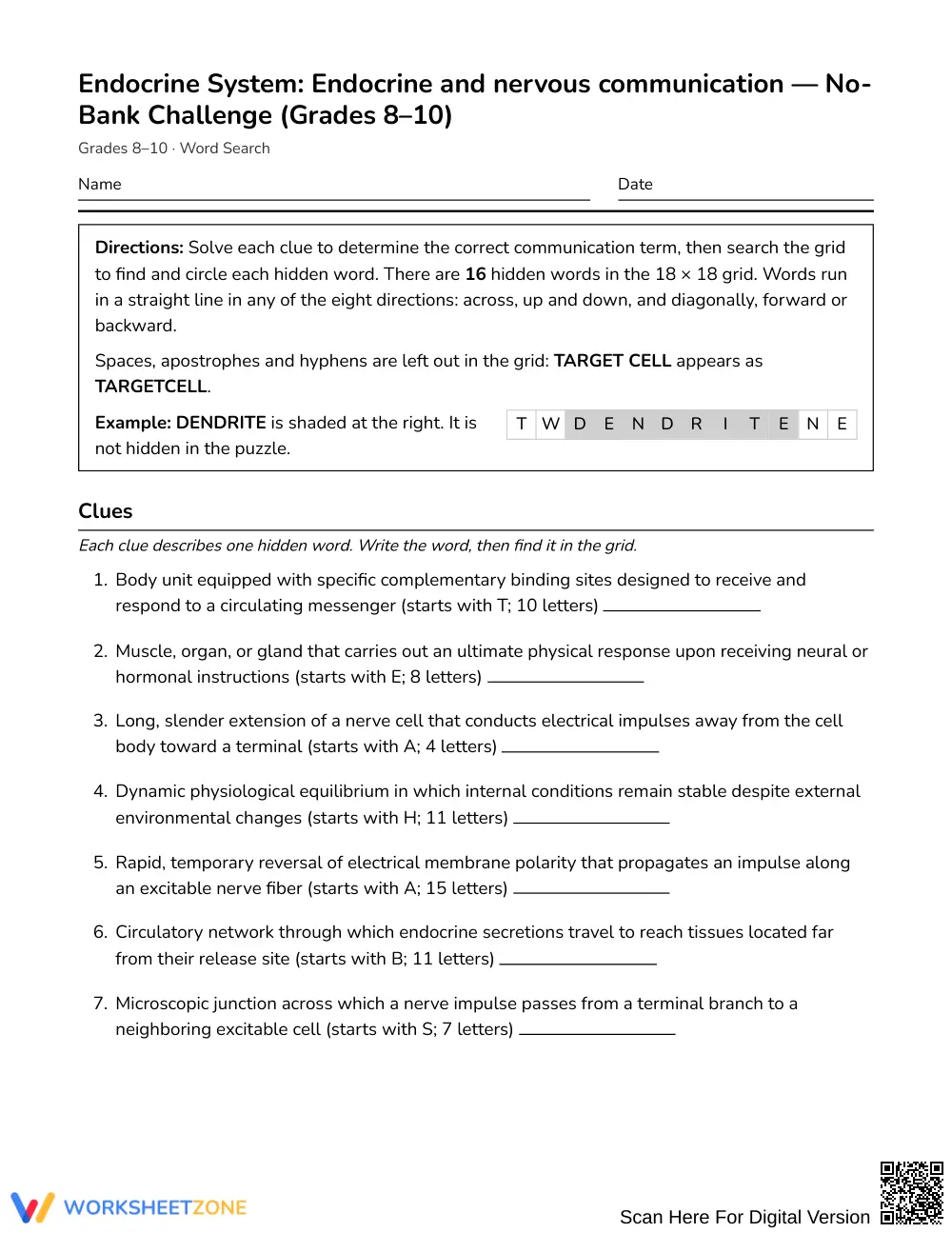
This endocrine and nervous communication word search strengthens science vocabulary across Grades 8–10 by challenging students to connect physiological mechanisms with key terminology. Instead of passively scanning a list, learners analyze rigorous definitions to identify target terms before locating them within the puzzle, reinforcing vital biological concepts regarding hormonal signaling, neural impulses, and systemic homeostasis.
At a Glance
- Grade: Grades 8–10 · Subject: Science
- Standard: Not standards-assessed — targeted vocabulary enrichment supporting human body systems
- Skill Focus: Endocrine and nervous communication signaling systems
- Format: 3 student pages · 16 words · Full answer key included · PDF
- Best For: Mid-unit vocabulary review, early finishers, emergency sub plans
- Time: 25–35 minutes
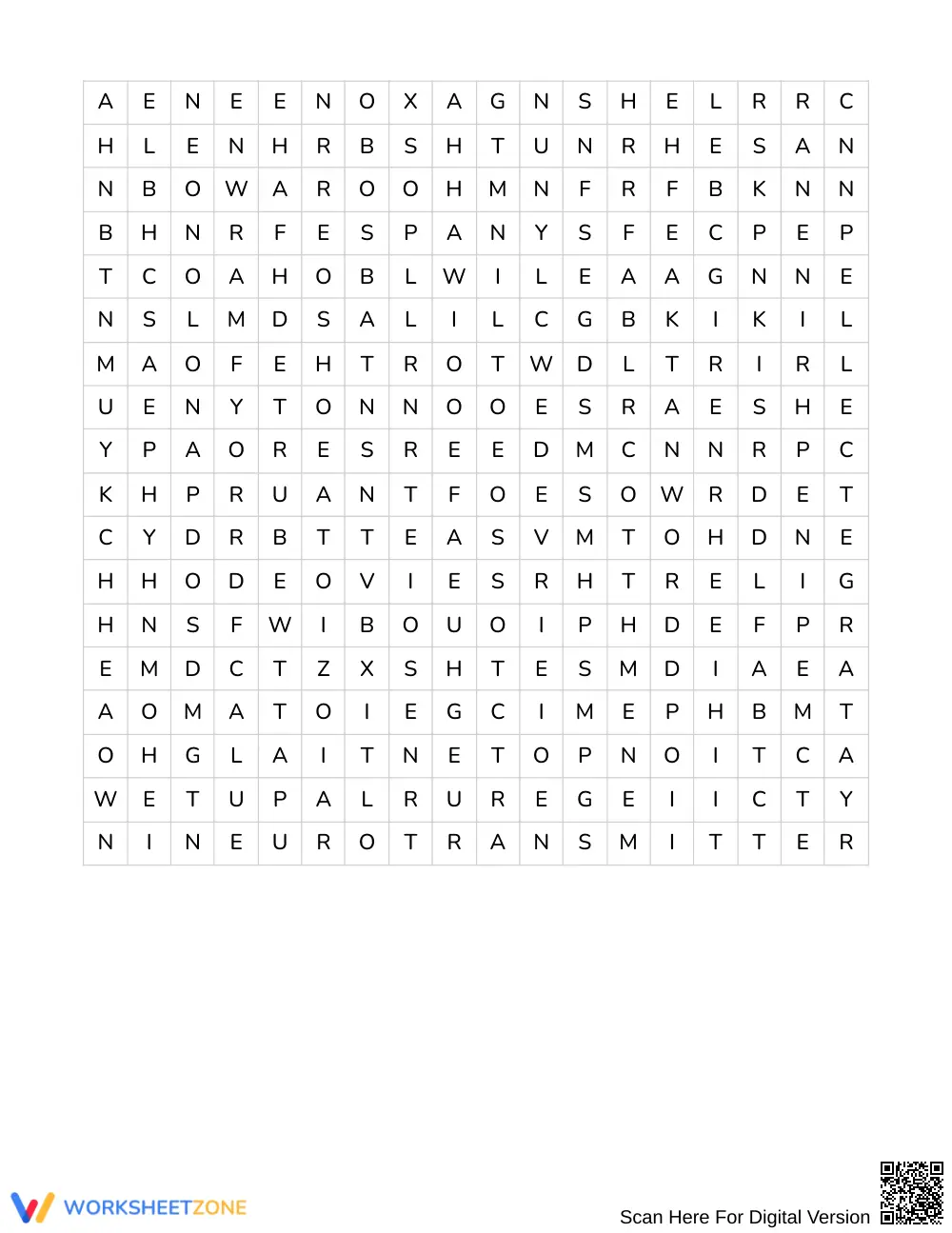
This 3-page science printable provides an engaging vocabulary task where students decode 16 clue-based definitions rather than relying on a traditional word bank. The packet features an extensive 18-by-18 letter grid, a dedicated prompt sheet presenting detailed clues for every target word, and a comprehensive 4-page answer key highlighting exact word placements for quick verification.
Puzzle Mechanics
This challenge is built around an 18-by-18 grid designed to test both recall and visual discrimination. To complete the activity, students must analyze each clue to identify terms such as neurotransmitter, hypothalamus, and action potential. The 16 words run in all 8 possible directions: north, northeast, east, southeast, south, southwest, west, and northwest. Because no word bank is provided, students cannot search the grid until they actively retrieve or research each term's scientific identity.
Standards Alignment
This activity is designed specifically as vocabulary enrichment and is not aligned to a formal standard. It supplements core life science curricula by strengthening student familiarity with specialized terminology before summative testing. Teachers can use this puzzle flexibly across introductory biology, health, or anatomy units without reporting compliance constraints.
How to Use It
Deploy this word search after direct instruction on human regulatory systems to reinforce key definitions. Alternatively, assign it as a self-contained emergency sub plan or an independent station activity during review rotations. While students work, circulate to observe whether they can identify words like effector or negative feedback directly from the clues or if they require their reference textbooks. Most students complete the full 16-word retrieval and search in 25 to 35 minutes.
Who It's For
This resource serves Grades 8–10 biology, life science, and introductory physiology classes. For students needing additional support, teachers can provide the first letter of each answered clue, while advanced learners can be asked to write an original sentence illustrating how two identified terms interact in the body. Pair this activity with an endocrine system labeling diagram or a nervous pathway flow chart for a comprehensive review package.
Educational research highlights the critical role of domain-specific vocabulary in secondary science comprehension. According to Fisher & Frey (2014), intentional vocabulary acquisition strategies that require students to retrieve definitions and manipulate technical language directly enhance disciplinary literacy and long-term retention. This word search applies these principles by eliminating standard word banks, requiring Grades 8–10 learners to decipher 16 detailed anatomical clues spanning endocrine and nervous communication pathways before initiating their grid search. By combining active definition recall with visual pattern recognition across an 18-by-18 grid, the resource reinforces foundational terms including action potential, negative feedback, and target cell without passive guessing. The unaligned enrichment format functions as an adaptable instructional tool for mid-unit consolidation, independent study, or formative vocabulary assessment in secondary life science classrooms.


