


























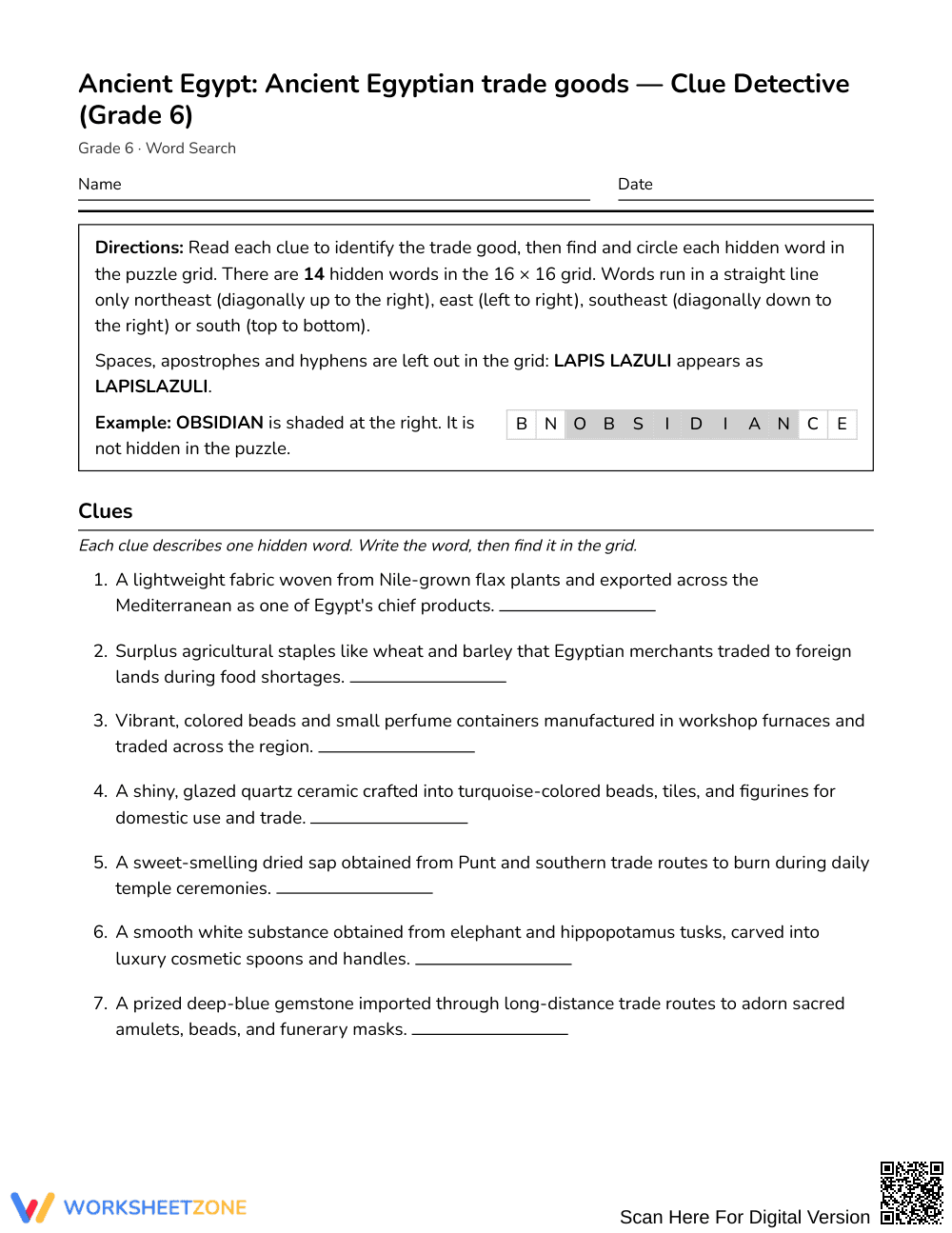


Ready Egypt Trade Goods Word Search | Grade 6 Social Studies
Paste this activity's link or code into your existing LMS (Google Classroom, Canvas, Teams, Schoology, Moodle, etc.).
Students can open and work on the activity right away, with no student login required.
You'll still be able to track student progress and results from your teacher account.
Build historical vocabulary and deepen ancient civilization knowledge with this focused word search activity. Students read detailed descriptive clues about raw materials, luxury exports, and agricultural staples, deduce the corresponding ancient Egyptian commodity, and locate all 14 words hidden across the puzzle grid. It reinforces World History content knowledge through active inquiry.
At a Glance
- Grade: Grade 6 · Subject: Social Studies
- Standard: Not standards-assessed — vocabulary enrichment
- Skill Focus: Ancient Egyptian trade goods
- Format: 3 pages · 14 words · Answer key included · PDF
- Best For: Lesson consolidation and vocabulary review
- Time: 20–30 minutes
What's Inside
This 3-page printable activity features a Clue Detective layout requiring deductive reasoning before grid searching. Rather than providing a basic alphabetical list, the resource presents 14 descriptive clues identifying historical goods such as cedar, lapis lazuli, myrrh, frankincense, ebony, papyrus, and faience. A full 3-page answer key provides visible word paths for swift visual verification.
Puzzle Mechanics
The activity is built on an expansive 16 × 16 letter grid. Words run in four specific orientations: northeast, east, southeast, and south. Students encounter a shuffled word bank tied directly to contextual definitions detailing regional mining, desert expeditions, and Mediterranean trade networks. This structure requires learners to connect historical utility with word recognition across vertical, horizontal, and diagonal letter paths.
Standards Alignment
This word search serves as targeted vocabulary enrichment and is not aligned to an individual academic standard. It reinforces sixth-grade social studies concepts by familiarizing students with historical terminology, economic trade networks, and material culture across the Nile River valley and neighboring ancient regions.
How to Use It
Introduce this puzzle midway through your ancient Mediterranean unit as an engaging formative check after direct instruction on regional trade networks. Circulate to observe whether students use clue keywords—such as geographic origins like Punt or the Sinai Peninsula—to identify commodities before scanning the grid. Alternatively, place this 25-minute printable in an independent learning station for early finishers or review days.
Who It's For
This activity is designed for Grade 6 World History classrooms. It accommodates diverse learners by offering detailed contextual clues that support reading comprehension while challenging spatial recall. Pair this puzzle with an ancient Nile trade map or primary source reading on Queen Hatshepsut's maritime expedition to the Land of Punt.
Domain-specific vocabulary acquisition forms the backbone of historical literacy in middle school social studies classrooms. According to Fisher & Frey (2014), intentional word exposure embedded within meaningful contextual clues strengthens cognitive retrieval and long-term conceptual retention far more effectively than isolated memorization drills. By challenging sixth-grade learners to read 14 rigorous clues detailing regional origins, material uses, and trading partners before locating terms in a 16 × 16 grid, this ancient Egyptian trade goods word search reinforces vital content vocabulary through purposeful search patterns. Middle school educators can reliably deploy this activity during Nile Valley civilization units to solidify student mastery of foundational historical terminology, economic concepts, and geographic trade networks without unnecessary administrative overhead.


