



























Ready Earthworm Dissection Worksheet | Grades 7-12 Science
Paste this activity's link or code into your existing LMS (Google Classroom, Canvas, Teams, Schoology, Moodle, etc.).
Students can open and work on the activity right away, with no student login required.
You'll still be able to track student progress and results from your teacher account.
This comprehensive science assessment evaluates student understanding of internal and external earthworm anatomy, organ specializations, and multi-system biological processes. Learners identify vital anatomical structures, justify structure-function relationships, and explain how organ systems coordinate during physiological responses across 39 rigorously designed questions.
At a Glance
- Grade: Grades 7–12 · Subject: Life Science / Biology
- Standard: Life Science Structure and Function — Analyze organ systems and explain physiological structure-function relationships
- Skill Focus: Earthworm anatomy, organ functions, and system interactions
- Format: 4 pages · 39 problems · Answer key included · PDF
- Best For: Post-lab evaluation, biology review, or unit test
- Time: 45–60 minutes
What's Inside
This four-page cumulative worksheet provides comprehensive anatomical diagrams and data tables. It contains clear word banks for dorsal anterior dissection and cross-sectional views, multiple-choice items testing physiological sequencing, and open-response prompts requiring evidence-based explanations of mechanical digestion, muscular locomotion, closed circulation, and multi-system feedback loops. A complete four-page answer key provides expected student responses.
Skill Progression
- Guided practice (Part A, 13 tasks): Students identify six anterior dorsal organs using a provided word bank, trace the linear alimentary tract, and contrast crop elasticity with gizzard muscularity.
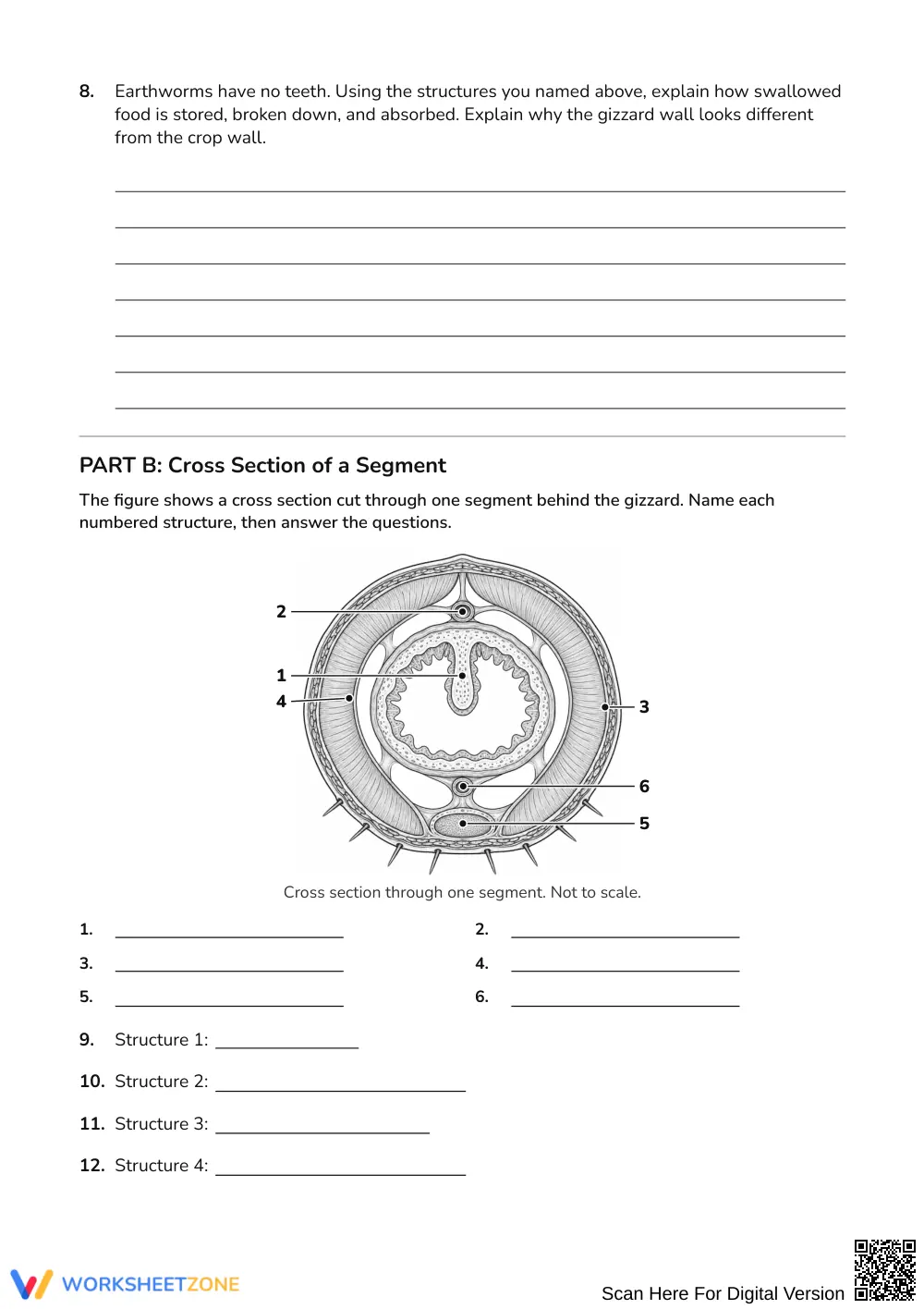
- Supported practice (Part B, 13 tasks): Learners label six cross-sectional structures and analyze how antagonistic circular and longitudinal muscles coordinate with anchor setae to generate peristaltic movement.
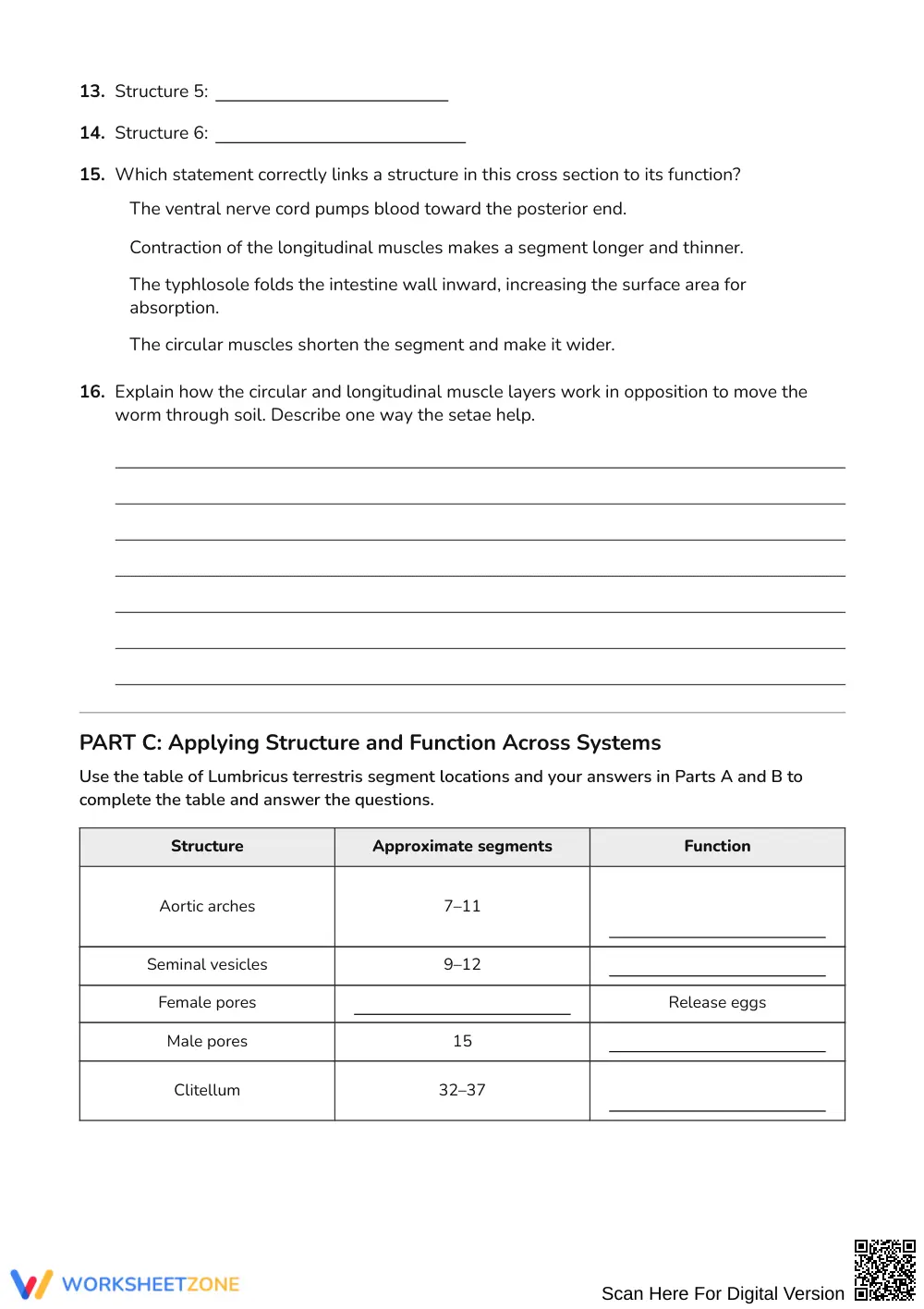
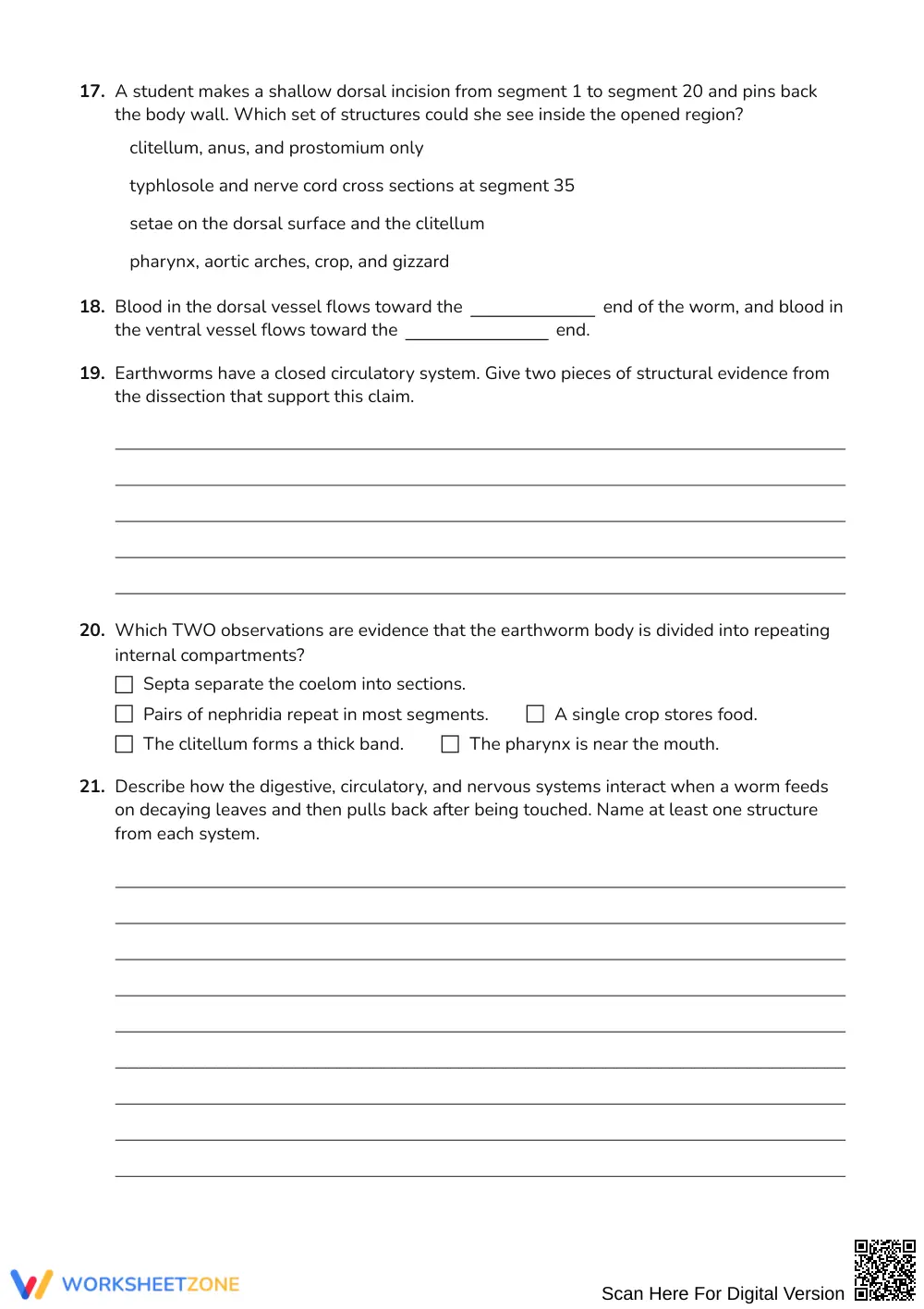
- Independent practice (Part C, 13 tasks): Students synthesize segment mapping tables, identify structural evidence for closed circulation and segmentation, and formulate a multi-system interaction model linking digestion, circulation, and nervous response.
This sequence implements a gradual-release model, moving from concrete visual identification to complex physiological integration.
Standards Alignment
This assessment targets core middle and high school life science standards requiring students to develop and use models explaining the structural organization of multicellular organisms. The tasks evaluate how specialized tissues and organs perform vital functions and how systems interact to support life. This content can be copied directly into lesson plans, IEP goals, or district curriculum mapping tools.
How to Use It
Administer this worksheet after completing an earthworm dissection laboratory or an interactive virtual anatomy module. Use Part A formatively as an entry check during class to assess anatomical landmark identification before releasing students to independent analysis in Parts B and C. Students typically finish the 39 questions in 45 to 60 minutes.
Who It's For
Designed for middle and high school biology students, this resource includes diagrammatic scaffolds for visual learners and challenging analytical prompts for advanced classes. It pairs naturally with pre-lab dissection manuals, stereomicroscope tissue investigations, or comparative invertebrate anatomy units.
Educational research from Fisher & Frey (2014) underscores that structured gradual release transforms visual anatomical identification into deep conceptual mastery. By guiding secondary learners from concrete organ labeling to complex structure-function analysis, this worksheet builds durable scientific reasoning. Students analyze 39 sequential tasks spanning dorsal anatomy, cross-sectional muscular systems, and multi-system integration without skipping foundational steps. Empirical studies confirm that pairing explicit diagrammatic representations with open-ended explanatory writing significantly strengthens conceptual retention in secondary biology curricula. When students systematically justify how specialized tissues support organ-level and organismal functions, they develop higher-order analytical abilities necessary for advanced life science coursework. This assessment supports rigorous laboratory follow-through, ensuring every student articulates how invertebrate systems collaborate to sustain vital biological processes.


