




























Views
Downloads


Ready Early Universe Atoms Word Search | Grade 6 Science

Paste this activity's link or code into your existing LMS (Google Classroom, Canvas, Teams, Schoology, Moodle, etc.).
Students can open and work on the activity right away, with no student login required.
You'll still be able to track student progress and results from your teacher account.
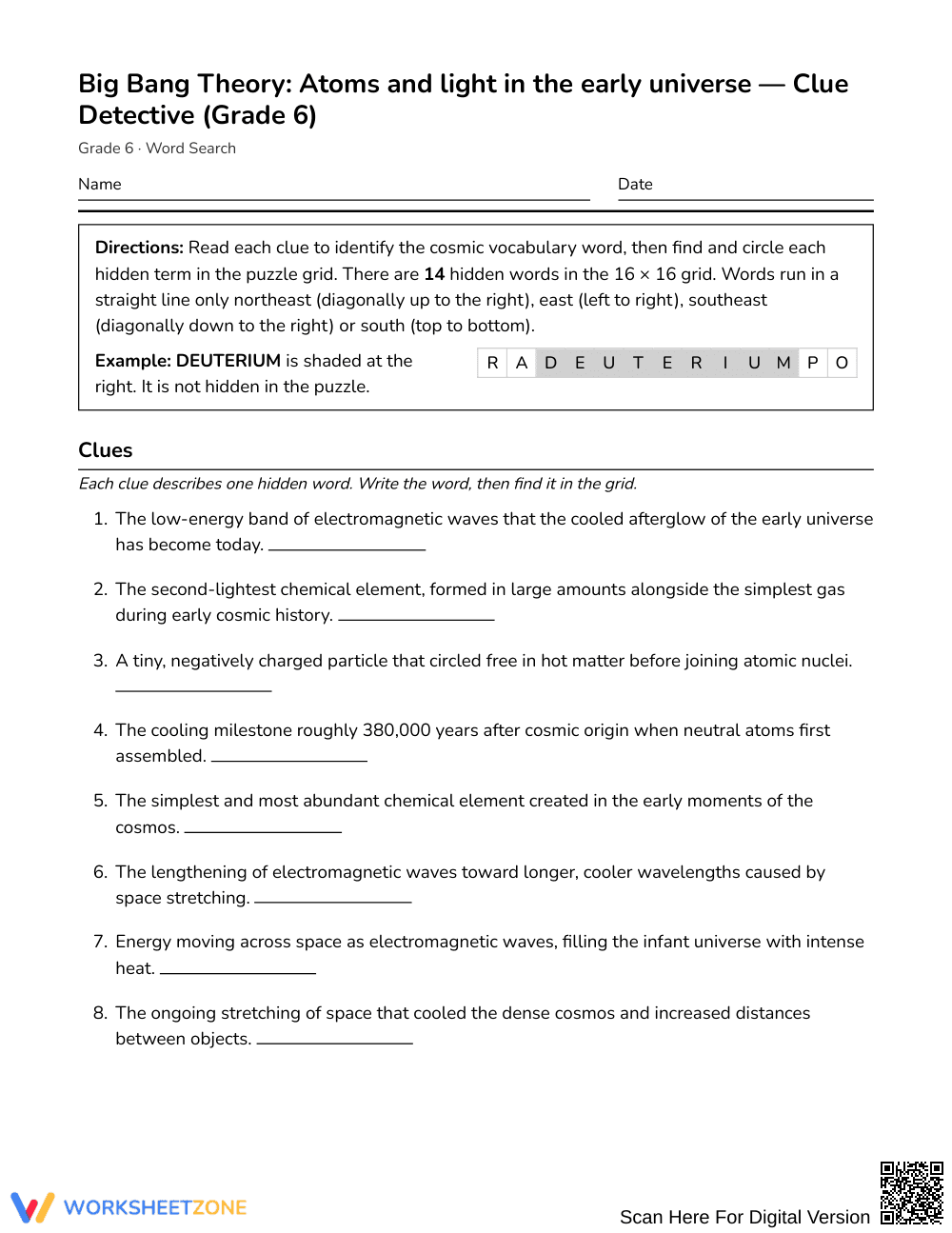
This Grade 6 science word search reinforces astronomy vocabulary by engaging students with key early universe concepts. Learners explore how matter and radiation interacted after the Big Bang, identifying fourteen essential scientific terms through descriptive clues before locating each term in the puzzle grid.
At a Glance
- Grade: Grade 6 · Subject: Science (Astronomy)
- Standard: Not standards-assessed — vocabulary enrichment
- Skill Focus: Early universe atoms and light
- Format: 3 pages · 14 words · Answer key included · PDF
- Best For: Astronomy vocabulary review and reinforcement
- Time: 20–30 minutes of independent or partner practice
What's Inside
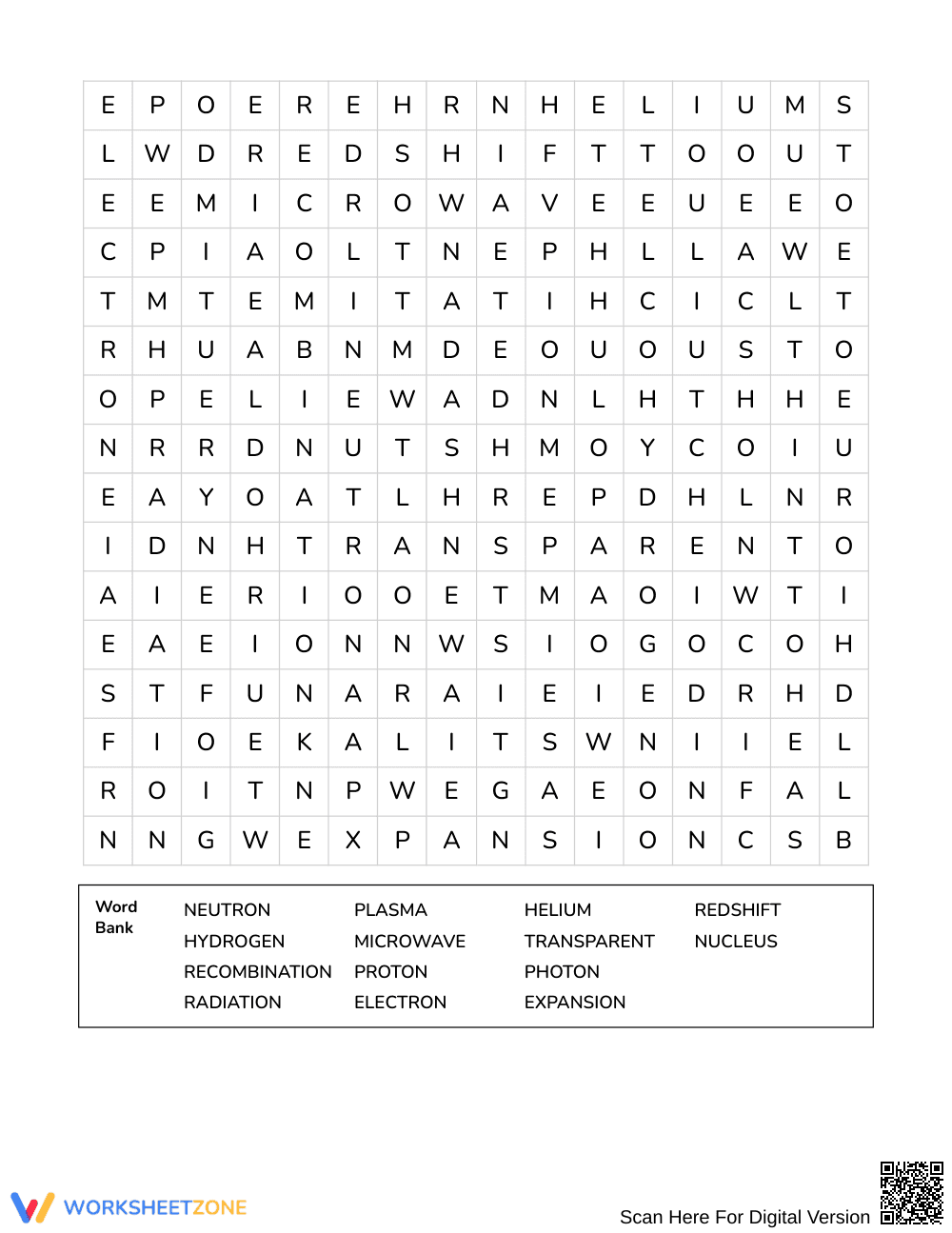
This 3-page science printable includes a complete 14-word cosmic puzzle with definition-style clues. Page 1 pairs the puzzle grid with definitions covering atomic formation, subatomic particles, and cosmic radiation. A 3-page answer key provides full visual solutions highlighting each word's exact placement.
Puzzle Mechanics and Structure
The puzzle features a 16 × 16 grid designed around 14 domain-specific astronomy terms. Students use clues to determine each term from a shuffled word bank. Hidden vocabulary runs in four directions: northeast, east, southeast, and south. This directional layout promotes systematic visual scanning across rows and diagonals without reverse-reading obstacles.
Standards Alignment
This word search is designed for vocabulary enrichment and is not aligned to a specific standard code. It strengthens the domain-specific academic vocabulary required to understand Big Bang nucleosynthesis, atomic assembly, and the propagation of light across cosmic history.
How to Use It
Use this activity following direct instruction on early cosmology or as a mid-unit astronomy review. In independent practice, students spend 20 to 30 minutes reading clues and locating terms. For collaborative practice, student pairs discuss clue meanings before searching. For formative assessment, observe whether learners recognize terms like plasma or recombination from the clues before scanning the grid.
Who It's For
This resource supports Grade 6 science learners mastering astronomical vocabulary. Striving readers benefit from an anchor chart highlighting particle definitions, while advanced students can write sentences explaining how recombination enabled transparent space. The activity pairs naturally with an introductory textbook passage on cosmic evolution.
Mastering scientific literacy requires structured exposure to academic vocabulary within clear conceptual frameworks. According to Fisher & Frey (2014), intentional domain-specific vocabulary acquisition accelerates content mastery when students engage in active retrieval practice rather than passive memorization. This Grade 6 astronomy activity supports deep comprehension of early universe cosmology, focusing on the fundamental behavior of atoms and light after the Big Bang. By pairing fourteen clue-based conceptual definitions with an orthographic search task across a 16 × 16 grid, students repeatedly encode and retrieve critical terms including plasma, recombination, photon, and radiation. This deliberate integration of contextual clues transforms standard word discovery into an authentic cognitive exercise, strengthening students' ability to read, discuss, and synthesize complex astrophysical models. The resource provides educators with an efficient, research-aligned instructional tool that reinforces specialized middle school physical science and astronomy vocabulary during core instruction or review cycles.


