




























Views
Downloads




Ready DNA Base-Pairing Errors Worksheet | Grade 10 Biology

Paste this activity's link or code into your existing LMS (Google Classroom, Canvas, Teams, Schoology, Moodle, etc.).
Students can open and work on the activity right away, with no student login required.
You'll still be able to track student progress and results from your teacher account.
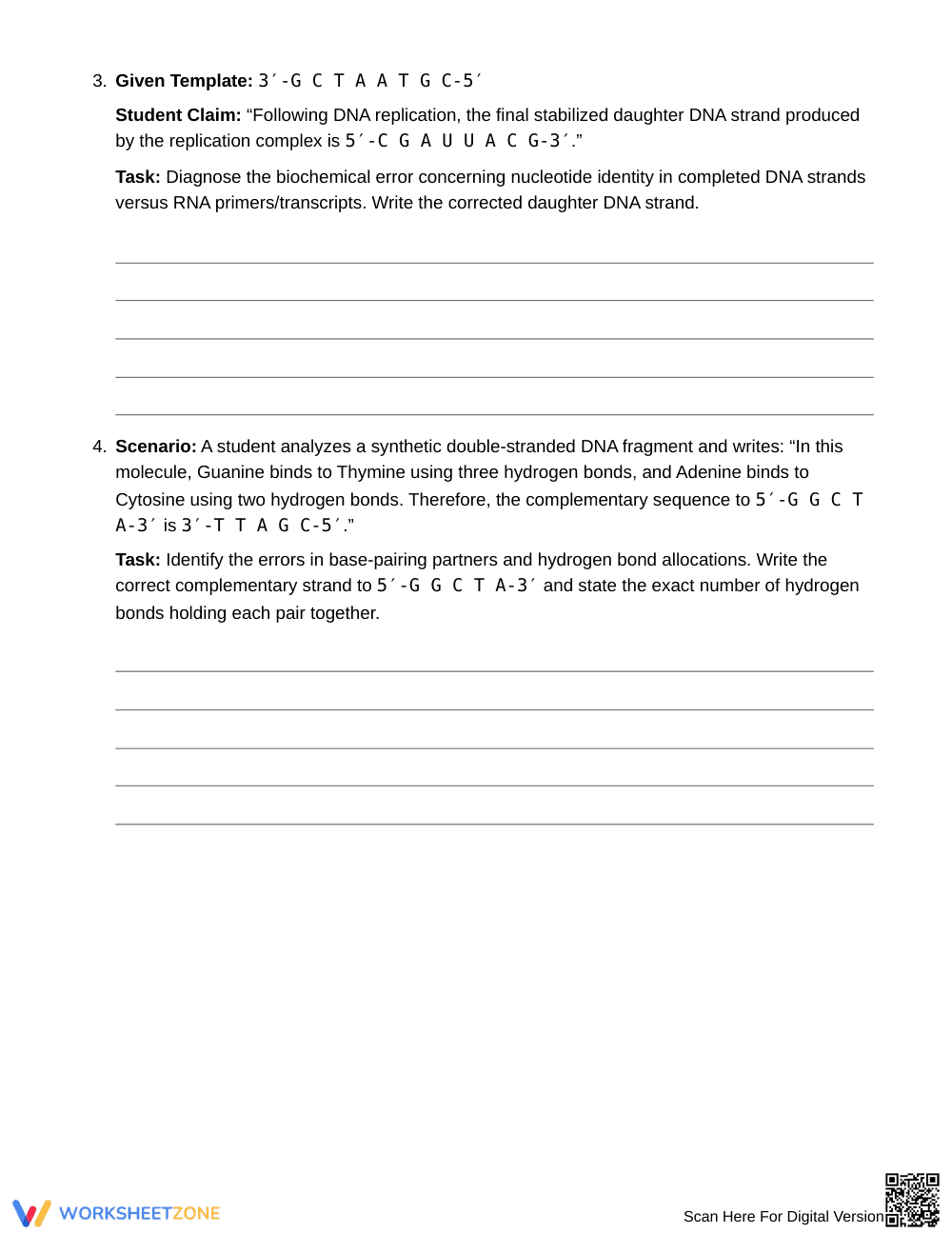
This Grade 10 biology worksheet trains students to identify and correct molecular errors in antiparallel orientation, enzymatic synthesis direction, and base pairing during DNA replication. By evaluating realistic misconceptions across 8 analytical tasks, learners master structural notation and solidify fundamental genetics principles.
At a Glance
- Grade: 10 · Subject: Biology
- Standard: High School Life Sciences — Construct an explanation based on evidence for how DNA structure guides replication fidelity
- Skill Focus: Correct Antiparallel and Base-Pairing Errors
- Format: 5 pages · 8 problems · Answer key included · PDF
- Best For: Formative practice and error analysis
- Time: 35–45 minutes
What's Inside
The 5-page packet features a core reference guide reviewing antiparallel polarity, Chargaff's rules, and 5′ to 3′ synthesis. A modeled repair shows students how to diagnose strand inversion before they tackle 8 analytical problems targeting base-pair mismatches, RNA primer confusion, replication fork geometry, and percentage calculations. A 2-page answer key provides complete rationales.
Skill Progression
- Guided practice (Problems 1–2): Students identify strand polarity and synthesis direction errors using the modeled example as a scaffold.
- Supported practice (Problems 3–5): Scenarios introduce biochemical variables, including uracil substitutions, hydrogen bonding counts, and replication fork directionality.
- Independent practice (Problems 6–8): Learners evaluate 3′-OH terminal chemistry, re-orient sequences to standard 5′ to 3′ notation, and compute Chargaff base ratios without hints.
This sequence implements the gradual-release model, advancing students from modeled sequence repair to independent molecular analysis.
Standards Alignment
This activity aligns with high school biology standards for molecular genetics, specifically constructing explanations for how DNA structure governs replication fidelity. Supporting standards address modeling how complementary pairing ensures genetic continuity across generations. Both standard codes can be copied directly into lesson plans, IEP goals, or district curriculum mapping tools.
How to Use It
Assign this worksheet directly after lecture instruction on DNA structure and replication. Use it as partner practice where pairs diagnose Problems 1 through 4, or administer Problems 5 through 8 as a post-lesson formative check. During monitoring, verify that students re-orient daughter strands from left to right (5′ to 3′) rather than merely swapping complementary letters. Estimated completion time is 35 to 45 minutes.
Who It's For
This worksheet serves Grade 10 general biology and honors students mastering molecular genetics. For struggling learners, pair this activity with a physical replication fork anchor chart or nucleotide base-pairing manipulatives to visualize antiparallel orientation before writing sequences.
Mastering DNA replication requires Grade 10 biology students to coordinate abstract biochemical principles, specifically correcting antiparallel and base-pairing errors across complementary template strands. Research by Fisher & Frey (2014) highlights that guided error diagnosis and structured gradual-release problem sets significantly enhance conceptual retention compared to passive sequence transcription. By analyzing authentic student misconceptions across 8 targeted tasks, learners confront common procedural errors in 5′ to 3′ enzymatic directionality, hydrogen bonding allocations, leading versus lagging strand mechanics, and Chargaff calculations. Evaluating why an incorrect daughter strand is scientifically invalid compels students to internalize molecular polarity and chemical constraints rather than relying on rote memorization. This instructional progression fosters deep scientific literacy, ensuring secondary learners can accurately predict complementary sequences, analyze replication fork dynamics, and understand how structural fidelity maintains genetic continuity during cellular division.


