































Ready Diffusion & Osmosis Worksheet | Grade 7-12 Science

Paste this activity's link or code into your existing LMS (Google Classroom, Canvas, Teams, Schoology, Moodle, etc.).
Students can open and work on the activity right away, with no student login required.
You'll still be able to track student progress and results from your teacher account.
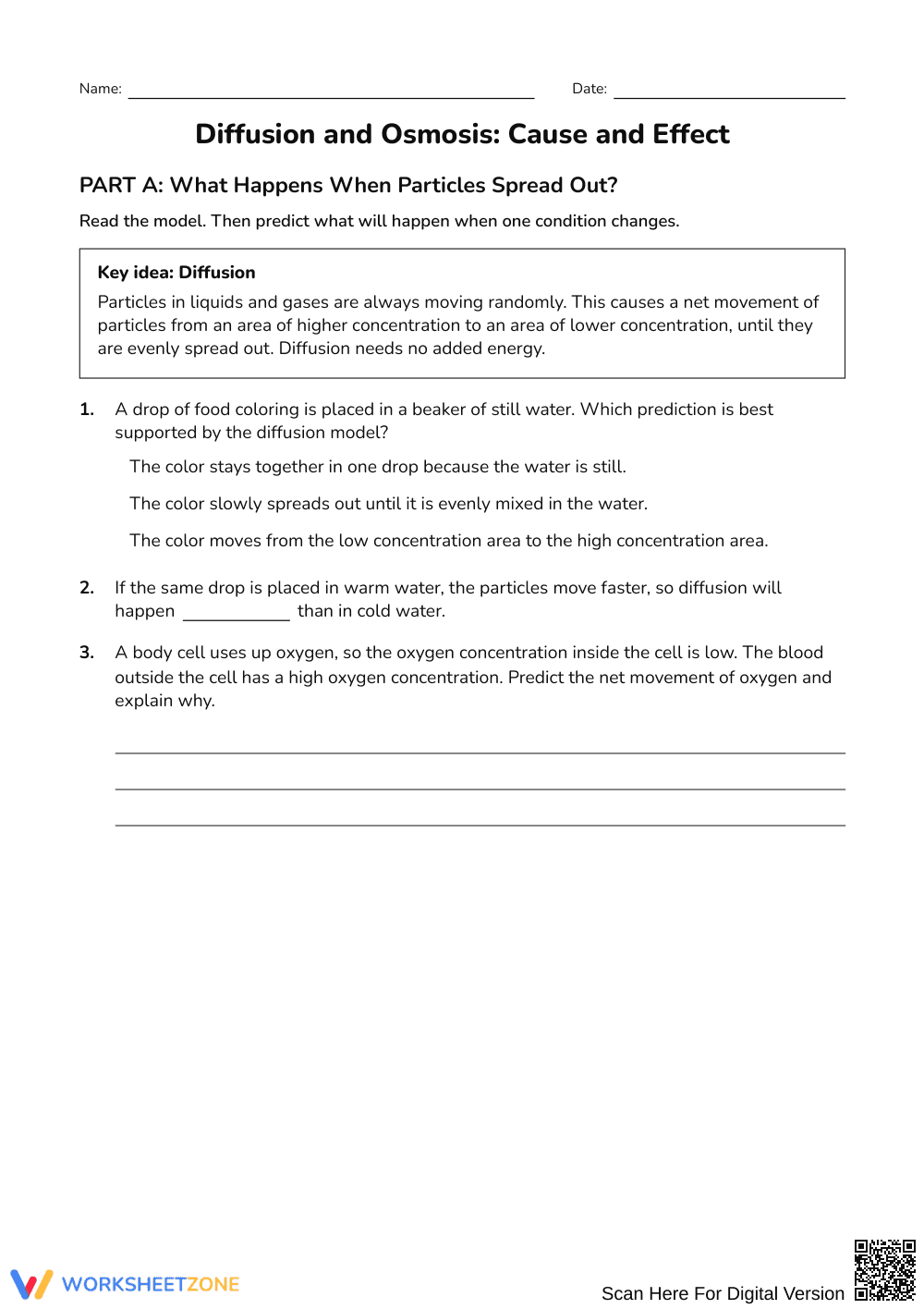
This comprehensive science worksheet guides secondary biology students through predicting cellular transport outcomes across changing environmental conditions. Students analyze molecular concentration gradients, examine selective permeability in U-tube models, and evaluate how hypertonic, hypotonic, and isotonic solutions alter animal and plant cell structures.
At a Glance
- Grade: Grades 7–12 · Subject: Science
- Standard: Cell Membrane Transport — Predict particle and water movement across selectively permeable membranes
- Skill Focus: Predicting diffusion and osmosis cause-and-effect outcomes
- Format: 4 pages · 19 problems · Answer key included · PDF
- Best For: Biology unit practice and review
- Time: 40–50 minutes
What's Inside
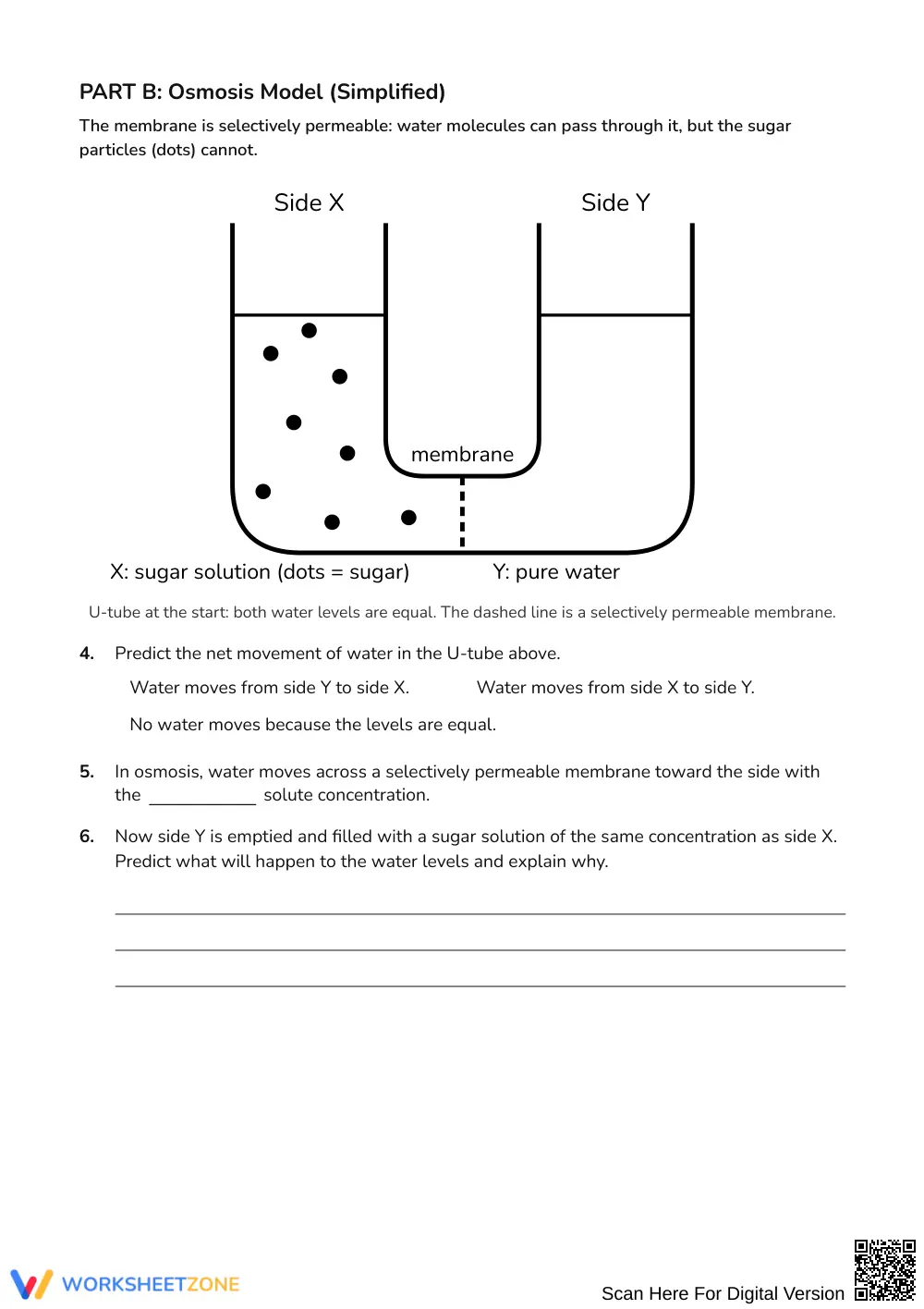
The 4-page student activity contains 19 targeted tasks organized into four focused sections: particle diffusion, selectively permeable membrane models, osmosis in red blood cells, and turgor dynamics in walled plant cells. The resource incorporates visual diagrams, multiple-choice prediction stems, and open-ended explanatory prompts, supported by a matching 4-page answer key.
Skill Progression
- Guided Practice (Part A): Students examine foundational diffusion rules and predict particle movement in dye and cellular respiration scenarios with explicit conceptual models (Tasks 1–4).
- Supported Practice (Parts B & C): Learners analyze selectively permeable U-tube systems and label red blood cells in varied tonicities while explaining hemolysis and crenation (Tasks 5–12).
- Independent Practice (Part D): Students independently evaluate plant cell wall resistance, explain agricultural fertilizer damage, and predict turgor changes in crisping celery (Tasks 13–19).
This sequence follows a gradual-release instructional model that transitions students from basic physical diffusion to complex physiological applications.
Standards Alignment
This worksheet aligns with middle and high school life science standards covering cellular structures and passive transport mechanisms. Students develop and use models to describe how matter moves into and out of cells across semipermeable boundaries without energy input. Both standard codes can be copied directly into lesson plans, IEP goals, or district curriculum mapping tools.
How to Use It
Deploy this worksheet after direct instruction on passive transport to reinforce conceptual understanding, or assign it during a mid-unit review station. During work time, check whether students attribute swelling in hypotonic environments to solute diffusion rather than net water entry, intervening promptly if misconceptions arise. Students require approximately 40 to 50 minutes to complete the tasks.
Who It's For
This resource serves general biology, life science, and introductory physiology students across grades 7 through 12. Teachers can support developing readers by highlighting bolded vocabulary terms or pairing the worksheet alongside a physical beaker demonstration of iodine and dialysis tubing.
Secondary science students frequently struggle to differentiate between solute diffusion and net water flow across selectively permeable membranes. According to Fisher & Frey (2014), structured cause-and-effect modeling bridges conceptual gaps by requiring learners to articulate the physical mechanisms underlying observable biological changes. This worksheet establishes mastery of diffusion and osmosis by asking students to predict structural outcomes across 19 structured items, including animal red blood cell lysis and plant cell wall turgor. The resource pairs visual membrane diagrams with targeted writing prompts, enabling students to connect molecular concentration differentials to macroscopic cell behavior. By moving through clear guided and independent tiers, learners build fluency in predicting passive cellular transport outcomes reliably across laboratory scenarios.


