
































Ready Competing Frameworks Worksheet | Grade 11 English III

Paste this activity's link or code into your existing LMS (Google Classroom, Canvas, Teams, Schoology, Moodle, etc.).
Students can open and work on the activity right away, with no student login required.
You'll still be able to track student progress and results from your teacher account.
This Grade 11 literary analysis worksheet guides students through evaluating competing interpretive frameworks across companion texts. Learners analyze how opposing worldviews generate narrative tension, evaluate deliberate textual ambiguity, and cite thorough evidence to assess conflicting claims, establishing essential skills for advanced literary critique.
At a Glance
- Grade: 11 · Subject: English III
- Standard:
RL.11-12.1— Cite strong textual evidence to evaluate complex literary themes and deliberate ambiguity- Skill Focus: Compare Competing Interpretive Frameworks
- Format: 6 pages · 10 rigorous problems · Full answer key included · PDF
- Best For: Advanced high school paired-text literary analysis instruction
- Time: 45–60 minutes
The 6-page worksheet features two original companion passages presenting opposing views on industrial expansion and communal water rights. Across 10 sequential tasks, students complete a comparative criteria chart, multiple-choice questions, and text-based constructed responses, supported by a comprehensive 3-page explanatory answer key with textual citations.
Skill Progression
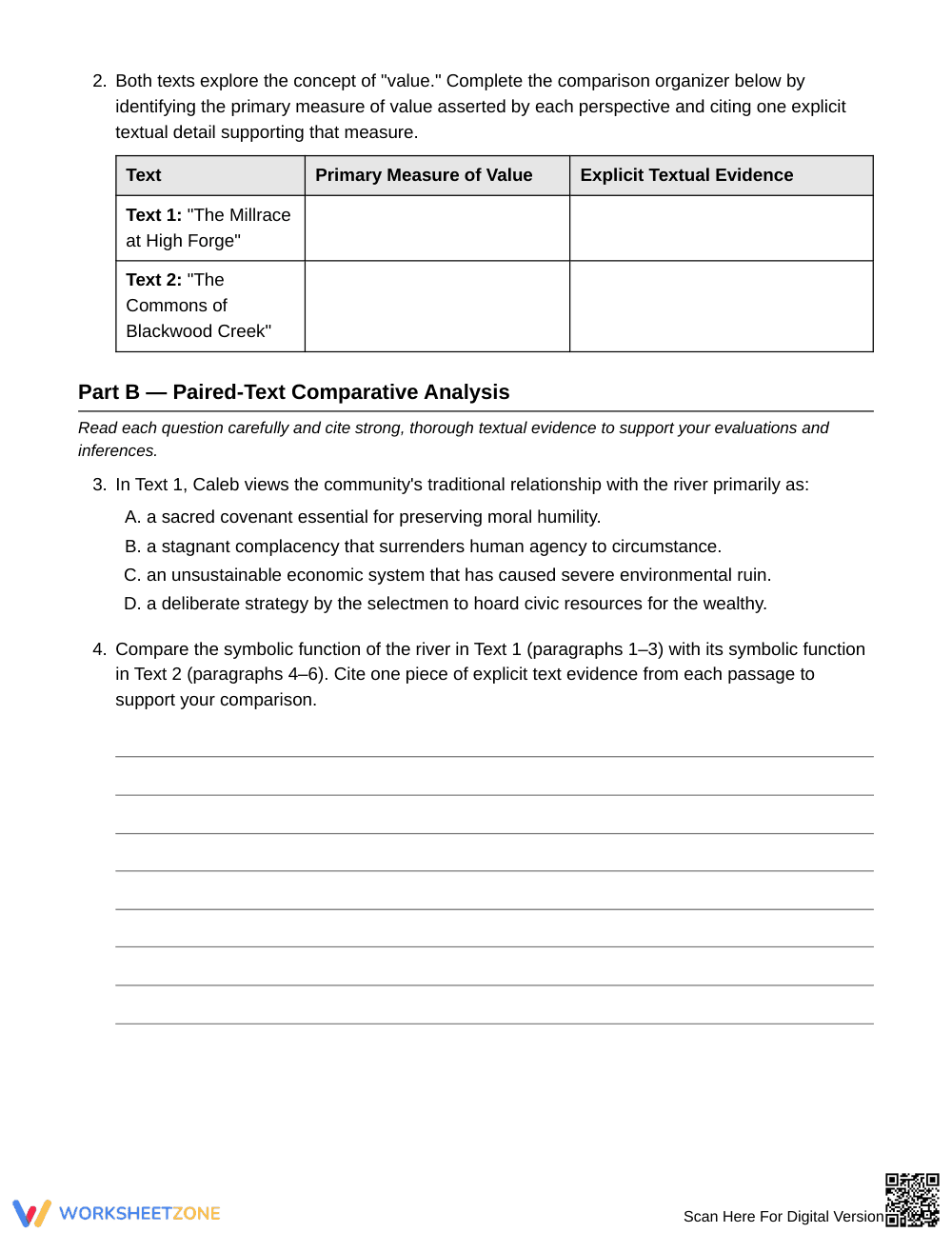
- Guided practice (Part A, Tasks 1–2): Establishes analytical criteria via a comparison chart tracking how each author defines value and landscape.
- Supported practice (Part B, Tasks 3–8): Features 6 multiple-choice and short-answer prompts evaluating character ambiguity, symbolic motifs, and rhetorical framing under RL.11-12.1.
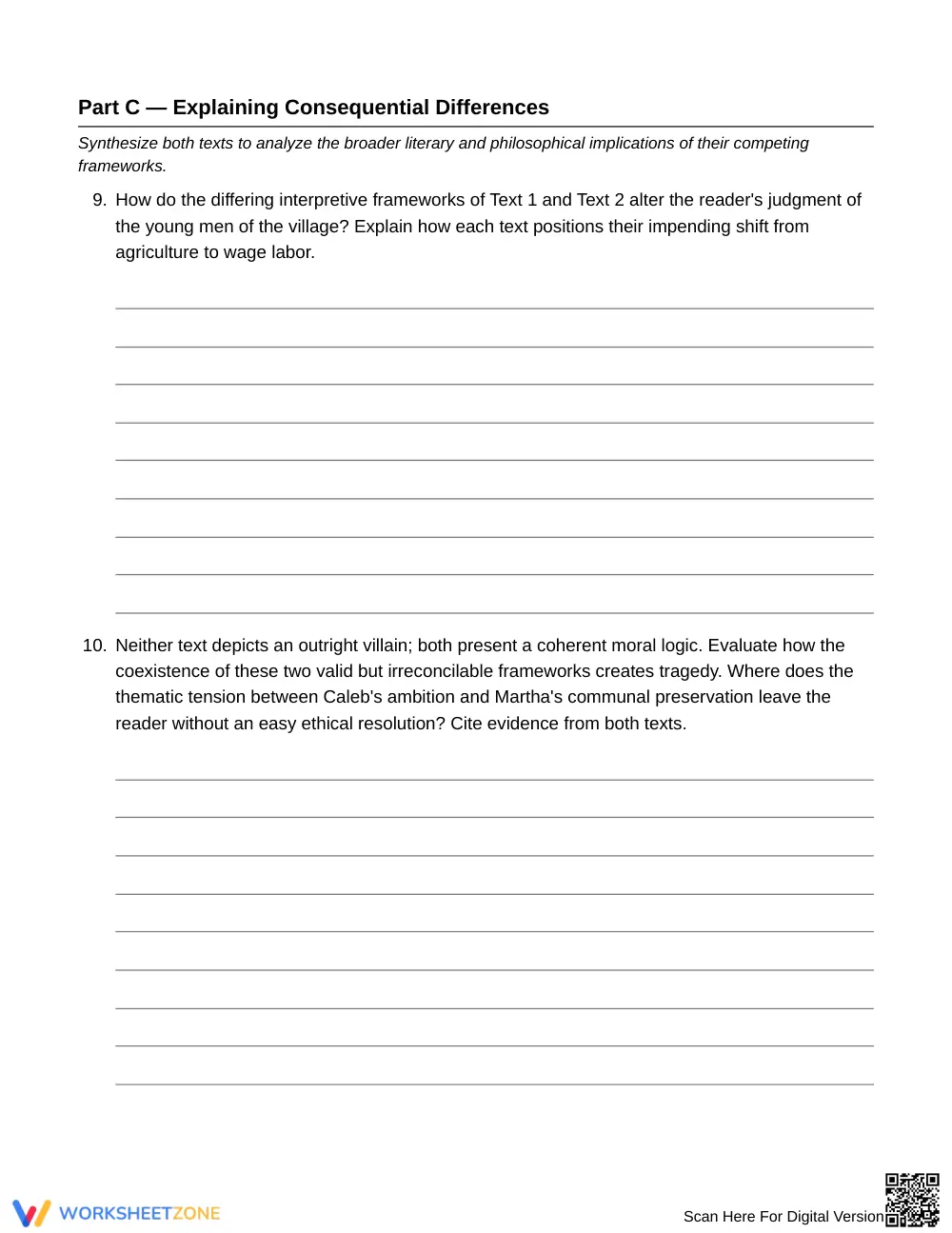
- Independent practice (Part C, Tasks 9–10): Prompts synthesis across 2 extended responses examining how irreconcilable moral frameworks create tragic outcomes.
This sequence follows a gradual-release framework, moving students from guided evaluation to independent synthesis.
Standards Alignment
This worksheet directly addresses `RL.11-12.1`: Cite strong and thorough textual evidence to support analysis of explicit details and inferences, including matters left uncertain. It also reinforces `RL.11-12.3` through comparative analysis of complex character motivations. Both standard codes can be copied directly into lesson plans, IEP goals, or district curriculum mapping tools.
How to Use It
Deploy this activity during paired-text analysis after direct instruction on conflicting literary perspectives. Students can complete Parts A and B with a peer before drafting Part C independently. Formatively assess comprehension during Task 6 by verifying that students identify Caleb's hesitation as deliberate moral ambiguity. Plan for 45 to 60 minutes of instructional time.
Who It's For
This resource targets Grade 11 English III and honors students mastering higher-order textual analysis. Differentiate by providing sentence starters for Part C or pairing learners during the initial organizer. It pairs naturally with American literature units exploring 19th-century agrarian culture versus industrialization.
Aligned to standard RL.11-12.1, this Grade 11 English III worksheet cultivates students' ability to compare competing interpretive frameworks across complex literary texts. By evaluating how differing authorial perspectives shape narrative conflict, high school learners develop critical skills in evidence citation, motif analysis, and evaluating deliberate ambiguity. Research by Fisher & Frey (2014) demonstrates that structured gradual-release frameworks—scaffolding from analytical organizers to independent evaluative writing—significantly enhance adolescent reading comprehension and analytical stamina when engaging with sophisticated, ambiguous prose. Across 6 comprehensive pages and 10 targeted tasks, students unpack contrasting worldviews regarding communal preservation and technological ambition without resorting to oversimplified moral judgments. Supported by a complete 3-page explanatory answer key with detailed citation exemplars, this resource offers secondary educators an effective tool for rigorous literature instruction, standards-aligned assessment, and college-ready analytical writing preparation.


