




























Ready Community Kindness Word Search | Grades 7–8 Behavior
Paste this activity's link or code into your existing LMS (Google Classroom, Canvas, Teams, Schoology, Moodle, etc.).
Students can open and work on the activity right away, with no student login required.
You'll still be able to track student progress and results from your teacher account.
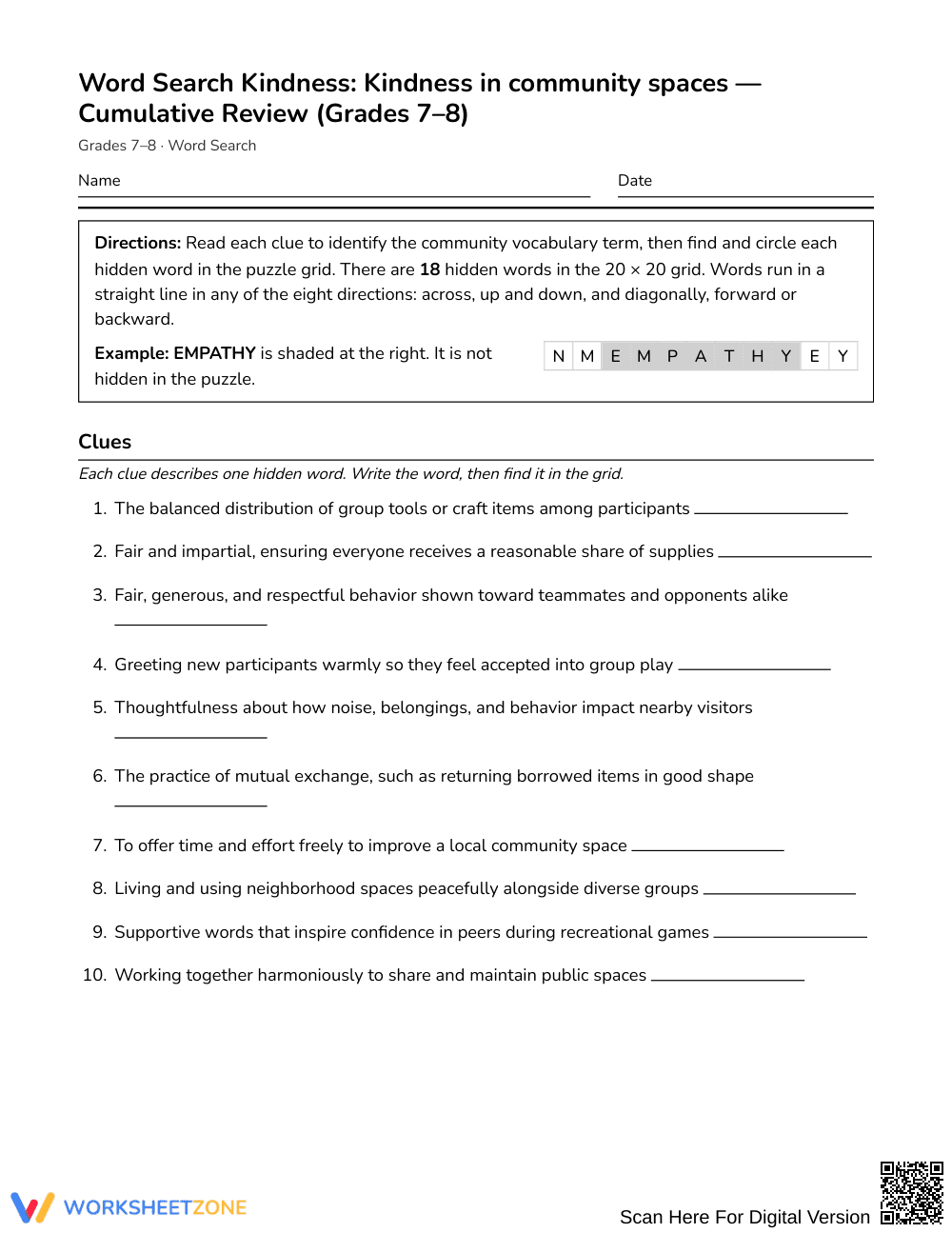
This community kindness word search reinforces prosocial behavioral vocabulary for middle school learners in Grades 7–8. Students analyze 18 contextual definitions related to shared public spaces and locate the matching terms within a grid puzzle. The activity strengthens citizenship language, ethical awareness, and collaborative habits across advisory periods, health classes, or character education units.
At a Glance
- Grade: Grades 7–8 · Subject: Behavior Worksheets
- Standard: Not standards-assessed — vocabulary enrichment
- Skill Focus: Kindness in community spaces
- Format: 3 pages · 18 words · Answer key included · PDF
- Best For: Advisory, homeroom, or character education
- Time: 20–30 minutes
What's inside this 3-page printable activity is an engaging vocabulary review designed for independent or partner work. The puzzle includes a complete clue bank defining 18 essential community terms, paired with a shuffled list of target words. Students read each situational definition before locating the term. A comprehensive 4-page answer key provides clear solution paths for efficient checking.
This word search utilizes an expansive 20 × 20 letter grid to challenge middle school students. The 18 target vocabulary terms are hidden across all eight compass directions: north, northeast, east, southeast, south, southwest, west, and northwest. Forward and backward letter sequences require learners to scan text strategically, combining receptive vocabulary retrieval with spatial pattern recognition as they match definitions to terms.
This activity serves as non-standards-assessed vocabulary enrichment supporting social-emotional learning and positive behavioral interventions. It emphasizes civic mindedness, cooperative space management, and personal accountability. Because this resource focuses on behavioral character education rather than academic testing benchmarks, teachers can integrate it flexibly across multi-tiered support systems without standard-specific reporting constraints.
Use this word search during homeroom advisory or following direct instruction on public etiquette and shared facility guidelines. For an effective warm-up, have students read the clues aloud and brainstorm practical community examples before searching the grid. Formatively assess comprehension by listening to peer discussions about terms like reciprocity and stewardship. Most learners will complete the search within 20 to 30 minutes.
This resource is tailored for learners in Grades 7–8 developing civic responsibility and interpersonal respect. It provides accessible behavioral reinforcement for general classrooms, advisory blocks, or restorative justice reflection circles. Pair this puzzle with a classroom norms anchor chart or a guided reading passage examining how cooperative stewardship preserves community centers and public recreation areas.
Vocabulary acquisition directly strengthens social-emotional competence and peer relationship building in secondary learning environments. According to Fisher & Frey (2014), intentional word exposure through structured puzzles and contextual definition matching reinforces semantic memory and deepens concept comprehension. When middle school students master foundational prosocial terminology such as civility, stewardship, and equitable allocation, they gain the expressive language necessary to resolve conflicts and manage shared communal spaces constructively. Research shows that explicit vocabulary instruction integrated into behavioral frameworks helps learners articulate ethical expectations and navigate collaborative tasks with greater empathy. This 18-word enrichment activity translates abstract civic values into concrete, recognizable behaviors across school hallways, community centers, and neighborhood recreation areas. By linking precise definitions to active cognitive retrieval, the resource promotes sustained character growth and mindful peer interactions across diverse educational settings and school communities.


