































Ready Cold War Word Search | Grades 9–10 Social Studies

Paste this activity's link or code into your existing LMS (Google Classroom, Canvas, Teams, Schoology, Moodle, etc.).
Students can open and work on the activity right away, with no student login required.
You'll still be able to track student progress and results from your teacher account.
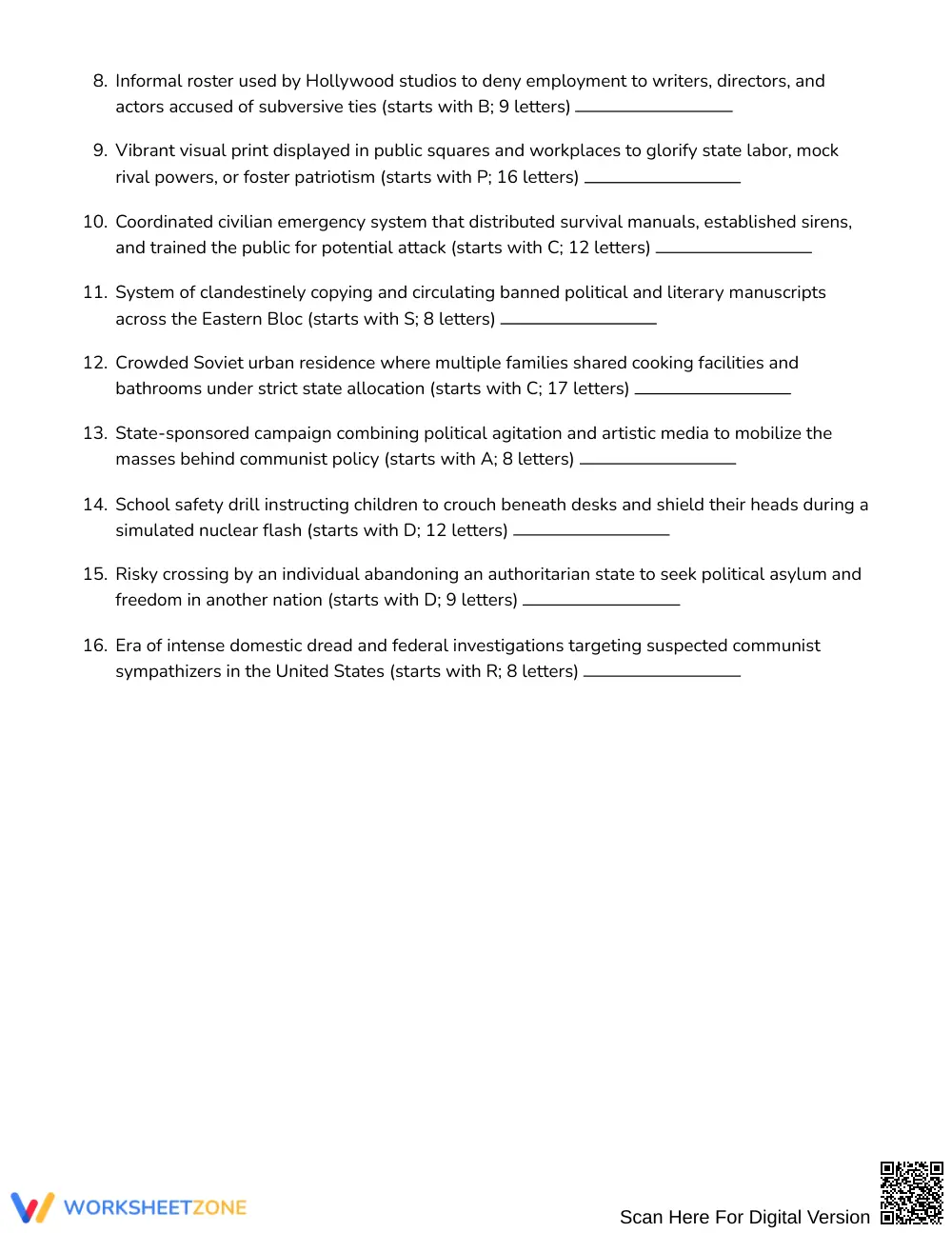
This World History word search engages high school learners with the cultural tensions of the Cold War. Students analyze 16 descriptive historical clues to determine essential terms before locating them across the puzzle grid. The activity reinforces critical domain-specific vocabulary surrounding ideological rivalry, state messaging, and civilian survival routines during the postwar superpower conflict.
At a Glance
- Grade: Grades 9–10 · Subject: Social Studies
- Standard: Not standards-assessed — vocabulary enrichment
- Skill Focus: Everyday life and propaganda
- Format: 3 pages · 16 words · Answer key included · PDF
- Best For: Vocabulary review and unit introduction
- Time: 25–35 minutes
What's Inside
The 3-page printable PDF features an advanced 18x18 puzzle grid paired with 16 rigorous definition clues spanning Western and Soviet domestic experiences. Instead of a standard word bank, students must read each clue to deduce target terms such as samizdat, agitprop, civil defense, and fallout shelter. A 4-page answer key provides clear letter-grid highlighting for quick verification.
Puzzle Mechanics
This no-bank vocabulary challenge requires active historical retrieval before grid searching begins. Hidden entries run across an 18x18 letter matrix in all eight cardinal and intercardinal orientations: north, northeast, east, southeast, south, southwest, west, and northwest. Because learners must decipher historical definitions to generate their own target list, the activity builds deeper recall than conventional recognition searches.
Standards Alignment
This activity is designed purely for vocabulary enrichment and historical concept reinforcement; it is not aligned to a specific state or national content standard. It deepens student familiarity with key terminology necessary for analyzing primary sources and historical narratives from the Cold War era.
How to Use It
Deploy this puzzle immediately after direct instruction on Cold War domestic policies or as a thematic introduction to civilian responses to nuclear tension. During the 25 to 35-minute completion window, circulate to check which clues require prompting; learners struggling to deduce terms like Pravda or Kitchen Debate benefit from quick reference to unit lecture notes.
Who It's For
Built specifically for Grades 9–10 World History and Modern US History classrooms, this challenge suits general education and honors courses. Teachers can differentiate by providing initial letter hints to emerging readers while encouraging advanced students to complete the puzzle independently. Pair this activity with authentic Cold War propaganda posters or civilian defense pamphlets.
According to Fisher & Frey (2014), intentional domain-specific vocabulary acquisition functions as a primary lever for disciplinary literacy in secondary social studies. When adolescent learners engage in clue-based word puzzles, they must activate conceptual memory and apply contextual definitions rather than relying on passive visual scanning. This no-bank instructional resource targets 16 core historical terms spanning ideological apparatuses, political surveillance, and everyday civilian defense measures during the global Cold War. By connecting historical terminology such as samizdat and agitprop directly to analytical descriptions, students develop the contextual schemata necessary to comprehend complex historical texts. The structured 18x18 search task consolidates orthographic and semantic recall, supporting retention across comprehensive World History units.


