

































Ready Claim Scope & Evidence Worksheet | Grade 10 English II

Paste this activity's link or code into your existing LMS (Google Classroom, Canvas, Teams, Schoology, Moodle, etc.).
Students can open and work on the activity right away, with no student login required.
You'll still be able to track student progress and results from your teacher account.
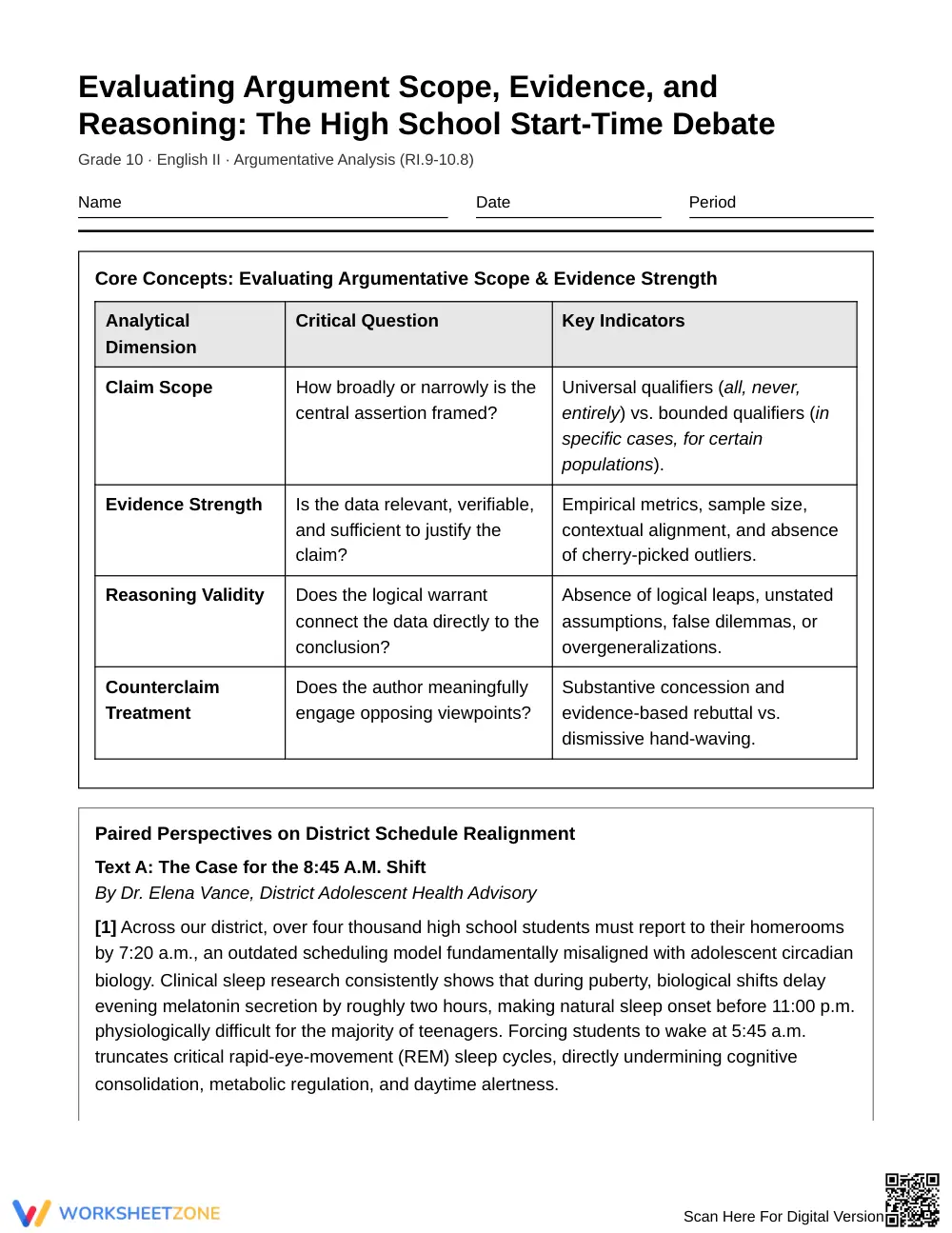
Equip Grade 10 students to evaluate rhetoric and dissect argumentative logic with this comprehensive English II resource. Learners examine paired informational texts presenting competing district policy perspectives, analyzing how authors establish claim scope, deploy empirical evidence, and construct reasoning. Students build the analytical discernment required to identify logical leaps, unstated assumptions, and bounded qualifiers in complex nonfiction.
At a Glance
- Grade: 10 · Subject: English II
- Standard:
RI.9-10.8— Delineate and evaluate argument claims, reasoning validity, and evidence sufficiency- Skill Focus: Connecting claim scope and evidence strength
- Format: 6 pages · 12 problems · Answer key included · PDF
- Best For: Argument analysis and rhetorical evaluation
- Time: 45–60 minutes
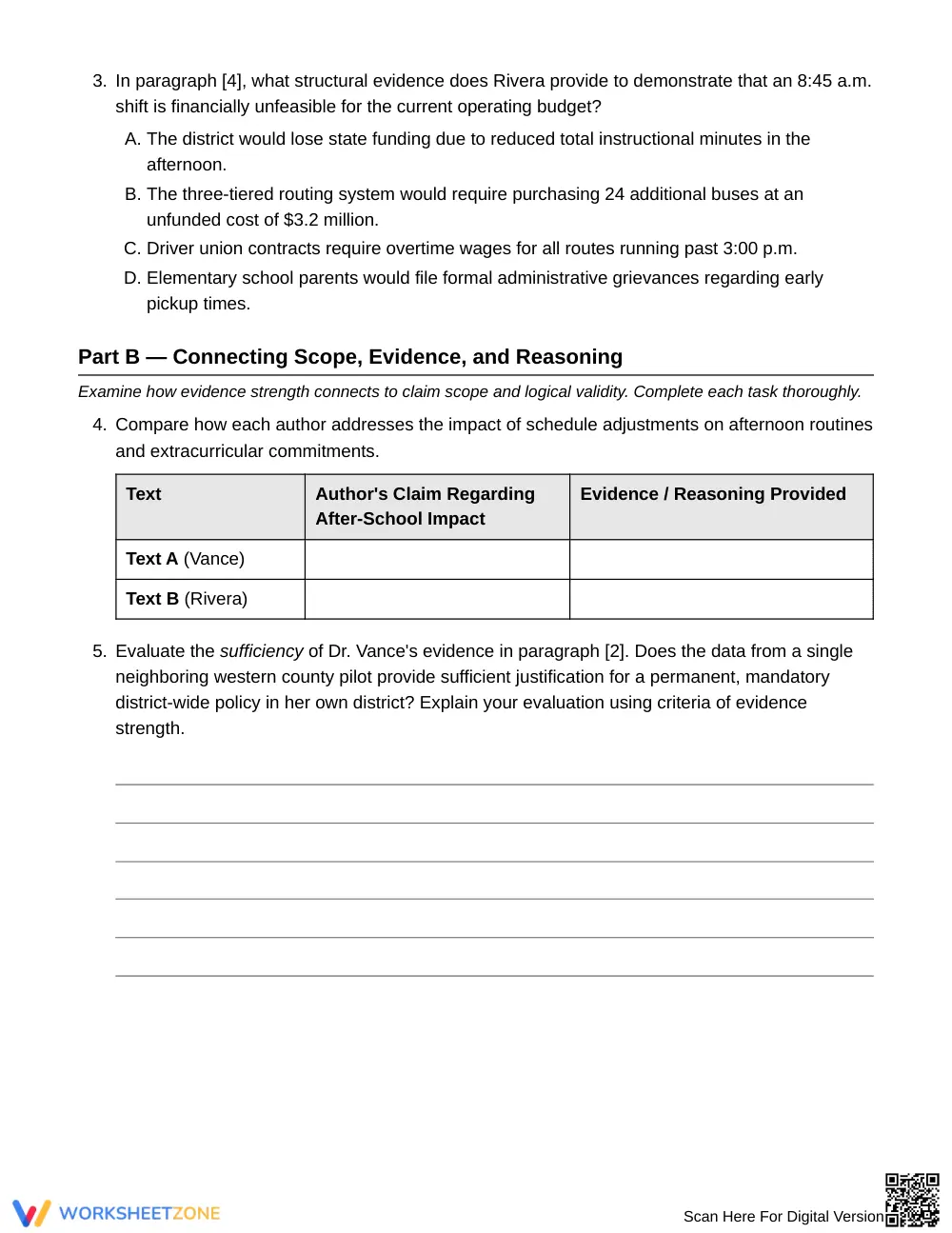
This 6-page printable worksheet centers on a realistic school schedule debate featuring two paired texts totaling over 700 words. It includes an analytical reference anchor chart, 3 targeted multiple-choice identification items, a structured evidence-comparison matrix, 5 text-dependent analytical response prompts, and 3 synthesis tasks. A thorough 5-page answer key provides exemplar student responses and logical breakdown notes.
Skill Progression
- Guided Practice: Part A includes 3 multiple-choice questions focusing on identifying primary claim scopes, isolating empirical statistics, and locating structural budgetary evidence across both texts.
- Supported Practice: Part B features 6 tasks including a comparison table, assumption identification, and bounded claim revision to connect data sufficiency directly to argumentative warrants.
- Independent Practice: Part C presents 3 open-ended synthesis prompts requiring students to judge counterargument refutation, detect potential false dilemmas, and construct a balanced policy recommendation.
This scaffolded architecture follows a gradual release model, guiding learners from baseline textual comprehension to independent evaluative synthesis.
Standards Alignment
This worksheet directly supports RI.9-10.8: "Delineate and evaluate the argument and specific claims in a text, assessing whether the reasoning is valid and the evidence is relevant and sufficient; identify false statements and fallacious reasoning." Both standard codes can be copied directly into lesson plans, IEP goals, or district curriculum mapping tools.
How to Use It
Administer this resource during or immediately following a direct instruction unit on rhetorical appeals and logical fallacies. For close reading, have students complete Part A and the Part B table in structured peer dyads before tackling individual analytical responses. To formatively assess mastery, monitor how students evaluate Vance's western county pilot data in Part B, observing whether they recognize sample size limitations. Expect completion within 45 to 60 minutes.
Who It's For
Designed for tenth-grade English II students preparing for state assessments and college-level rhetorical analysis. The embedded reference chart supports struggling readers with clear analytical criteria, while the policy synthesis tasks offer rigorous extension for advanced learners. Pair this printable with an anchor lesson on qualifiers and warrants.
Aligned with standard RI.9-10.8, this Grade 10 English II worksheet trains high school students to analyze argument scope, evaluate evidence sufficiency, and detect logical fallacies across paired informational texts. According to Fisher & Frey (2014), structured close reading paired with scaffolded text-dependent questioning significantly strengthens adolescent reading comprehension and analytical reasoning. By guiding students through explicit scope identification, comparative data evaluation, and argumentative revision, this 6-page practice module builds mastery in distinguishing valid warrants from overgeneralized assertions. Students directly apply critical reading benchmarks by weighing empirical health statistics against logistical budget constraints. The complete 12-task progression and detailed 5-page answer key provide secondary educators with an assessment-aligned instructional asset that reinforces rigorous textual evaluation and evidence-based writing across the English language arts curriculum.


