




























Ready Claim Qualifications Worksheet | Grade 10 English II
Paste this activity's link or code into your existing LMS (Google Classroom, Canvas, Teams, Schoology, Moodle, etc.).
Students can open and work on the activity right away, with no student login required.
You'll still be able to track student progress and results from your teacher account.
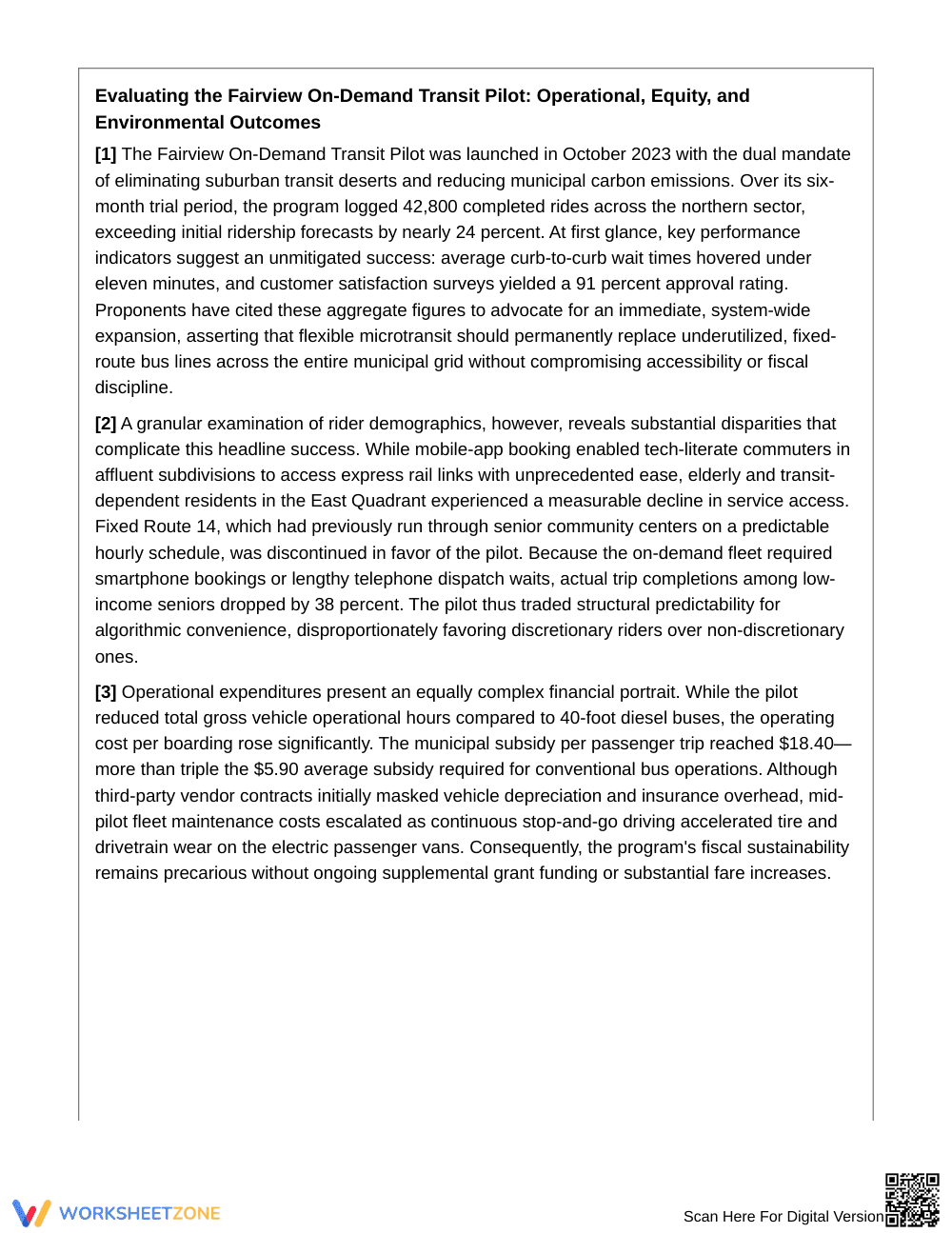
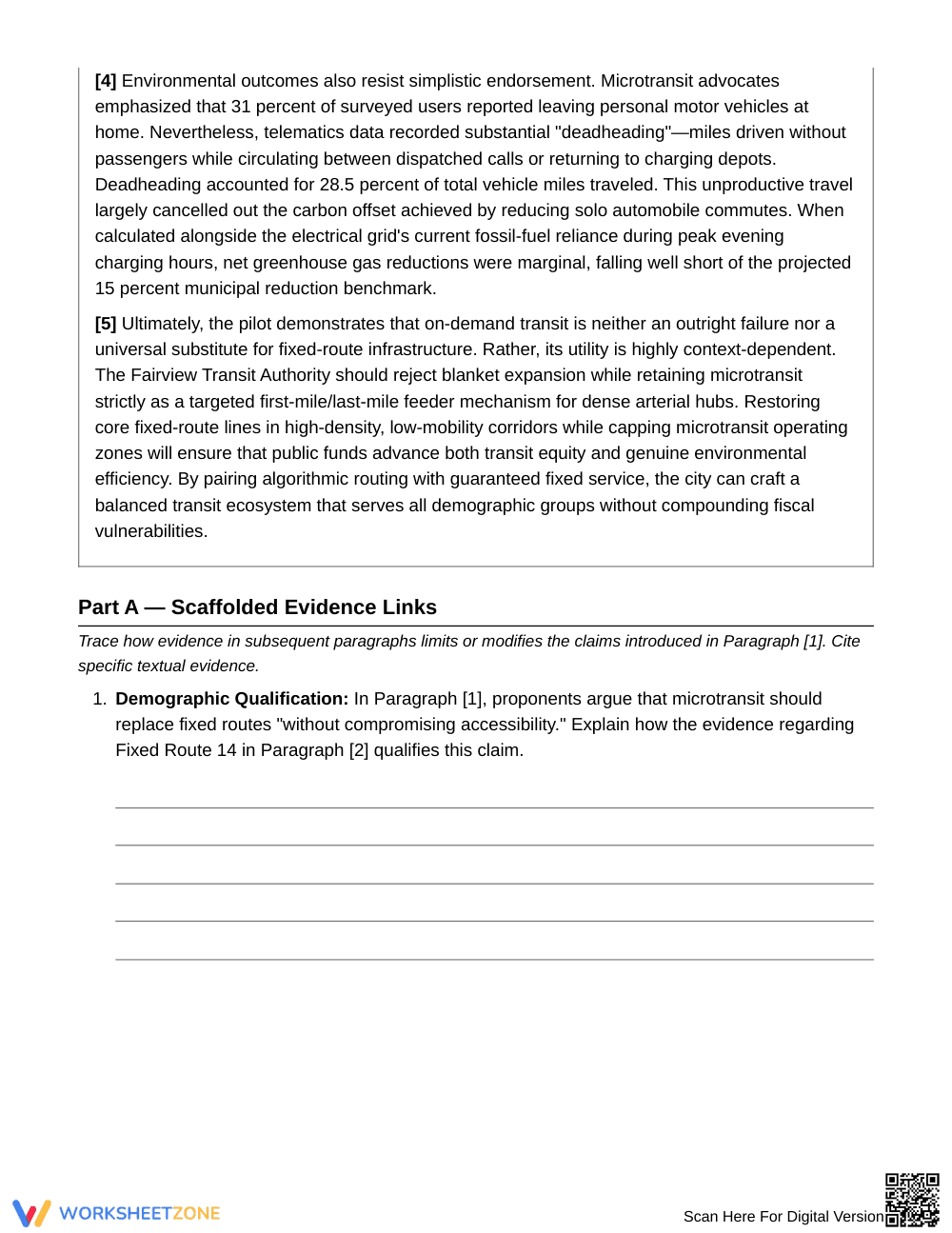
This Grade 10 informational text worksheet trains students to trace how authors qualify and refine claims across extended prose. By examining an authentic policy analysis of municipal transit, learners evaluate how subsequent evidence restricts initial claims, developing the structural reading skills required for advanced rhetorical analysis.
At a Glance
- Grade: 10 · Subject: English II
- Standard:
RI.9-10.5— Analyze how an author's claims are developed and refined across sections- Skill Focus: Tracing qualifications across sections
- Format: 6 pages · 10 problems · Answer key included · PDF
- Best For: Close reading and structural analysis
- Time: 45–60 minutes
What's Inside
The 6-page printable resource includes a foundational strategy overview with a model annotation, a 5-paragraph informational text on public transit equity and economics, and 10 analytical tasks divided into three distinct phases. A comprehensive 3-page answer key provides complete model responses, evidence citations, and structural explanations for efficient grading.
Skill Progression
- Guided Practice (Part A, 3 tasks): Students use targeted textual prompts to link demographic, fiscal, and environmental counter-metrics directly back to initial baseline claims.
- Supported Practice (Part B, 5 tasks): Learners analyze sequencing, authorial diction, and claim evolution across multiple paragraphs with multiple-choice and short-answer prompts.
- Independent Practice (Part C, 2 tasks): Students synthesize how contrasting evidence produces nuanced policy conclusions and evaluate counterfactual structural omissions.
This structured progression follows a gradual-release framework that shifts cognitive ownership from guided textual identification to independent structural synthesis.
Standards Alignment
This worksheet directly aligns with RI.9-10.5: "Analyze in detail how an author's ideas or claims are developed and refined by particular sentences, paragraphs, or larger portions of a text." It also supports RI.9-10.1 by requiring textual evidence for all structural inferences. Both standard codes can be copied directly into lesson plans, IEP goals, or district curriculum mapping tools.
How to Use It
Deploy this activity directly after whole-group instruction on argumentative text structures or during an informational nonfiction unit. For formative assessment, examine student responses in Part A to check whether learners confuse a qualifying nuance with a full counterargument before letting them proceed to Part C. The lesson is designed for a 45- to 60-minute instructional block or two focused 30-minute small-group interventions.
Who It's For
This resource is tailored for Grade 10 English II students preparing for state reading assessments and rhetorical analysis essays. It offers built-in scaffolding for developing readers via model annotations while challenging advanced students with counterfactual reasoning. Pair this activity with an anchor chart on transitional qualifiers and structural pivots.
According to Fisher & Frey (2014), explicit instruction in complex text structures significantly strengthens high school students' ability to comprehend informational prose and evaluate rhetorical balance. Mastering standard RI.9-10.5 requires students to move beyond surface-level main idea identification and track how sophisticated authors refine, restrict, and qualify initial arguments across multiple paragraphs. By examining transitional cues, competing demographic data, and fiscal constraints, learners develop the close-reading discipline needed to understand nuanced non-fiction arguments. This 6-page resource operationalizes these research-backed principles through 10 targeted tasks that move systematically from scaffolded evidence linking to independent structural synthesis. High school readers analyze how specific paragraphs modify broader thesis statements, ensuring measurable growth in text-based analytical reasoning and preparing students for rigorous postsecondary academic writing.


