




























Views
Downloads

Ready Civil War Era Word Search | Grades 4–5 Social Studies

Paste this activity's link or code into your existing LMS (Google Classroom, Canvas, Teams, Schoology, Moodle, etc.).
Students can open and work on the activity right away, with no student login required.
You'll still be able to track student progress and results from your teacher account.
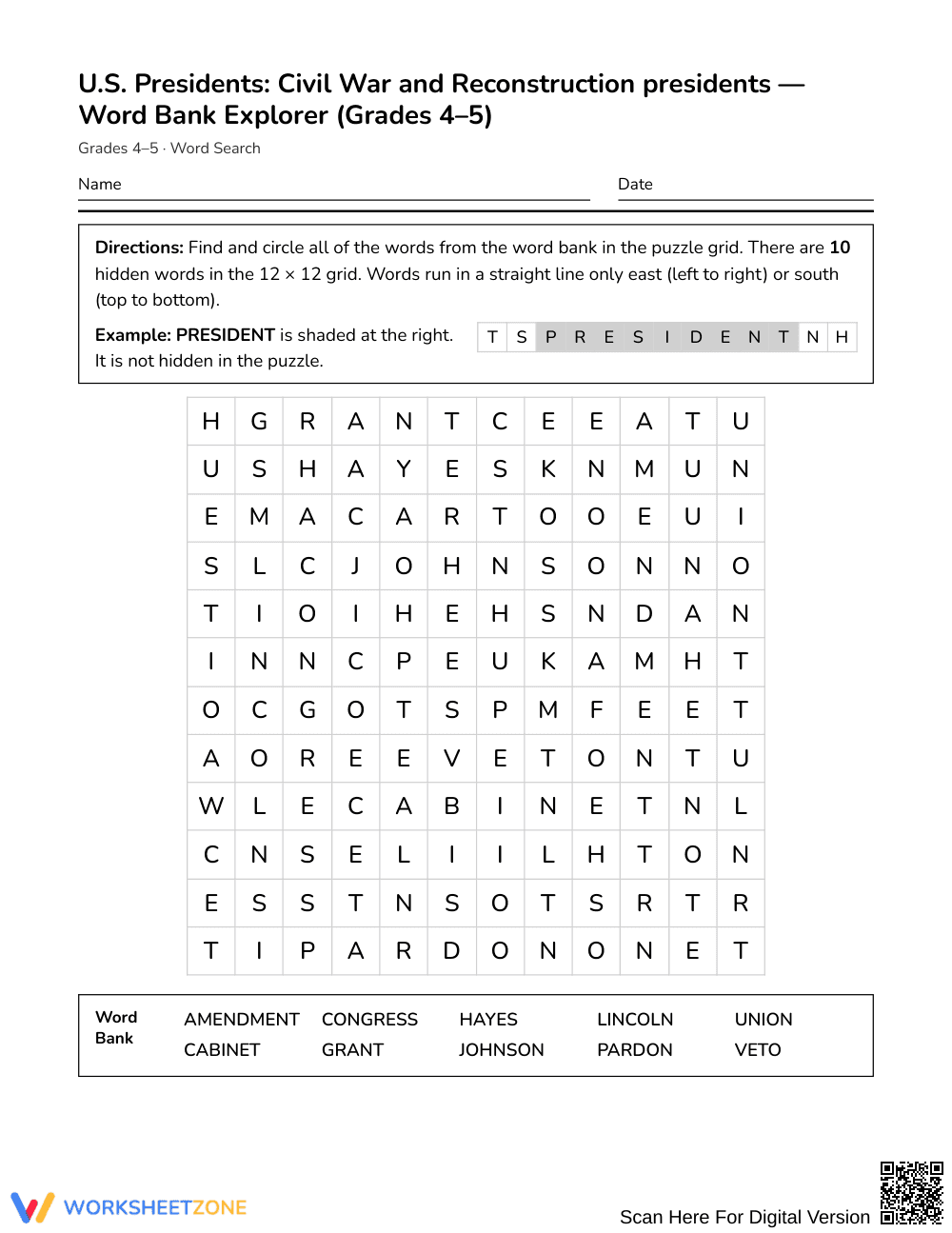
This Grades 4–5 Social Studies word search reinforces knowledge of Civil War and Reconstruction presidents and pivotal 19th-century governance concepts. Students locate 10 vocabulary terms hidden in a letter grid, connecting leaders and constitutional powers to historical definitions to build retention and domain literacy.
At a Glance
- Grade Level: Grades 4–5 · Subject Area: Social Studies
- Standard: Not standards-assessed — vocabulary enrichment
- Skill Focus: Civil War and Reconstruction presidents and governance
- Format: 1 student activity page · 10 words · 3-page answer key · PDF
- Best For: Classroom history vocabulary review, lesson warm-ups, and early finishers
- Time: 15–25 minutes
What's Inside
This 1-page activity features 10 words central to the Civil War and Reconstruction eras. The sheet combines a compact letter grid with an alphabetical word bank and concise historical clues for each term. Students review definitions for leaders including Lincoln, Johnson, Grant, and Hayes, alongside civic terms like amendment, congress, and veto. A 3-page answer key provides complete solutions.
Puzzle Mechanics
The puzzle uses a 12 x 12 letter grid designed for elementary learners. Hidden words run in two directions: horizontally left to right (E) and vertically top to bottom (S). Students work from an alphabetical word bank spanning AMENDMENT to VETO, using context clues to reinforce each term's historical role while locating it.
Standards Alignment
This word search provides vocabulary enrichment and is not aligned to an assessed standard. It is designed to reinforce domain-specific terminology within 19th-century American history units, strengthening student familiarity with executive branch powers, post-war legislation, and presidential timelines without generating formal assessment data.
How to Use It
Use this word search after direct instruction on Reconstruction to reinforce key vocabulary, or assign it as an independent warm-up. Formatively check understanding by asking students to read a clue aloud and explain why terms like pardon or veto were significant during Andrew Johnson's presidency. Students typically complete the 10-word puzzle in 15 to 25 minutes.
Who It's For
This resource is designed for Grades 4–5 social studies classes studying the Civil War and executive leadership. Differentiate by pairing developing readers with a partner to discuss the clues, or have advanced students write sentences using terms like Union and Congress. Pair this puzzle with an anchor chart displaying a timeline of 19th-century U.S. presidents.
Vocabulary acquisition in upper-elementary social studies relies on intentional exposure to domain-specific language and conceptual definitions. While designed as a non-standards-assessed vocabulary enrichment activity rather than a testing instrument, this word search reinforces students' ability to recognize and define Civil War and Reconstruction executive leadership vocabulary. According to Fisher & Frey (2014), intentional word exposure embedded within engaging, contextualized learning tasks strengthens background knowledge and reading comprehension across informational texts. By combining an alphabetical word bank with historical clues highlighting presidential administrations from Lincoln to Hayes, this puzzle allows learners in Grades 4–5 to solidify essential terminology before encountering complex historical documents. Students bridge basic word recognition with deeper civic understanding as they locate governance terms including veto, cabinet, and amendment across a 12 x 12 grid, building the lexical foundation necessary for sustained academic literacy.


