































Ready China Bronze Word Search | Grades 5–6 Social Studies

Paste this activity's link or code into your existing LMS (Google Classroom, Canvas, Teams, Schoology, Moodle, etc.).
Students can open and work on the activity right away, with no student login required.
You'll still be able to track student progress and results from your teacher account.
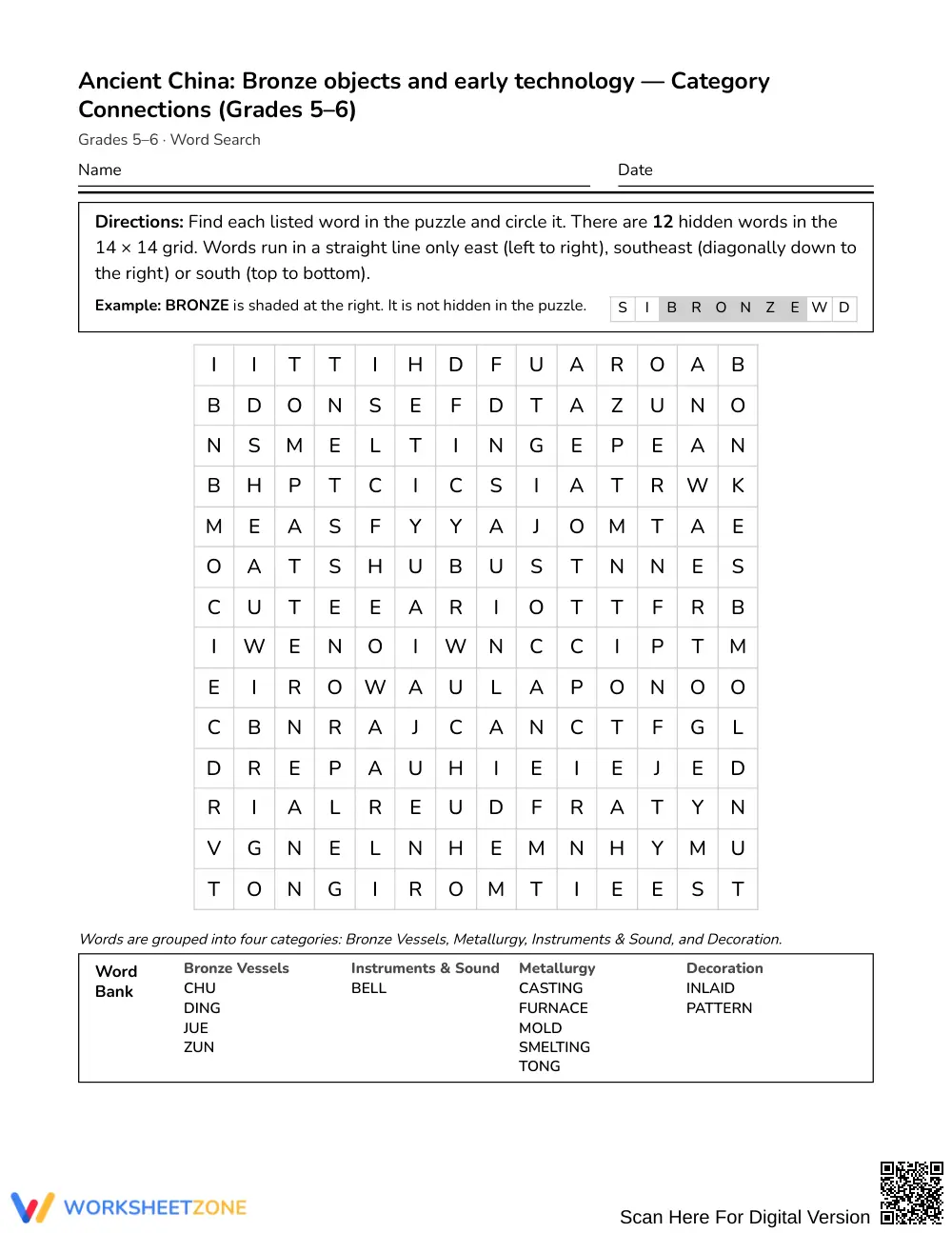
This ancient China bronze objects and early technology word search helps students in Grades 5–6 master historical vocabulary through targeted visual discovery. Learners locate twelve key terms related to Shang and Zhou dynasty metallurgy, ritual vessels, and craftsmanship, reinforcing content knowledge and domain-specific terminology for your world history unit.
At a Glance
- Grade: Grades 5–6 · Subject: Social Studies (World History)
- Standard: Not standards-assessed — historical vocabulary enrichment
- Skill Focus: Ancient Chinese bronze objects and metallurgy technology
- Format: 1 page · 12 hidden words · Full answer key included · PDF
- Best For: Social studies vocabulary review and unit warm-up
- Time: 15–20 minutes of independent work
What's Inside
The single-page puzzle delivers twelve vocabulary terms organized under four thematic categories: Bronze Vessels, Metallurgy, Instruments & Sound, and Decoration. Students encounter authentic archaeological terms like ding, jue, and zun alongside technological processes such as smelting and casting. A complete three-page answer key provides clear letter-grid solutions for swift checking.
Puzzle Structure and Mechanics
The activity features a 14 by 14 letter grid configured with three search directions: east (horizontal forward), southeast (diagonal down-right), and south (vertical down). No backwards or upward-running words are used, making the puzzle accessible yet engaging for middle grades. The categorized word bank groups related concepts together, helping students build contextual associations between artifact types, tools, and decorative techniques as they search.
Standards Alignment
This word search is designed strictly for vocabulary enrichment and is not aligned to a formal academic standard. It serves as a supplementary resource to reinforce historical terminology and support reading comprehension across ancient civilization units.
How to Use It
Incorporate this puzzle during the introductory phase of an ancient China unit to familiarize learners with specialized archaeological vocabulary before reading primary texts. Alternatively, assign it after direct instruction as an engaging bell-ringer or independent review station. For formative assessment, circulate as students work to note whether they can define terms like mold or smelting in their own words. The activity typically takes 15 to 20 minutes to complete.
Who It's For
This resource is tailored for upper elementary and middle school learners in Grades 5–6 studying world history. It offers effective vocabulary support for English language learners through its categorized word bank and clear letter paths. Pair this word search directly with an illustrated anchor chart displaying Shang dynasty bronze vessels or a museum artifact informational passage.
Word searches that group domain-specific terminology into conceptual categories serve as an effective entry point for historical vocabulary acquisition in upper elementary and middle school classrooms. According to Fisher & Frey (2014), intentional exposure to technical terminology within structured thematic frameworks supports background knowledge schema before complex informational reading tasks begin. Although this activity is not standards-assessed, mastering specialized vocabulary—such as smelting, casting, jue, and ding—removes decoding barriers that frequently impede historical text comprehension. Categorized puzzle tasks activate pattern recognition and semantic grouping, allowing students in Grades 5–6 to build mental models of ancient Chinese technological achievements and material culture. Combining visual word identification with archaeological contexts provides accessible content reinforcement across diverse learning environments, creating a low-stakes instructional routine that strengthens long-term concept retention and prepares learners for subsequent artifact analysis.


